13 homes burnt, dozens damaged in West Bank settlement as crews battle blaze for 2nd day
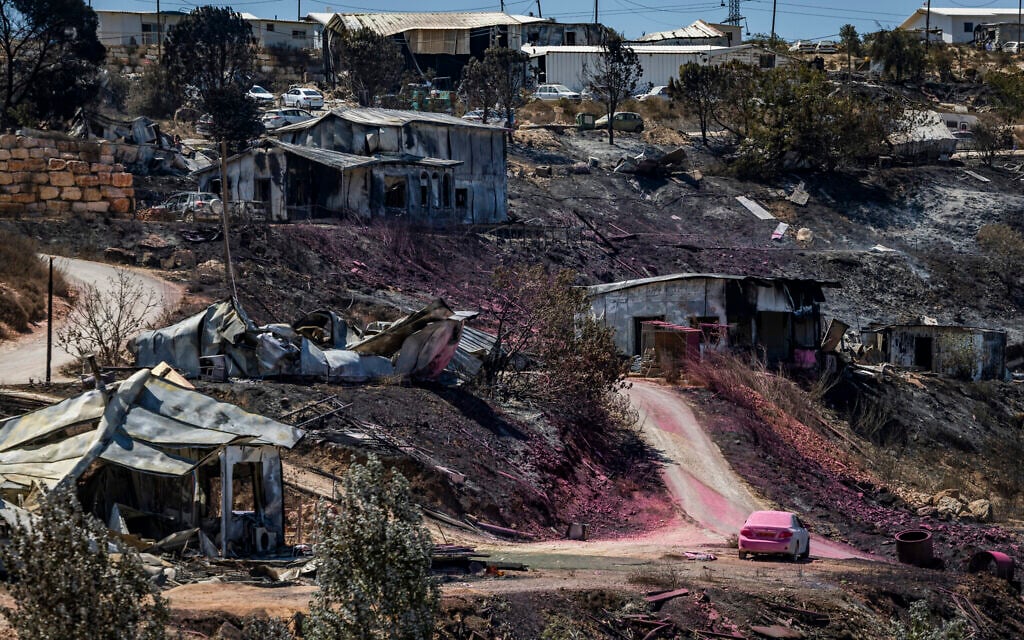

Fire crews on Sunday continued battling a wildfire that began the day before in the northern West Bank, with emergency services saying the fire destroyed 13 homes and damaged dozens more in the Havat Gilad settlement, and that intensive efforts were still underway to limit the blaze from spreading.
According to the Fire and Rescue service, two firefighters were injured during the firefighting efforts, and were evacuated for medical treatment in moderate and light condition, respectively.
Investigators said that an initial probe indicated that the wildfire was sparked by an unextinguished cigarette butt flicked to the side of a road. Law enforcement was working to track down the vehicle from which it was thrown.
According to Army Radio correspondent Doron Kadosh, security officials were able to identify a single cigarette as the cause of the fire, adding that no other flammable materials, such as fuels or rags, were found at the scene, indicating that arson was not at play.
Kadosh added that security forces said they were “narrowing in” on the person suspected of throwing the cigarette, who they believe to be Palestinian, largely based on the fact that it took place on a Saturday afternoon, during Shabbat, and that Israelis rarely drive on that road during the Jewish day of rest.
Still, the assessment is that the blaze was not intentionally sparked, the report said, adding that the Shin Bet domestic security agency, which had initially joined the investigation, had already withdrawn from the effort, leaving Israel Police to deal with the probe alone. Despite that assessment, authorities warned of potential attacks from Israeli settlers, who are already suspected of carrying out an arson attack on a West Bank mosque in an apparent act of revenge for the fire in the settlement.

According to reports, by Sunday morning the fire in Havat Gilad had damaged 29 separate structures in the settlement, complete destroying 13 houses. Over 100 families were forced to evacuate their homes.
“By a great miracle, we had no casualties,” said Moshe Hachmon, the chairman of the settlement’s local council.
He noted that the community was now facing what he called a “humanitarian crisis,” with many families left homeless and a significant amount of the settlement’s infrastructure damaged.
“People fought for twenty years to build their homes here. Every stone was built with a lot of soul, effort and sacrifice,” Hachmon told the Israel National News outlet.

According to the Fire and Rescue Service, dozens of firefighting crews from across the country were still working at the scene on Sunday morning, and were trying to prevent the blaze from spreading to other areas of the community.
Their efforts included a helicopter and eight firefighting aircraft, which the fire service said were “carrying out repeated airdrops in parallel with ground operations.”
The Havat Gilad fire was one of several that hit Israel and the West Bank over the weekend, with another major wildfire forcing dozens of families to flee their homes in Shimshit, in the northern Jezreel Valley.

The fire service said Sunday that its teams were still battling that fire, and had successfully prevented it from spreading to homes in the area.
At the nearby Mount Tabor, a small fire had engulfed an open area near the town of Shibli, which fire crews were working to contain.
Further north, near Kfar Vardim, fire crews, with the help of several aircraft, were able to gain control of a wildfire that was sparked the day before.

The war with Iran has been draining for all of us in Israel. But when I heard about a high casualty incident – ballistic missile impacts in Arad and Dimona that left nearly 200 people wounded – I drank a cup of coffee, packed a bag, and headed south.
There, I spoke with Shilgit, the head of an after-school program for underprivileged youth. Standing outside her destroyed center, Shilgit said it was a miracle that no children were hurt and spoke about the community coming together in the hours since.
As a Times of Israel reporter, I’m committed to telling stories of resilience like Shilgit’s. But my colleagues and I can't do this alone. If you value work like this, please consider joining our reader support group, The Times of Israel Community. Your financial support is essential to keep real human reporting like this going.
— Stav Levaton, military reporter

We’re really pleased that you’ve read X Times of Israel articles in the past month.
That’s why we started the Times of Israel – to provide discerning readers like you with must-read coverage of Israel and the Jewish world.
So now we have a request. Unlike other news outlets, we haven’t put up a paywall. But as the journalism we do is costly, we invite readers for whom The Times of Israel has become important to help support our work by joining The Times of Israel Community.
For as little as $6 a month you can help support our quality journalism while enjoying The Times of Israel AD-FREE, as well as accessing exclusive content available only to Times of Israel Community members.
Thank you, David Horovitz, Founding Editor of The Times of Israel


© All rights to the original article belong to the source. Din Online shows a headline, an excerpt and a link only. The objectivity rating is computed automatically and is an estimate only.
Discussion
No comments yet — be the first to comment.