25 years ago today, the Sbarro bombing opened a wound in Israel that still hasn’t healed

Ben Sales is a news editor at The Times of Israel
At the time, the catastrophe was unimaginable.

The numbers themselves told a horror story: 16 killed, 130 injured. Eight children among the dead. Five members of a single family. Another of the victims was a woman pregnant with her first child, visiting from New Jersey.
And yet, somehow, while those gruesome figures conveyed the worst of the nightmare that was the Sbarro terror attack, they didn’t convey its entirety.
Sbarro was the center of Jerusalem, the expansive curved storefront dominating one of the capital’s busiest intersections. For Israelis, it was a place to meet up. For tourists, especially religious ones, it was an enticing example of an American fast food chain made kosher in the Jewish state.
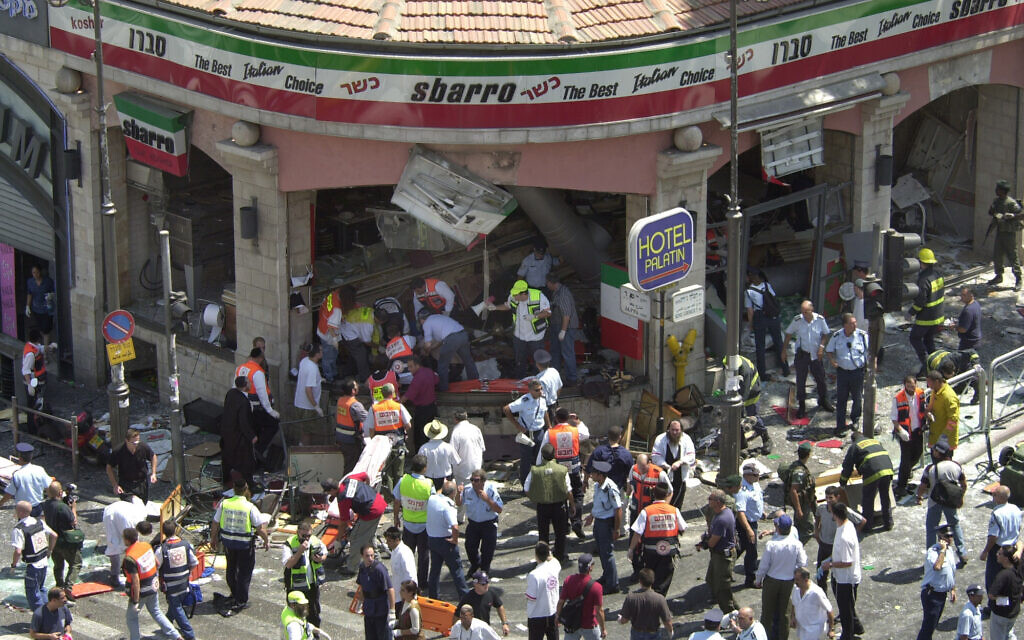
Twenty-five years ago, the crowded pizzeria became a hellscape.
If you’re old enough, you remember the photos: A bombed-out storefront. Debris everywhere. Medics and first responders scrambling in their vests to tend to the wounded. The terrorist who detonated the bomb had packed it with nuts and bolts and nails to cause maximum pain to the adults and children he was about to kill and maim. It worked.
A quarter-century later, who still thinks about this terrible attack? It was not the deadliest suicide bombing of the Second Intifada, or even of 2001. Globally, it was overshadowed 33 days later when terrorists flew two planes into the World Trade Center in New York City and another into the Pentagon, killing exponentially more people. More than two decades after that, the same Hamas terror group that killed 16 at Sbarro would kill 1,200 in southern Israel.
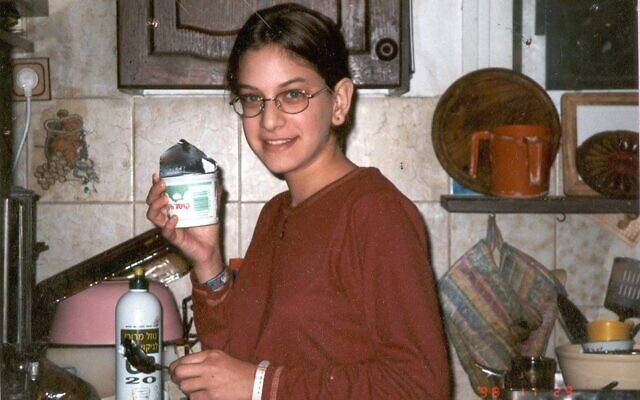
But of course, 25 years after it happened, there are those who still think about it: The parents, children, siblings and other loved ones of the 16 victims who walked into a pizzeria on that Thursday afternoon and never came out. At least one of those parents has never stopped thinking about it, because for him, 25 years later, it isn’t really over.
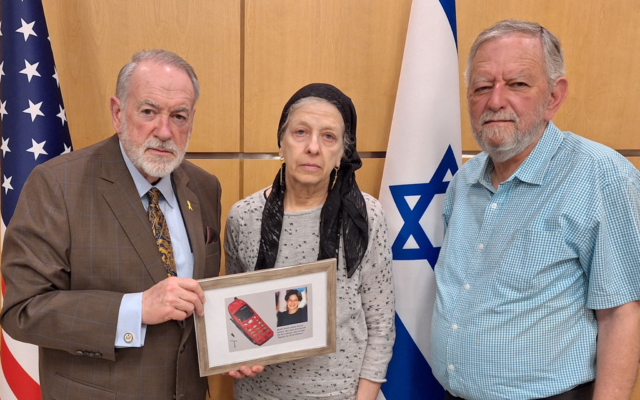
“The only reason I’m involved in this is because my daughter was murdered and the murderer has been free all these years,” Arnold Roth, whose daughter Malki was killed in the Sbarro attack, told The Times of Israel in an interview last week. “It’s unthinkable to me that we’re still fighting for justice for a child who was murdered in broad daylight.”
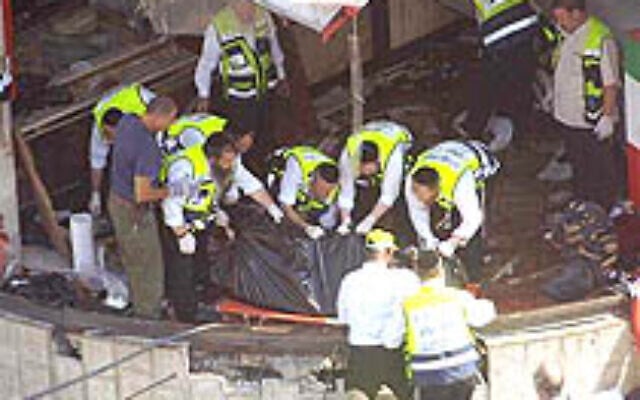
One of the terrorists who committed the attack killed himself along with the 16 victims. But another, Ahlam Tamimi, walked away and has lived free in Jordan for more than a decade. Roth and his wife have dedicated the past 15 years of their lives to making her face justice, so far without success.
And in recent years, that struggle has become harder. Because losing Malki is not the Roths’ most recent bereavement: They lost a son-in-law in Gaza, shortly after Hamas’s October 7, 2023, attack.
“Losing a son-in-law along the way to the very same enemy that this savage barbarian represents has not been easy,” Roth said. “It’s a replay of having to address the need of keeping my loved ones safe and unharmed by the grief.”
The Roth family’s grief, and its ongoing fight for justice, also raises a set of questions that Israel has faced since its earliest days: How do we keep the memory of previous tragedies alive when new ones keep coming? And as the country struggles to heal from its freshest wounds, who will still be there to help right the wrongs of the past?
When Roth describes the past quarter-century, he speaks of “an eviscerating sense of bitterness at the failure.” He’s not talking about his own failure. He’s talking about the failure of those who are meant to support him — who have pledged to support him — to do what is in his mind the most important and unimpeachable thing one can do: bring his daughter’s killer to justice.
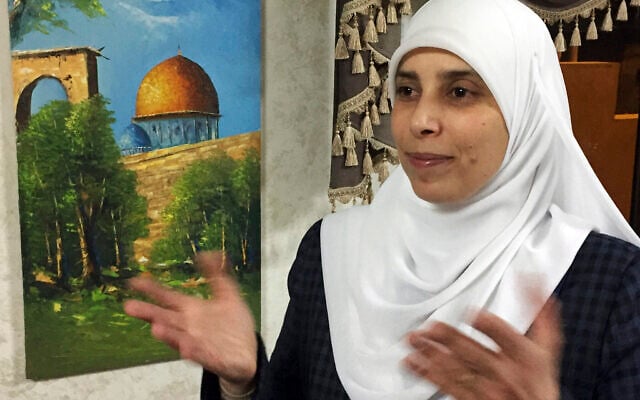
Tamimi, who orchestrated the attack and accompanied the bomber, walked out of Sbarro that day, was arrested shortly thereafter, and was released in the 2011 exchange for Israeli soldier Gilad Shalit in which more than 1,000 Palestinian terrorists went free. She lives in Jordan now. The Roths have invested 15 years of effort into having her extradited to the United States, where she could stand trial for killing American citizens, including Malki, and is on the FBI’s Most Wanted list. But despite a criminal indictment against her, she has not been brought to the US and still lives across the border, in Jordan, unconstrained and wholly unrepentant.
Roth blames presidents of both parties for being too timid to extract a known criminal from the territory of an ally that receives a huge amount of US foreign aid. And he blames Jewish organizations (though he was reluctant to name names) for not putting this on their priority list and not pushing their own governments to pursue this proud, murderous antisemite.
“I don’t understand why there hasn’t been a coming together of fury over this case,” he said. He added later, “It’s not going to bring her back and it’s not going to improve anything in our lives at all. But the idea that the woman who did it is dancing on Malki’s grave — and that’s the way I always look at it and always think about it — is unbearable to me. Unbearable in every sense of those words.”
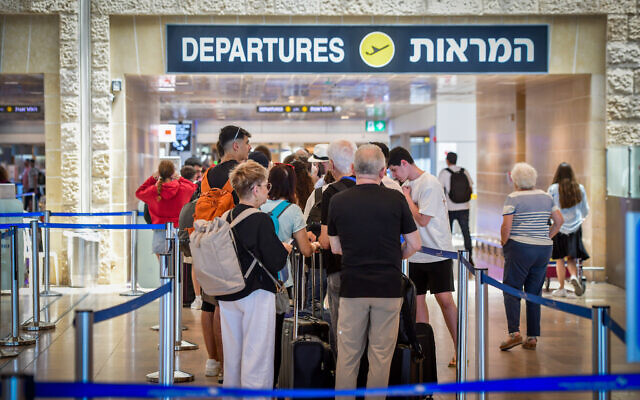
Roth is aware of why Tamimi hasn’t been extradited, and why people who have devoted themselves to fighting antisemitism and terrorism have shied away from the case: Jordan is an ally of the United States, has diplomatic relations with Israel, and shares a long border with Israel and the West Bank. Although Jordan signed an extradition treaty with the US, officials don’t think it’s worth the risk of antagonizing Jordan’s monarchy to arrest someone who committed a terror attack 25 years ago, and who is regarded by many in that country as a hero.
Roth summarizes those concerns as “Don’t piss off the king.” And he thinks it’s nonsense.
“Who says that bringing this woman, as the treaty requires, to the airport to hand her over to the FBI agents is going to cause dissension in the streets?” he asked. “Because if that’s right, then we’re sitting on a powder keg today, and if we’re sitting on a powder keg today, why are we giving every indication that Jordan is a moderate state?”
Time may also be a factor. Ksenia Svetlova, executive director of the Regional Organization for Peace, Economics and Security, said Tamimi should face justice, but that for Israel, she is just one of many terrorists who have been released in a prisoner exchange, a number that’s only grown after the October 7 attack.
“I think the perpetrator of the terror attack, like perpetrators of every terror attack, should be extradited,” she said. She added later, “Something to take into account is that so many things happened after that and before it. We are speaking about so many perpetrators, and so many were released.”
The October 7 attack also unleashed a wave of advocacy that dwarfed anything coming out of the Second Intifada, as hundreds of thousands in Israel and around the world took to the streets and persistently lobbied their governments to bring the hostages, living and dead, back home.
At its core, the demand was not that different from Roth’s: Both are a quest for justice, stemming from the unimaginable loss wrought by a Hamas terror attack. But while the struggle for the hostages was a global movement that engaged the world’s most powerful people, Roth sometimes sounds like a solitary voice crying out in the desert.
To Roth, the difference between the hostage protests and his case is no mystery. The struggle to free the hostages, when it took place, was “current,” with protesters pleading for lives to be saved. When he began fighting for Tamimi’s extradition, a decade had past since his daughter was killed.
“My story is all about getting justice years after the massacre took place,” he said. “There’s a long list of reasons.”
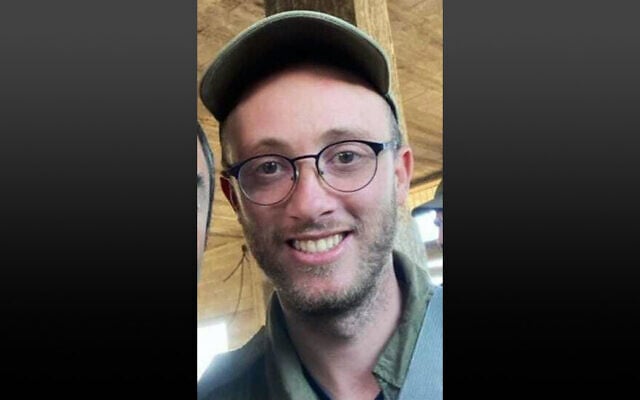
Instead, October 7 brought only more grief to the Roth family. Naftali Yonah Gordon, husband of Roth’s daughter Pesi, showed up for reserve duty after the massacre, and was killed on December 7 in Gaza. He was 32.
Since then, Roth’s wife, Frimet, has taken a step back from the Tamimi case, on which she was once more active. Their widowed daughter and her children have moved two doors down from them. For Roth, it’s brought back memories of the aftermath of Malki’s death.
When Malki was killed, he said, “Our children went through a very hard time. I’m not saying I didn’t, but I’m an adult and I’ve got my tools. The kids didn’t have the tools. And suddenly we found ourselves in the same situation.”
He added, “Issues like that become my responsibility. Not only mine — I’m a part of a family, we all contribute, and I can tell you we do — but it really sits heavily with me.”
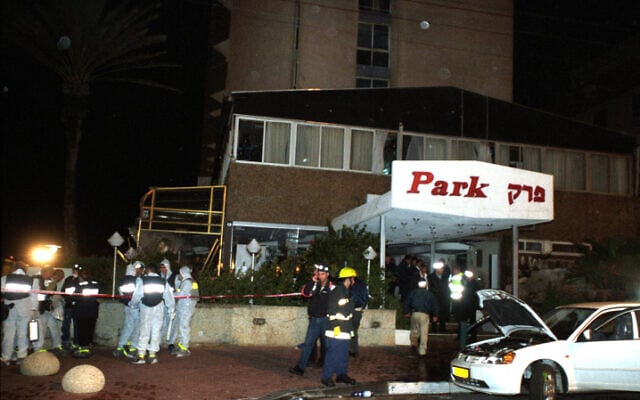
The passage of time has also impacted how Israelis think about the Sbarro bombing. In the country’s public consciousness, scholars acknowledge, there isn’t really a “Sbarro attack” in isolation. There is the Second Intifada, when terrorists killed 1,000 Israelis in what felt like an unending chain of attacks at cafes and buses and shopping malls. Sbarro is remembered as part of a list whose names evoke memories of bloodshed: Dolphinarium, Park Hotel, Hebrew University, the number 32 bus and so many more.
Svetlova remembers where she was when the attack happened — working not far away at the Education Ministry — but recalls it as one of a string of bombings.
“I cannot tell you that it stood out,” she said. “Everything that happened at the time was very scary. It came after this very brief period of high hopes for the future, and it all just fell apart. Taking buses was scary. Everything was scary.”
She added, “It was a horrific crime, but so was every other crime. As a Jerusalemite, it was horrendous, and I remember having to go around this place that was very central, you can hardly avoid it, but I tried to avoid it.”
And yet, there is also a sense that it was around the time of the Sbarro attack, maybe on the day of the Sbarro attack itself, that something changed: a realization dawned that the sporadic, horrific suicide bombings Israelis endured for years were now becoming something much more constant and inescapable: that the era of imminent Middle East peace had come to an end, and the state had to gird itself for years of something much darker.
“It was part of a series [of attacks] at the time that had really, really started to escalate,” said Alon Yakter, a senior lecturer in political science at Tel Aviv University. “What happens in 2001 is that, first of all, the level of fatalities and the series of terror attacks was unprecedented, and Sbarro was an escalation in that regard.”
Attacks like Sbarro, targeting restaurants and killing children, also had a lasting effect on Israelis’ views of the Palestinians, Yakter said. He referenced polling data from his university that shows that the percentage of Israelis who believe the Palestinians want to take over Israel and kill its Jews shot up after the Second Intifada.
“What didn’t go away was the collective feeling of threat, the feeling as a collective that there’s a group whose end goal in this whole business is not just to take over the state but to destroy Israel and also, really, to kill us,” he said. “Sbarro was the beginning of a period that had something inhuman, almost: to go to a cafe in the city center, to kill families and children, and to celebrate it… That did something very powerful to the consciousness.”
Surveys have shown that since the October 7 attack, Israelis are even more skeptical of the chances for peace.
While the Sbarro attack remains distinctly at the forefront of Roth’s mind, he’s keenly aware of how much time has passed. Last week, his family held a memorial for Malki. Her childhood friends who showed up are now in their 40s, with kids of their own.
Still, 25 years later, he speaks with love of Malki’s generosity and her passion for working with children with disabilities, including her sister. The Roth family has carried on that legacy through the Malki Foundation, which helps disabled children stay at home with their families.
But his work for her is not finished, not until Ahlam Tamimi is brought to the US to stand trial for her crimes. Despite the time that has passed, Roth doesn’t feel like he’s spinning his wheels. He doesn’t feel like he’s failed.
He made clear that he isn’t pursuing Tamimi because he enjoys it. He’s fighting to extradite her, he said, “because no one else is doing it. And because at the end of the day it’s the only thing I can do for my daughter Malki, who I adored.”

As a multimedia journalist, my job is to take the quality, fact-based journalism produced by The Times of Israel newsroom and make it accessible across every platform — from Instagram posts to podcasts to short-form videos.
This is how many, especially young people, consume news these days. But misinformation is rampant on social media. Our team at ToI produces accurate, responsible short-form reporting on Israel and the Jewish world.
If you believe in the importance of factual social media journalism, please consider joining our reader support group, The Times of Israel Community. Your financial support is essential to sustain responsible multimedia reporting.
— Gabriella Jacobs, multimedia journalist

We’re really pleased that you’ve read X Times of Israel articles in the past month.
That’s why we started the Times of Israel – to provide discerning readers like you with must-read coverage of Israel and the Jewish world.
So now we have a request. Unlike other news outlets, we haven’t put up a paywall. But as the journalism we do is costly, we invite readers for whom The Times of Israel has become important to help support our work by joining The Times of Israel Community.
For as little as $6 a month you can help support our quality journalism while enjoying The Times of Israel AD-FREE, as well as accessing exclusive content available only to Times of Israel Community members.
Thank you, David Horovitz, Founding Editor of The Times of Israel





The article commemorates the 25th anniversary of the Sbarro pizzeria bombing in Jerusalem, a terror attack on August 9, 2001, that killed 16 people, including eight children and a pregnant American woman, and injured 130. The attack, orchestrated by Hamas, involved a bomber who packed explosives with nuts and bolts for maximum casualties.
“The only reason I’m involved in this is because my daughter was murdered and the murderer has been free all these years,”
said Arnold Roth, whose daughter Malki was killed. Roth and his wife have spent 15 years seeking the extradition of co-conspirator Ahlam Tamimi, who was released in a 2011 prisoner exchange and lives freely in Jordan, despite being on the FBI’s Most Wanted list. The Roths’ ongoing fight for justice is complicated by diplomatic considerations between the US and Jordan, and has been further impacted by the recent loss of their son-in-law in Gaza following the October 7, 2023, Hamas attack.
© All rights to the original article belong to the source. Din Online shows a headline, an excerpt and a link only. The objectivity rating is computed automatically and is an estimate only.
Discussion
No comments yet — be the first to comment.