A 'piyut' for former Gaza hostage Agam Berger

Agam Berger was handed a small whiteboard and a marker on the afternoon of Jan. 30, 2025, in the back of an Israeli Air Force helicopter carrying her from Gaza to Beilinson Hospital in Petach Tikvah. Hamas terrorists had held her hostage for 482 days. Her parents sat beside her.
She wrote six words in Hebrew, which roughly translate as “I chose the path of faith, and by the path of faith I returned.” Beneath them, she thanked the people of Israel and the soldiers who brought her out, adding that there is no one like them in the world.

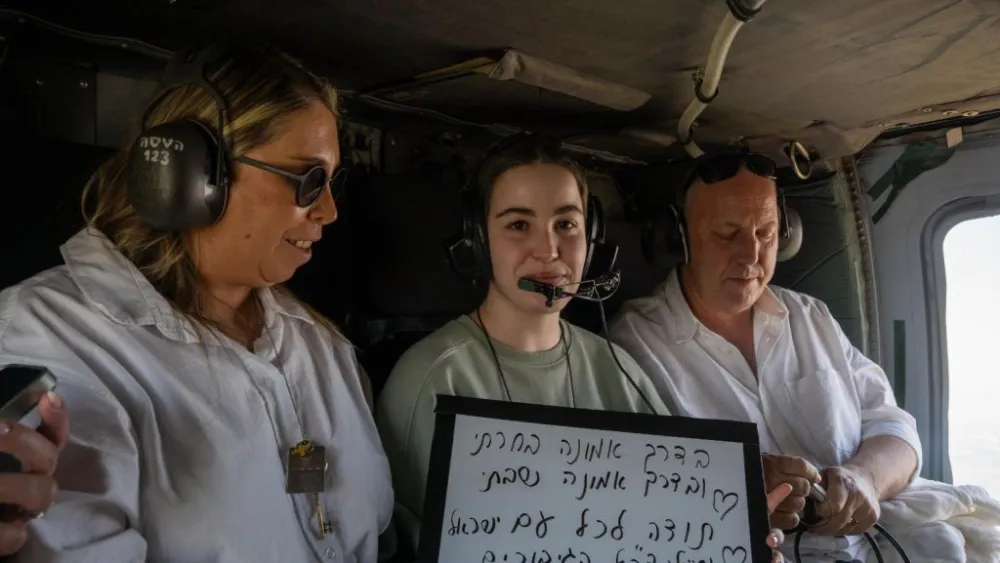
The photograph reached Israeli phones within the hour.
Some 50 miles to the east, in Ma’ale Adumim, Rabbi Zev Shandalov read the six words and wrote a piyut, a form of prayer-poetry that rabbis have composed since antiquity.
Berger had written on a surface designed to be wiped clean. Her words survived because a military photographer was in the aircraft with her.
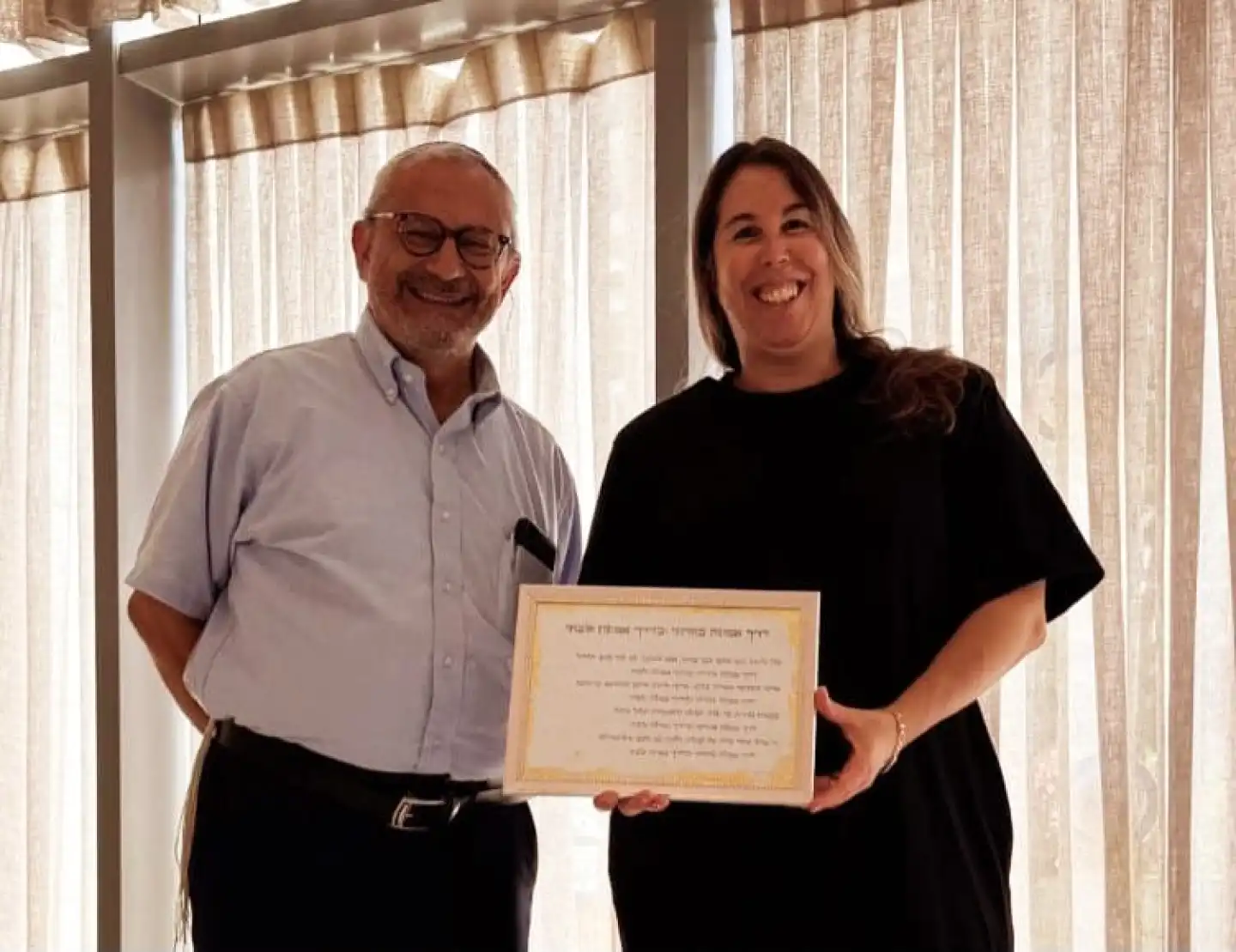
The poem Shandalov built around her sentence is now on parchment, lettered by a scribe in Torah script and framed in the home of Berger’s mother in Holon.
What separates a piyut from an ordinary poem, Shandalov told JNS, is that Scripture is stitched into it—“sometimes entire verses and sometimes just one word, from a biblical verse that has some meaning or resonance.”
Beyond that, the category is loose. “It can be a song, it can be a prayer, it can be sung or it can be read.”
“Adon Olam” is a piyut. So is “Yedid Nefesh,” written by the 16th-century Safed kabbalist Elazar Azikri, as is much of what is sung at a Shabbat table and a good deal of the Rosh Hashanah and Yom Kippur liturgy.
“Many people know piyutim without even realizing that that’s what they are,” Shandalov told JNS.
The form’s productive centuries ran from late antiquity through medieval Spain—Yannai and Elazar ben Kalir in the Land of Israel, Solomon Ibn Gabirol and Yehuda Halevi in Andalusia. Thousands of long-forgotten piyutim emerged from the Cairo Genizah, a storeroom in the Ben Ezra Synagogue where worn pages were placed because Jewish law forbids destroying texts containing God’s name. The Genizah’s contents were carried to Cambridge in the 1890s.
Shandalov’s piyut for Berger has no melody, and he does not expect it to get one. Others of his could be set to music, he told JNS. Not this one.
“It was meant to be a text.”
Shandalov, a native Chicagoan, spent 50 years there, the last 10 as rabbi of Congregation Kehilath Jacob Beth Samuel and three as president of the Chicago Rabbinical Council. He holds semichah (rabbinical ordination) from the Hebrew Theological College in Skokie, Ill. In July 2009, he made aliyah to Ma’ale Adumim with his wife, Andria, and their three daughters.
He came to the form in a classroom, translating.
At AMIT Eitan High School for Boys in Ma’ale Adumim, he sat in on lessons to render Hebrew into English for four immigrant students. One day, the teacher was teaching the structure of a piyut. Shandalov translated the lesson and learned it himself.
He then wrote more than 60 of his own and, encouraged by the school, made them into a book. There are now three volumes, published as Zemirot Azamer B’Fiyut (roughly, “Songs I Will Sing in Liturgical Verse”), written in the idiom of the Middle Ages.
The choice of register is deliberate.
“The feelings I try to get across resonate more in that style than modern Hebrew,” Shandalov told JNS. “It also connects our past and present.”
“There are things that inspire me—a statement, an event—and I’ll right away sit down and write something,” he said.
Those come fast. The ones he considers first take longer.
The Gaza hostages had been part of his daily life for more than a year. Shandalov wore the solidarity necklace every day and folded the hostages into his family’s Seder more than once.
What struck him about the whiteboard was its compression.
“A young woman—she was 20 at the time—was able to express in one sentence some emotions that some people take a lifetime to really concretize and articulate,” he said. “It was this passion for faith and Hashem, for God, that sustained her and enabled her to return home.”
Asked whether the words carried something particular for religious readers, he agreed, then widened the frame.
“It’s for everybody, not just for somebody religious,” he told JNS. “Even a person who did not grow up religious, or who was religious and has since left, or who is not religious anymore—the idea of emunah, or faith, is there. Even if they say, ‘I don’t believe. I don’t have any faith,’ there is somewhere within them that level of faith.”
After each of the poem’s four stanzas, Shandalov used Berger’s sentence as a refrain—a poetic device he thinks he has used only two or three times before.
He had two reasons, he said. Repetition would lodge the phrase in a reader’s head. And the last line of the final stanza describes Berger strengthening an entire people by declaring it—then the refrain arrives and makes the declaration itself.
He also edited her. Berger wrote “b’derech emunah bacharti.” Shandalov’s refrain opens “derech emunah bacharti.” The change is not a slip, he said. It is grammatically more accurate.
The voice switches. Across the stanzas, Berger is in the third person: “Agam was seized,” “she was dragged,” “she understood” and “she strengthened.” The refrain is her own first person: “I chose” and “I returned.”
Read aloud, the poem alternates between stanzas about Berger and refrains in her own voice.
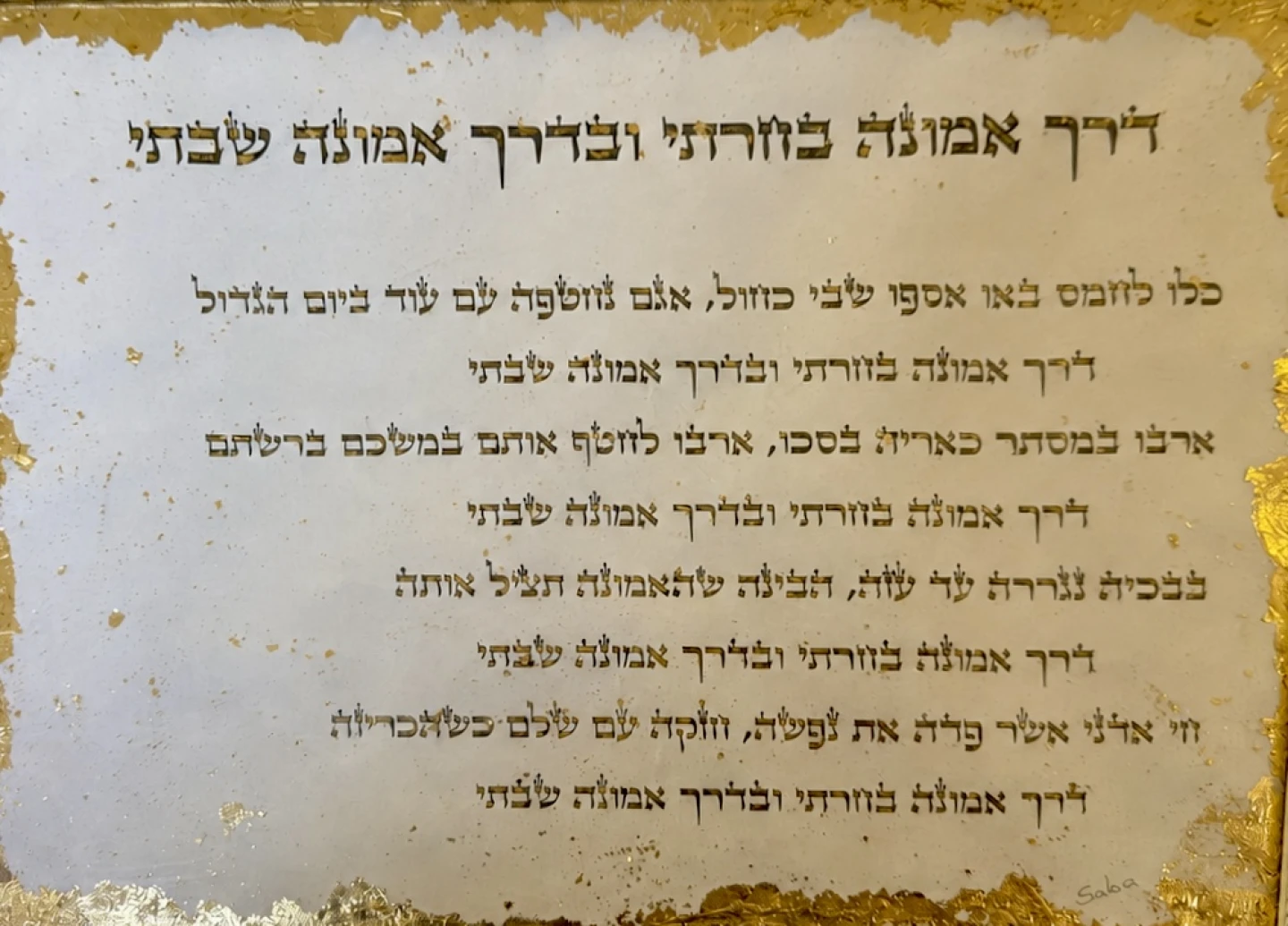
Shandalov footnoted each stanza to its source.
The first reaches for Habakkuk 1:9, where an enemy comes “l’chamas,” for theft, and gathers captives like sand. The biblical noun for theft sounds like Hamas, the name of Berger’s captors, and Shandalov’s footnote flags the line as a play on words. The stanza closes on “the great day,” which he glosses as Simchat Torah, the Jewish holiday on which Hamas launched its Oct. 7 massacre and mass kidnapping, including Berger’s abduction.
The second goes to Psalm 10:9, where the enemy crouches in ambush like a lion in its lair and seizes the poor, dragging him off in a net. Shandalov lifts the psalm’s own verb, “lachtof,” into his line—the root of chatufim, the word Israel has used for the hostages since Oct. 7. Both halves of the stanza open with the same word, “arvu:" They lay in wait, they lay in wait.
The third takes Genesis 10:19, a boundary marker that reads, in part, “as you come toward Gerar, unto Gaza.” Shandalov turns “Gerarah” into “nigrerah.” She was dragged to Gaza, weeping.
The fourth borrows from II Samuel 4:9, where David swears by the God “who redeemed my soul from all adversity.” Shandalov changes one letter. “Nafshi” becomes “nafshah”: her soul. The verb he keeps, “padah,” is the root of pidyon shevuyim, the ransoming of captives.
Classical Jewish liturgical poets, known as paytanim, frequently spelled out words with the opening letters of their stanzas—sometimes their own name, sometimes the theme of the poem, and by design rather than for anonymity. Shandalov does it, too. Many of his piyutim carry an acrostic tied to the message, and the title of his three volumes, Zemirot Azamer B’Fiyut, spells Zev.
The Berger piyut has none. Its stanzas open on kaf, aleph, bet and chet, which spell nothing.
He put his name at the foot of the page instead, in parentheses, the way a modern author would.
Shandalov got the idea of putting the poem on parchment from an earlier gift.
Sgt. First Class (res.) Yakir Shmuel Tatelbaum, 21, a former student of his and a neighbor in Ma’ale Adumim, was killed in Gaza City’s Shejaiya neighborhood on June 28, 2024, the 22nd of Sivan. He served with the 7th Armored Brigade’s 77th Battalion.
Two weeks before he was killed, Tatelbaum wrote a public tribute to one of his own teachers, Warrant Officer (res.) Elon Weiss, 49, who fell in Gaza.
“The heart is broken,” Tatelbaum wrote.
Shandalov wrote a piyut in his memory and dedicated his third volume to him. The poem for Yakir opens the book. Part of what the volume earns goes to Yakir’s Bustan, an orchard planted in his memory in Kedar, down the road from Ma’ale Adumim.
He brought the poem to the Tatelbaum family.
“They surprised me by having it written by a sofer, a scribe, on parchment and having it framed for me,” he told JNS.
A family in mourning had his poem put on parchment before he ever commissioned one himself.
“I thought to do the same thing,” he said, “and that’s why I asked Rav Brown to do it.”
Rabbi Yehuda Brown, a scribe and a friend, wrote out the Berger piyut in the letters otherwise reserved for Torah scrolls, mezuzahs and tefillin.
“The fact that the letters are written in the same way as they are in the Torah gives it a special level of—I won’t say holiness per se—but a connection more to the root of Judaism,” Shandalov said. “It gives it a different feel.”
Asked whom a piyut is for, Shandalov gave two answers.
“I am writing it for me and those who will read it over the next many years,” he said, calling the writing “cathartic.”
‘Words that come out of the heart’
Shandalov had presented his work to a prominent figure before. He presented his volumes to Israeli President Isaac Herzog. Shandalov said Herzog examined the books. He added that he was later invited to read one of his piyutim at the president’s annual gathering during the Ten Days of Repentance (which begin each year with Rosh Hashanah and end with the conclusion of Yom Kippur) in 2024.
“It was very stately, and it was a great honor,” he said of the President’s Residence reading. “But this was more personal, I think. Presenting it to Meirav was something different.”
He and Meirav Berger, Agam’s mother, had agreed the piyut would go to Meirav first. She would pass it to her daughter herself. As of publication, Agam has not yet received it. She has been traveling abroad, and her mother will give it to her when she returns.
Shandalov drove to Holon. What was meant to be a handover became a long conversation about the Jewish people, captivity, belief and Torah. Then he read her the poem, and she asked whether she could film him reciting and explaining it. He agreed.
In the recording, which JNS viewed, he gets through three stanzas steadily.
His voice rises on the last word of the fourth: “hikhrizah,” “she declared it.” It is the last word he says in his own voice. The refrain follows, in hers.
Then his voice drops. The break is audible.
Meirav answers: “Dma’ot.” Tears.
Shandalov answers her in Hebrew.
“Sitting in front of the mother who bore this tremendous pain and difficulty for so many days—482 days—it was very emotional to read it to her.”
There is an expression in Hebrew, he said: Words that come out of the heart enter the heart.
“I felt that very strongly sitting there with Meirav.”
Shandalov still hopes to sit with Agam and read her the piyut. Asked what he would want to say to her, he did not mention the poem.
“Thank you,” he told JNS. “Very often people do things without even making a big deal about them. They may simply say a sentence or do an act without realizing the unbelievable positive repercussions that can come from it.”




Get the latest updates in our WhatsApp group.







Rabbi Zev Shandalov, a teacher from Ma’ale Adumim, has transformed six words written by former Gaza hostage Agam Berger into a piyut, an ancient form of Hebrew prayer-poetry. Berger penned the phrase, "I chose the path of faith, and by the path of faith I returned," on a whiteboard while being transported from Gaza after 482 days in Hamas captivity. Shandalov, inspired by her concise expression of faith, crafted a piyut that incorporates biblical verses and uses Berger's original sentence as a recurring refrain. The poem, now inscribed on parchment, is displayed in Berger's mother's home. Shandalov explained that a piyut "can be a song, it can be a prayer, it can be sung or it can be read," and often stitches in Scripture. He noted that Berger's words, written by a 20-year-old, articulated emotions that many take a lifetime to express, emphasizing the universal message of faith.
© All rights to the original article belong to the source. Din Online shows a headline, an excerpt and a link only. The objectivity rating is computed automatically and is an estimate only.
Discussion
No comments yet — be the first to comment.