After earthquake rocks Colombia, Cali’s Jews look to quickly rebuild
Zev Stub is the Times of Israel's Diaspora Affairs correspondent.
When a 7.4-magnitude earthquake struck Colombia Monday morning, members of Cali’s Sephardic Jewish community were in the middle of morning prayers.

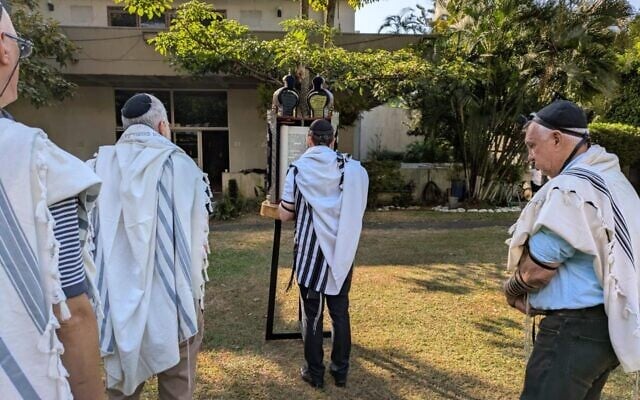
“About 15 men were praying shaharit, the morning prayer service, at the time,” Ary Harf, president of the Hebraika synagogue, told The Times of Israel. “When the earthquake started, it was very scary, and they had to go outside to a little garden to finish services. The synagogue building sustained some damage during the tremor, so we’ve been praying outside since then.”
For Cali’s small Jewish community, rebuilding the synagogue is now a top priority — even as the community has been shrinking for decades. No deaths have been reported among Cali’s roughly 400 Jews, but about 10 families have had to leave their homes because of earthquake damage, Harf said.
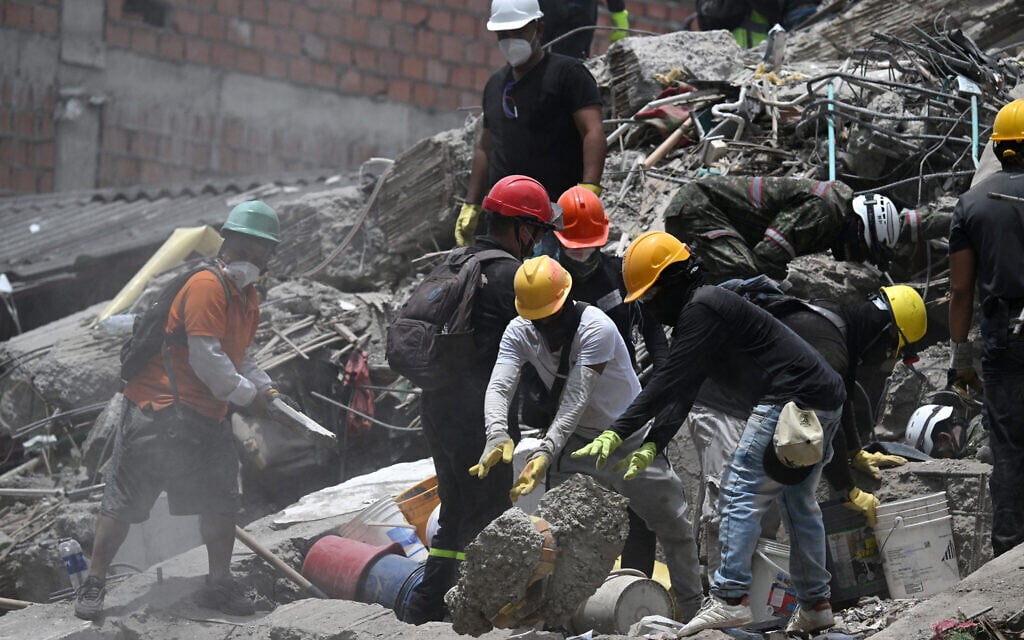
Cali, a city of some 2.2 million people in southwestern Colombia with a long history of drug cartel violence, was among the hardest-hit cities in Monday’s earthquake, which killed at least 265 people and left more than 3,000 missing as of Thursday morning.
Members of the Jewish community have been working to support displaced families and others in need by providing food, water, clothing and other necessities, Harf said. The synagogue is also running an international fundraising campaign to help the community recover.
“We are a small community, but we are very united,” he said.
The synagogue’s kitchen — the community’s main source of kosher food — and other rooms were damaged, and part of the building’s exterior facade fell away, making the entire building unsafe for use, Harf said.
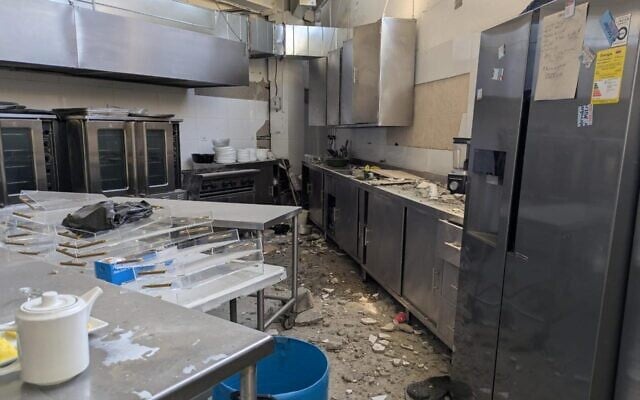
“But rebuilding efforts started today, so we should be able to come back, hopefully, in a couple of weeks.”
Colombia’s Jewish population is small, with an estimated 2,100 members, according to census figures cited by the World Jewish Congress. About 800 live in the country’s capital, Bogotá, which was largely spared by the earthquake, Harf said. Small communities also exist in Barranquilla and Medellín.
Colombia’s Jewish community dates back centuries, with waves of Sephardic Jews arriving from the Caribbean, the Ottoman Empire and North Africa in the 19th and early 20th centuries. Ashkenazi Jews fleeing European fascism arrived in larger numbers in the 1930s.
In Cali, home to Colombia’s second-largest Jewish community, most Jews live in the northern part of the city, which was hit relatively lightly. The situation in southern neighborhoods is “terrible,” with collapsed buildings throughout the area, Harf said.
Unlike Bogotá, which has a Jewish school and recreational clubs, Cali is home to a smaller, aging Jewish community with three synagogues serving Sephardi, Ashkenazi and traditional (Masorti) congregations. There are also several congregations of recent Catholic converts to Judaism that are not associated with the Jewish community, Harf noted. Some of these claim to be descended from the anusim of the Spanish Inquisition, who were forced to abandon their Judaism.
The community numbered about 800 people several decades ago, but many younger members have since moved away, Harf said.
That makes the synagogue’s reconstruction particularly urgent: One of the community’s top priorities is ensuring that Hebraika’s afterschool youth program can resume in time for the start of the school year in a few weeks, Harf said.
The earthquake has also disrupted kosher food services. While most members of the community do not strictly observe the laws of kashrut, those who do rely on the synagogue’s kitchen and catering services, which are currently out of commission.
“Kashrut depends a lot on the kitchen there, so it’s kind of difficult,” Harf said.
Jewish humanitarian aid groups, including Cadena, have been on the ground providing assistance, Harf said. IsraAID, an Israeli team, has been working with local partners on water and sanitation needs and providing psychological support, the organization said. The ZAKA emergency response organization has also established a temporary clinic to provide emergency care.
The earthquake struck just days after Colombia swore in a new president, Abelardo de la Espriella, who has sharply shifted the country’s foreign policy toward Israel after two years of strained relations under former president Gustavo Petro. De la Espriella’s government has restored diplomatic relations, recognized Israeli sovereignty over the Golan Heights and announced plans to move Colombia’s embassy to Jerusalem.
Israeli Foreign Minister Gideon Sa’ar visited Cali for de la Espriella’s inauguration and toured the Hebraika synagogue just days before the earthquake. Sa’ar sent de la Espriella his condolences and offered Israel’s assistance in a post on X.
In the meantime, Harf said, the community continues to gather, pray, care for its most vulnerable members and rebuild.
“We’re working hard to fix the synagogue and help the families who had to leave their homes,” he said. “With God’s help, we’ll be back inside soon.”

As a multimedia journalist, my job is to take the quality, fact-based journalism produced by The Times of Israel newsroom and make it accessible across every platform — from Instagram posts to podcasts to short-form videos.
This is how many, especially young people, consume news these days. But misinformation is rampant on social media. Our team at ToI produces accurate, responsible short-form reporting on Israel and the Jewish world.
If you believe in the importance of factual social media journalism, please consider joining our reader support group, The Times of Israel Community. Your financial support is essential to sustain responsible multimedia reporting.
— Gabriella Jacobs, multimedia journalist

We’re really pleased that you’ve read X Times of Israel articles in the past month.
That’s why we started the Times of Israel – to provide discerning readers like you with must-read coverage of Israel and the Jewish world.
So now we have a request. Unlike other news outlets, we haven’t put up a paywall. But as the journalism we do is costly, we invite readers for whom The Times of Israel has become important to help support our work by joining The Times of Israel Community.
For as little as $6 a month you can help support our quality journalism while enjoying The Times of Israel AD-FREE, as well as accessing exclusive content available only to Times of Israel Community members.
Thank you, David Horovitz, Founding Editor of The Times of Israel







A 7.4-magnitude earthquake struck Colombia, severely impacting Cali and its Sephardic Jewish community. The Hebraika synagogue sustained damage, forcing services outdoors, and approximately 10 Jewish families were displaced. Ary Harf, president of the Hebraika synagogue, stated, "The synagogue building sustained some damage during the tremor, so we’ve been praying outside since then." The community, numbering around 400, is prioritizing synagogue rebuilding and supporting affected families with food, water, and clothing. Rebuilding efforts for the synagogue, which also houses the community's main kosher kitchen, began promptly, with hopes of reopening in a few weeks. International Jewish aid groups like Cadena, IsraAID, and ZAKA are providing assistance. The earthquake occurred shortly after Colombia's new president, Abelardo de la Espriella, took office, signaling a shift towards stronger relations with Israel.
© All rights to the original article belong to the source. Din Online shows a headline, an excerpt and a link only. The objectivity rating is computed automatically and is an estimate only.
Discussion
No comments yet — be the first to comment.