Amid Israeli pushback, source reveals Board of Peace weighing new disarmament framework

Jacob Magid is The Times of Israel's US bureau chief
The Board of Peace is considering abandoning its phased framework for Hamas’s disarmament amid Israeli pushback to the US-controlled body’s original plan, a source directly familiar with the negotiations told The Times of Israel on Monday.

Instead of having Hamas hand over its weapons in phases, with Israel conducting corresponding withdrawals, the source said another option being weighed by the Board of Peace would see Hamas hand over all of its weapons throughout Gaza, and only then would Israel have to pull back its troops to the Gaza border.
While the shift could be enough to get Israel on board, it risks losing the support of Hamas, after the Board of Peace spent months coaxing the terror group to accept the phased disarmament plan.
That original disarmament roadmap approved by Hamas on July 30 broke the roughly 47 percent of the Gaza Strip still controlled by Hamas into five sectors and envisioned each sector demilitarized successively, the source said.
Under the original framework, once the weapon handovers and tunnel destructions for a particular sector are verified by the Board of Peace, the IDF would be required to pull back the troops stationed along that decommissioned sector.
The troops would redeploy closer to the Gaza-Israel border, moving back from the Yellow Line to a Red Line, as demarcated in the September 2025 map issued as part of US President Donald Trump’s 20-point plan for ending the Gaza war.
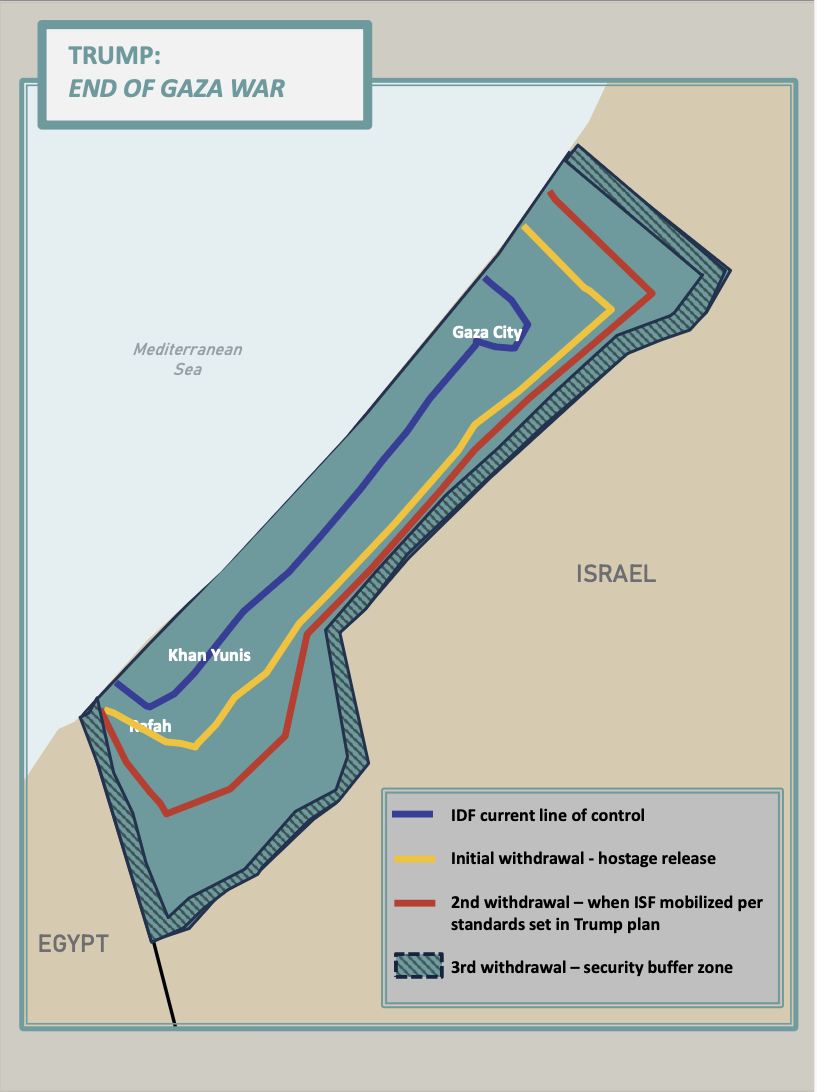
Netanyahu came out against that framework, insisting that Israel will not conduct any withdrawals until Hamas has been completely disarmed.
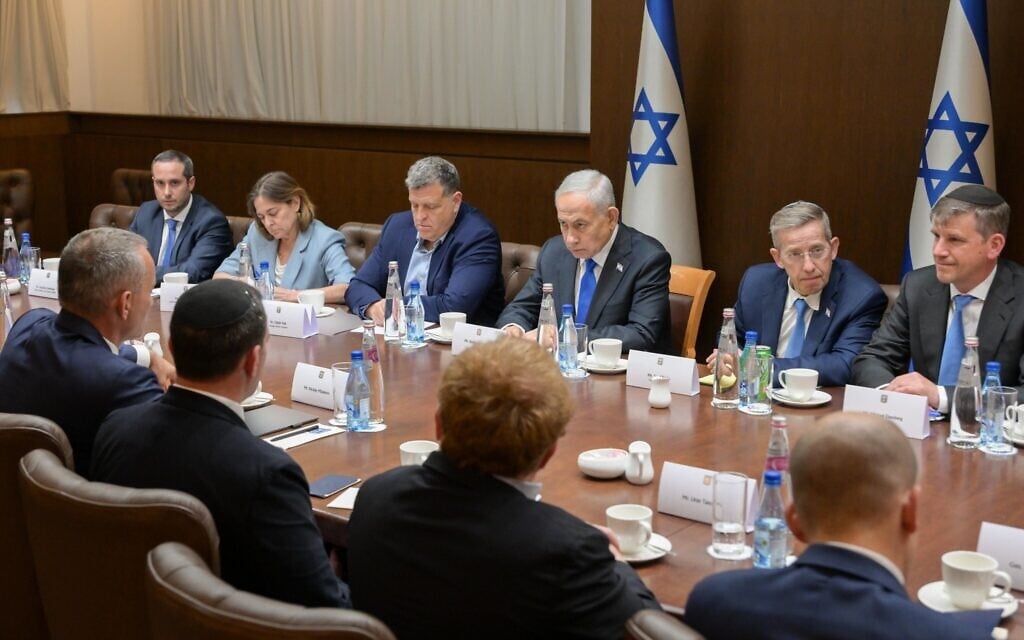
An Israeli official acknowledged that the dispute was not resolved during Monday’s Jerusalem meeting between Netanyahu and top Trump aide Jared Kushner.
While the source familiar with the negotiations clarified that the Board of Peace has not yet abandoned its original phased framework, he admitted that a wholesale approach is being considered.
In this different approach, the entire area currently under Hamas’s control would be decommissioned of weapons all at once, rather than sector by sector, the source said.
Once that wholesale disarmament has been verified by the Board of Peace, Israel would be required to withdraw its troops, not just the Red Line, but all the way to the perimeter of Gaza, the source added.
Such a drastic change to the disarmament roadmap would inevitably require Hamas’s approval, in what would surely drag out the process further.

Arab diplomats from mediating countries have told The Times of Israel that this was the risk in trying to advance the disarmament plan before the October 27 Knesset election, given that Netanyahu is unlikely to make any substantive concessions as the vote approaches.
The source’s revelation helped explain a statement issued by a Board of Peace official earlier Monday that said Netanyahu and Kushner agreed during their meeting “that there will be no IDF redeployment from Gaza until Hamas is fully disarmed and all of Gaza is demilitarized.”
The source noted that the operative phrase in that sentence is “from Gaza,” meaning that the sides have agreed that Israeli troops won’t be required to physically pull out of the Strip.
But that was never the main dispute, since the original Board of Peace disarmament plan only requires the IDF to pull its troops back closer to the Israel-Gaza border as each sector is verifiably decommissioned, rather than exit Gaza completely.
Given that Netanyahu has not agreed to such withdrawals, the Board of Peace official sufficed with reiterating a point that was not a matter of dispute. It did so in a manner that allowed for the interpretation that the Board of Peace had publicly adopted Jerusalem’s stance on the issue, as it seeks to gain Netanyahu’s acquiescence to its plan.
As for confusion regarding the Yellow Line, the source downplayed Israeli declarations that the IDF had moved the demarcation from the October 2025 ceasefire deal toward the coast.
While Israel has boasted of expanding its control of Gaza from 53% to between 60 and 70%, it did not actually redeploy its troops to that new Yellow Line.
Accordingly, IDF soldiers will remain in positions east of the original ceasefire demarcation, the source said, indicating that Palestinians will not be targeted for entering areas beyond the new Yellow Line barriers that Israel dragged toward the Gaza coast in recent months.

As a multimedia journalist, my job is to take the quality, fact-based journalism produced by The Times of Israel newsroom and make it accessible across every platform — from Instagram posts to podcasts to short-form videos.
This is how many, especially young people, consume news these days. But misinformation is rampant on social media. Our team at ToI produces accurate, responsible short-form reporting on Israel and the Jewish world.
If you believe in the importance of factual social media journalism, please consider joining our reader support group, The Times of Israel Community. Your financial support is essential to sustain responsible multimedia reporting.
— Gabriella Jacobs, multimedia journalist

We’re really pleased that you’ve read X Times of Israel articles in the past month.
That’s why we started the Times of Israel – to provide discerning readers like you with must-read coverage of Israel and the Jewish world.
So now we have a request. Unlike other news outlets, we haven’t put up a paywall. But as the journalism we do is costly, we invite readers for whom The Times of Israel has become important to help support our work by joining The Times of Israel Community.
For as little as $6 a month you can help support our quality journalism while enjoying The Times of Israel AD-FREE, as well as accessing exclusive content available only to Times of Israel Community members.
Thank you, David Horovitz, Founding Editor of The Times of Israel








The Board of Peace is reportedly considering a new framework for Hamas’s disarmament in Gaza, moving away from its original phased plan due to Israeli objections. The initial proposal, accepted by Hamas on July 30, involved successive demilitarization of five sectors, with the IDF withdrawing troops closer to the Gaza-Israel border after verification. However, Israeli Prime Minister Netanyahu opposed this, insisting on complete disarmament before any withdrawals.
“there will be no IDF redeployment from Gaza until Hamas is fully disarmed and all of Gaza is demilitarized.”
A new option being weighed would require Hamas to hand over all weapons across Gaza simultaneously, after which Israel would withdraw its troops to the Gaza perimeter. This shift, while potentially satisfying Israel, risks losing Hamas’s support and could prolong the disarmament process, especially with upcoming elections in Israel.
© All rights to the original article belong to the source. Din Online shows a headline, an excerpt and a link only. The objectivity rating is computed automatically and is an estimate only.
Discussion
No comments yet — be the first to comment.