שבת, אוגוסט 15, 2026 עברית|English Log in Free sign-up
LIVE
The new crescent: Mecca pact gives rise to a Saudi-led Sunni bloc, posing new challenges for IsraelRashida Tlaib rally canceled at Florida venue after lawmaker calls event ‘anti-Jew’Ancient Egyptian princesses were skilled archers, trained with weapons, controversial study claimsDeity-inscribed tombstones, sarcophagi unearthed at ancient Egyptian burial siteBronx man arrested, charged with hate crimes after disrupting NYC synagogue servicesIsraeli strike kills 7 in Lebanon, 2 tankers attacked in Hormuz and other news from the Middle EastIsraeli airstrike kills seven in southern Lebanon in deadliest attack since June lullFlorida venue cancels Rashida Tlaib rally after controversy over Israel criticismLebanon IsraelLebanon Israel Iran WarSaudi-led Sunni bloc emerges in the Middle East, posing challenges for IsraelWomen’s Movement That Helped Build Medicine in Israel Gains Strength in BrazilThe new crescent: Mecca pact gives rise to a Saudi-led Sunni bloc, posing new challenges for IsraelRashida Tlaib rally canceled at Florida venue after lawmaker calls event ‘anti-Jew’Ancient Egyptian princesses were skilled archers, trained with weapons, controversial study claimsDeity-inscribed tombstones, sarcophagi unearthed at ancient Egyptian burial siteBronx man arrested, charged with hate crimes after disrupting NYC synagogue servicesIsraeli strike kills 7 in Lebanon, 2 tankers attacked in Hormuz and other news from the Middle EastIsraeli airstrike kills seven in southern Lebanon in deadliest attack since June lullFlorida venue cancels Rashida Tlaib rally after controversy over Israel criticismLebanon IsraelLebanon Israel Iran WarSaudi-led Sunni bloc emerges in the Middle East, posing challenges for IsraelWomen’s Movement That Helped Build Medicine in Israel Gains Strength in Brazil
Business

‘Annihilation through work’: London exhibit highlights overlooked story of slave labor in WWII
4h ago ·  Source: The Times of Israel 82Objectivity score82/100

‘Annihilation through work’: London exhibit highlights overlooked story of slave labor in WWII

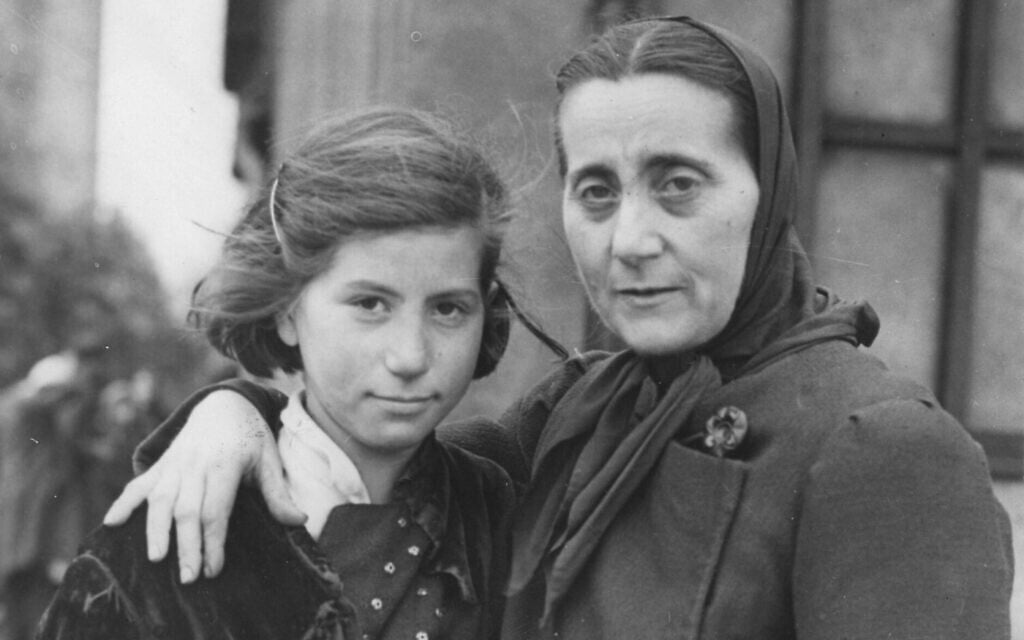
A mother and daughter, both Czech Jewish slave laborers at Lippstadt, a subcamp of Buchenwald, 1945. (Wiener Holocaust Library collections)

Robert Philpot is a writer and journalist. He is the former editor of Progress magazine and the author of “Margaret Thatcher: The Honorary Jew.”

LONDON — Agnes Kaposi was just 11 years old when she was forced to work on a state farm in Austria contributing to Nazi agricultural production. Still a child, she was later sent to an armaments plant, where she moved materials around a factory producing anti-aircraft guns.

Born to a Jewish family in Hungary, Kaposi was one of an estimated 20 million men, women and children exploited by the Nazis’ vast apparatus of forced and slave labor — an often-overlooked topic in wider Holocaust remembrance and commemoration that is now the focus of a major exhibition in London this summer.

“Nazi Slave Labor: Perpetrators and Victims” runs through the end of October at the Wiener Holocaust Library. It highlights the breadth and development of the system, which stretched from the Atlantic coast of occupied France to the Eastern Front in the Soviet Union.

Kaposi survived. Her portrait is among those displayed at the exhibition, which features six survivors whose early lives were shaped by the horror of the Third Reich’s slave labor program.

But millions didn’t survive. Two and a half million slave laborers died — victims not simply of the Nazi war effort, but also the greed of civilian industries and businesses that tapped the ready supply of cheap labor to line their own pockets and bolster their profits.

Agnes’s cousin, András, was among them. Enlisted into a labor service unit run by the Nazis’ Hungarian allies in 1941, he perished in 1944 as a result of ill treatment. A postcard he sent shortly before his death is displayed in the exhibition: “My dearest parents, I implore you to report as soon and often as you can about our home, so I can also feel its nearness and warmth.”

Exhibition curator Clara Dijkstra says that while it is well-covered by academics, the subject has been less of a focus in more popular retellings of the Holocaust story.

תמונת סיקור

“Because it’s linked to economic history, it can be quite a dry topic based on anonymous statistics, big numbers and faceless companies,” Dijkstra told The Times of Israel. The exhibition thus sought to “put a lot of faces and names” to the victims.

Those victims stretch back to the Nazis’ earliest days in power. Newly established concentration camps required inmates to engage in heavy manual labor, with forced labor designed to punish and “reeducate” the Third Reich’s opponents.

The annexation of the rump of Czechoslovakia and invasion of Poland in 1939 marked a growth of, and shift in, the system. Economics, rather than punishment alone, became the focus, with groups of Czech and Polish civilians employed as voluntary laborers or conscripted to work in the Third Reich. As the exhibition states, forced labor was also “a key part of early discriminatory policy against Jews.”

תמונת סיקור

Jews in Germany, Poland and Czechoslovakia were dragooned into labor deployments and often sent to work in temporary labor camps. By the end of 1940, over 700,000 Polish Jews had been forcibly sent to work on construction sites in the Greater Germanic Reich. Their efforts were mocked by the Nazi press. A 1939 photo article entitled “The Jews must work” in Illustrierter Beobachter (Illustrated Observer), for instance, featured images of Jews carrying out forced labor with captions such as: “The Jews have never worked so hard in their life” and “Polish Jews are not working hard enough yet; a German construction worker carries five times as many stones up a ladder.”

From 1940, Jews forced into ghettos in occupied Poland were also exploited for their labor.

The Lodz ghetto, a one-and-a-half square-mile area in which 160,000 Jews were confined, became a center of textile production. Three years after the German invasion, nearly 74,000 poorly fed and clothed Jews were working 12-hour shifts in 90 small factories and workshops throughout the ghetto.

תמונת סיקור

The exhibition features remarkable images of life in the ghetto taken by Mendel Grossman, a Jewish-Polish artist who worked in the photography section of the Lodz Jewish Council statistics department. Grossman, who was later murdered on a death march in the closing weeks of the war, was charged with documenting daily life in the ghetto, although he also secretly took pictures of the personal lives of inhabitants.

Meager wages were paid using a special currency that could only be used in the ghetto and which frequently wouldn’t manage to feed a family. So important was the ghetto’s output that it wasn’t until August 1944 — nearly two years after other Polish ghettos were liquidated — that Lodz was destroyed and its inhabitants murdered.

As survivor Elsa Kafka, who was deported from Prague to the Lodz ghetto in October 1941, later recorded in testimony held by Wiener Library: “Everyone was so occupied that there was no time, nor energy, nor sense for possible friendships. One was far too undernourished and exhausted… People worked hard in the ghetto. Only the old were exempt from this. The children had to be at the workplace at 7 a.m. already; the girls in the sewing rooms, the boys in a mechanical engineering workshop. There were countless factories.”

תמונת סיקור

In the west, the blitzkrieg through Belgium, the Netherlands and France in 1940 saw 1.6 million prisoners of war sent to Stalags, forced labor camps, in Germany. Civilians, too, soon found themselves subject to increasingly coercive methods at the hands of newly established German employment offices.

With Hitler’s assault on the Soviet Union stalling in 1942, and the tide of the war turning, the Nazis engaged in the mass exploitation of Red Army prisoners of war and Soviet civilians. By 1944, nearly 2 million POWs, including prisoners from France, Britain and Italy, were working for the German war economy, which the previous year had been ramped up with the onset of Totaleinsatz or total deployment as industry was converted to arms production. August 1944 saw some 7.6 million foreign forced laborers working in Germany, constituting over one-quarter of the total labor force.

תמונת סיקור

As the exhibition makes clear, while Soviet laborers, who were made to do particularly dangerous and demanding work, were treated especially badly, “Jewish prisoners were at the bottom of the slave labor hierarchy.” Those not immediately selected for the gas chambers were instead subjected to “annihilation through work” — a process of overwork and underfeeding. Testimony by Peter, a Polish-Jewish survivor of the Majdanek extermination camp in German-occupied Poland, details how Jewish workers were exposed to poisonous fumes while making explosives. Not permitted to wear protective masks, they “died like flies,” he recalled.

On the order of SS head Heinrich Himmler, hundreds of slave labor subcamps were constructed in or around major concentration and extermination camps from 1942. The Auschwitz complex, for instance, had more than 40 slave labor subcamps. Autumn 1943 marked the beginning of the widespread system of “leasing” concentration camp prisoners — including Jews, political prisoners, Roma and Sinti, and “asocials” — to private firms.

תמונת סיקור

“Far from being confined to the Nazi camps, the system of slave labor extended into factories and boardrooms, implicating some of Germany’s most powerful companies. Bureaucracy enabled brutality, and profit became indistinguishable from persecution,” the Wiener Library noted in a press statement accompanying the exhibition.

In all, over 1 million inmates became slave laborers, most forced to work for companies producing weaponry. Heavy labor, textiles and chemicals had the horrific distinction of offering both the worst living conditions and shortest life expectancy. Slave laborers were frequently housed in barracks, barns and small huts.

For German business — which included the likes of fashion house Hugo Boss, pharma giant Bayer and the engineering firm Siemens — camp slave laborers could be “rented” from the SS at rates far lower than those commanded by ordinary civilian workers.

The notorious chemical, pharma and industrial synthetics cartel IG Farben, for instance, struck deals with the Nazis to exploit slave labor at multiple concentration camps. At its height in 1944, Farben’s factory at the Buna-Monowitz subcamp of Auschwitz, which the company built in partnership with the SS in 1942, held more than 10,000 prisoners.

Similarly, arms company Krupps operated factories in subcamps at Buchenwald, Ravensbruck and elsewhere.

תמונת סיקור

It wasn’t just well-known industrial behemoths who, as more German men were called up, plugged labor shortages by tapping slave labor. The exhibition cites farms and tailors as examples of smaller businesses which were party to systematic mass exploitation. In 1943, half of the workers in German agriculture were foreign civilian workers, very often women and children.

Some relationships between perpetrator and victim were, as the exhibition suggests, less easy to define.

The Leitz family, who owned Leica cameras, helped some of their Jewish employees and friends escape pre-war Germany. But despite his liberal sympathies, Leica factory owner Ernst Leitz II opted not only to join the Nazi Party during WWII to protect his company, but also to use forced laborers, primarily young Ukrainian women. The company, which manufactured important items for the German war effort, such as periscope gunsights, employed 600-1,000 forced laborers from September 1942 until the end of the war. Stone’s photographs of survivors in the exhibition were taken on a Leica camera produced in 1938 at the very Wetzlar factory that was later staffed by forced laborers.

But, for those who suffered grievously at the hands of the Nazis’ slave labor program, justice was both partial and delayed.

תמונת סיקור

Armaments minister Albert Speer and Fritz Sauckel, who oversaw the mobilization of forced labor, were both tried at Nuremberg. Speer used millions of forced laborers but denied any knowledge of the Holocaust. Photos, such as that displayed in the exhibition of him examining a group of slave laborers in Mauthausen in June 1944, prove, however, that he knew of conditions in the camps. Speer received a 20-year-sentence, while Sauckel was hanged in October 1946 with many of the regime’s other leading war criminals.

In two subsequent cases, top officials and directors at IG Farben and Krupp were put in the dock. Affidavits provided by IG Farben bosses described personal visits to Auschwitz and falsely boasted that workers’ meals contained 1,500 calories per day (itself 1,000 below what an adult male engaged in physical labor should receive). The company claimed to have had a “positive” impact on the treatment of prisoners, blaming any mistreatment on SS guards.

These claims, Dijkstra says, were utterly untrue. Aside from “very, very isolated incidents,” there is no evidence that the companies which used slave and forced labor did anything to ameliorate the conditions of workers or ease their plight. Nor was it true that they were unaware of how slave and forced laborers were treated. “If a company’s employing labor, they’re going to be trying to oversee the production process,” says Dijkstra. “It was impossible for them not to know.”

In all, 13 of the 24 Farben officials who were initially charged were found guilty in July 1948. Most received sentences of two to three years — the longest stretch handed down was eight years — and all of them were no longer behind bars by 1951.

תמונת סיקור

But 1951 also saw Norbert Wallheim, who had spent two years as a forced laborer, successfully bring a groundbreaking case against Farben. Krupp, Siemens and Volkswagen agreed to limited compensation payments two years later and, in 1957, Farben set a precedent by agreeing to pay out 27 million Deutschmarks to Jewish slave laborers and 3 million Deutschmarks for non-Jewish slave laborers of their Auschwitz factory.

Have high-profile companies involved in slave and forced labor reckoned with their past? “It’s almost impossible for them to completely compensate for this past activity because no amount of monetary compensation can really ever fix these wrongdoings,” says Dijkstra.

Instead, she believes, they should acknowledge and publicize to customers that their companies are, in part, built on the backs of slave laborers. “I think a lot of companies have not done that publicly enough,” she says.

The German state has — albeit haltingly and imperfectly — also acknowledged its role.

In 1953, the new West German state established a deeply flawed compensation scheme: payments were only to be made to those discriminated against on the basis of their race or political beliefs who were still residing in the Federal Republic. Many former forced laborers were thus effectively excluded.

It would not be until the turn of the century that the German Bundestag would finally create a foundation, co-funded by German companies, to organize compensation payments to all those who had suffered at the Nazis’ hands, including 1 million surviving slave laborers.

By that time, of course, millions of those whom the Nazis had so brutally exploited had long died.

תמונת סיקור

As a multimedia journalist, my job is to take the quality, fact-based journalism produced by The Times of Israel newsroom and make it accessible across every platform — from Instagram posts to podcasts to short-form videos.

This is how many, especially young people, consume news these days. But misinformation is rampant on social media. Our team at ToI produces accurate, responsible short-form reporting on Israel and the Jewish world. 

If you believe in the importance of factual social media journalism, please consider joining our reader support group, The Times of Israel Community. Your financial support is essential to sustain responsible multimedia reporting.

— Gabriella Jacobs, multimedia journalist

X
google
apple
facebook
timesofisrael
google
apple
facebook
timesofisrael
timesofisrael
google
apple
facebook
timesofisrael
check your email
X
X
Confirm Mail
A mother and daughter, both Czech Jewish slave laborers at Lippstadt, a subcamp of Buchenwald, 1945. (Wiener Holocaust Library collections)
The aftermath of a reported deadly strike in Ansar, Lebanon on August 15, 2026 (Screenshot/ Lebanondebate via X)
Israelis count the remaining ballots at the Knesset in Jerusalem, a day after the election, early on March 4, 2020. (Olivier Fitoussi/Flash90)
Police stationed outside Central Synagogue in New York City, November 4, 2022. (Luke Tress/Times of Israel)
US President Donald Trump holds an article about prescription drug prices as he speaks with reporters before boarding Air Force One, August 14, 2026, at Joint Base Andrews, Md. (AP Photo/Julia Demaree Nikhinson)
Mali and Liel Yahalomi located on a bus in Argentina by police on August 14, 2026. (Screen capture/Israel Police)
Israeli forces stand in front of the entrance of a Palestinian house besieged by Israeli settlers in the village of Qusra, south of Nablus, in the West Bank, on August 14, 2026. (Jaafar ASHTIYEH/AFP)
Prime Minister Benjamin Netanyahu speaks in an episode of an Army Radio podcast released on August 13, 2026. (Screen capture: Army Radio/Youtube)
Mahmoud Amin Ya’qub Al-Muhtadi, in black, with a group of Democratic Front for the Liberation of Palestine trainees, in 2022. (US Western District of Louisiana court)
An El Al plane takes off at Ben Gurion Airport, outside Tel Aviv, August 4, 2026. (Yossi Aloni/Flash90)
Palestinians walk among tents and rubble on the coastal road in Gaza City, in the Strip's north, on August 13, 2026. (AP Photo/Abdel Kareem Hana)
MK Elazar Stern speaks during a Foreign Affairs and Defense Committee meeting at the Knesset in Jerusalem, December 14, 2025. (Yonatan Sindel/Flash90)
Prime minister Benjamin Netanyahu and Likud MK Nir Barkat present the Likud economic plan, during a Likud party event in Tel Aviv on February 16, 2020. (Tomer Neuberg/Flash90)
Priests gather at the garden of the Basilica of the Transfiguration on Mount Tabor, northern Israel, on August 6, 2026. (AP Photo/Ariel Schalit)
Illustrative: Hebrew and English signs on Ko Pha Ngan in Thailand, August 17, 2019. (Moshe Shai/FLASH90)
Dr. Bjorn Lomborg joins host Lazar Berman for this week's Lazar Focus. (R Mathiasson)
An armed student waves a Yemeni flag as he is flanked by a peer waving a Palestinian flag and others displaying the Houthi rebels' banner, which reads 'Death to America, death to Israel, a curse on the Jews,' at a rally in support of the Iran-backed rebels amid escalating tensions with Saudi Arabia, on the Sanaa University Campus in the Houthi-held Yemeni capital, on July 22, 2026. (Mohammed HUWAIS/AFP)
💬 Want to join the discussion and comment? Sign up — free, and get the weekly digest too.
🗞️ In-depth summary

A new exhibition in London, "Nazi Slave Labor: Perpetrators and Victims" at the Wiener Holocaust Library, sheds light on the often-overlooked story of the estimated 20 million people exploited by the Nazi regime's vast forced and slave labor system during World War II. Running through October, the exhibit highlights the breadth and evolution of this system, which spanned from occupied France to the Soviet Union.

Because it’s linked to economic history, it can be quite a dry topic based on anonymous statistics, big numbers and faceless companies.

Curator Clara Dijkstra notes the exhibition aims to "put a lot of faces and names" to the victims, moving beyond academic statistics. The exhibit features testimonies and portraits of survivors like Agnes Kaposi, who was forced into labor as a child, and commemorates the millions who perished, including Agnes's cousin András. It details how forced labor evolved from a punitive measure in early concentration camps to a widespread economic tool, implicating major German companies like IG Farben, Bayer, and Siemens, which rented prisoners from the SS for their factories.

Automatically generated summary based on the original article; quotes are from the source.
This story is based on reporting by The Times of Israel.
Read the full article at the source →

© All rights to the original article belong to the source. Din Online shows a headline, an excerpt and a link only. The objectivity rating is computed automatically and is an estimate only.

Related

Discussion

No comments yet — be the first to comment.

Add a comment