As toxic sewage and factory sludge choke Hebron stream, locals refuse to go with the flow
Sue Surkes is The Times of Israel's environment reporter
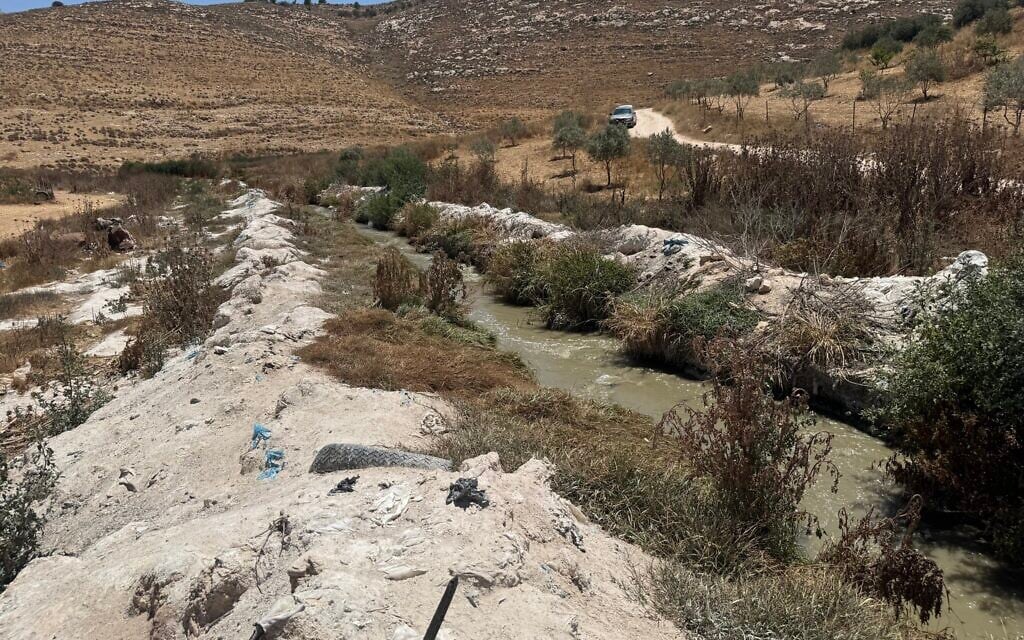
It’s the stench that hits first — a nauseating wave that reveals raw sewage coursing through the Hebron Stream beneath the Jewish settlement of Otniel in the southern West Bank, a riverbed meant to be dry in July.
Its banks are caked in a blinding white crust that allows only the most resilient of plants to survive. The white powder is not natural to the stream; it has entered via the city of Hebron’s sewage pipe network, originating at stone-cutting factories that use large amounts of water to cool lathes that cut Hebron stone — also sometimes known as Jerusalem stone — into slabs for the area’s characteristic building facades, flooring and tiles.
For years, the Palestinian Authority has been building an internationally funded wastewater treatment plant for Hebron. Delays were caused partly by Israeli changes of plan. But even once finished, the facility will sit idle until the stone dust problem is resolved — it would chew the machinery to bits.
For years, the toxic cocktail of raw sewage and marble sludge has flowed beyond the city limits. In winter, floods spill the slurry onto the banks; when the rains stop, it bakes into a concrete-like crust.
Hundreds of thousands of residents from communities not connected to sewage infrastructure add their untreated waste to the current, helping to drive ecological devastation.
Unless the stone sludge is thick enough to seal the stream bed, the filth percolates downward, threatening the Mountain Aquifer — the most critical remaining source of natural sweetwater in the region.
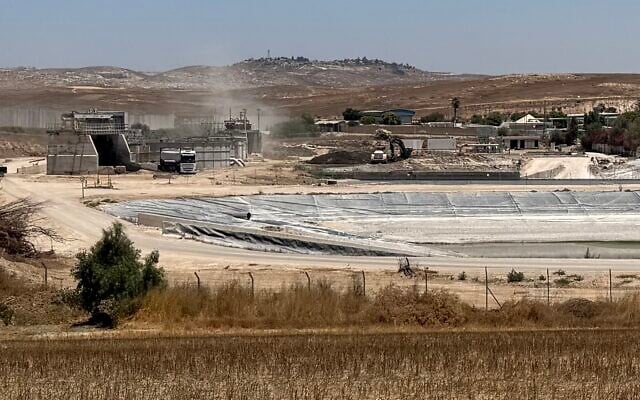
At the Israeli border, a specialized filtration facility strains out the white dust, channeling the remaining raw sewage toward the Shoket wastewater treatment plant. When Shoket overflows, the deluge pours directly into the Beersheba Stream, carving a stinking path through a key municipal park and spreading foul odors to neighborhoods nearby.
Instead of leading to a permanent Israeli-Palestinian peace, as intended, the 1990s Oslo Accords have created a bureaucratic nightmare.
Israel wields civil and security control over 60% of the West Bank — designated during the accords as Area C — home to Jewish settlements, military zones, open and agricultural land, and Palestinian villages. Half of Hebron’s stone-cutting factories operate in Area C, where Israel, through its Civil Administration, holds exclusive planning authority. The other factories operate in Area A, entirely outside Israel’s civilian reach.
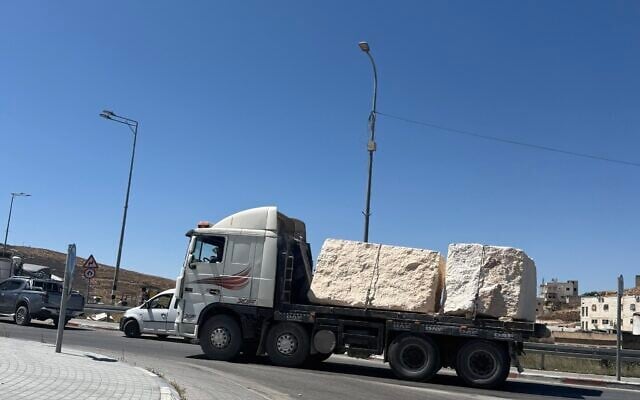
In late June, a legal battle erupted. Green Now, a Jewish West Bank environmental group, joined forces with the right-wing Regavim — co-founded two decades ago by current pro-settler Finance Minister Bezalel Smotrich — to petition the High Court. They want an immediate crackdown and closure of polluting Area C stone-cutting plants. The court has given the state 60 days to respond.
Meanwhile, EcoPeace Middle East, a left-wing NGO with directors in Israel, Ramallah and Amman, has chosen the path of diplomacy, signing a Memorandum of Understanding with Palestinian marble engineers to fund and engineer sustainable upgrades.
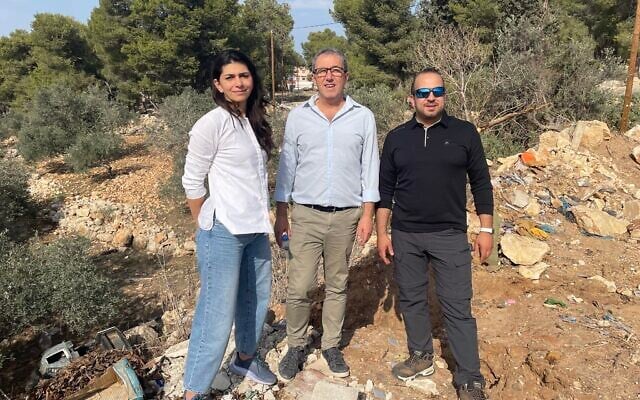
Yet, EcoPeace Israel director Gidon Bromberg warns that the division of the West Bank is the culprit.
“It’s hard enough to manage things between countries,” Bromberg said. “When one area is divided into three jurisdictions with two responsibilities, nobody takes responsibility.”
He noted that even Hebron is divided between Israel and the Palestinian Authority.
Decades of explosive population growth had not been met with infrastructure investment, he said.
“Hebron is behind, but so is [the] Gush Etzion bloc… Even the most liberal settlement bloc doesn’t treat its sewage properly, so let’s stop the blame game,” he said. “We have to stop managing the conflict and resolve it — if not for the people, then for the environment.”
A drive down Route 60 with Green Now’s head, Barak Verker, and Regavim’s international director, Naomi Kahn, exposed the stinking problem.
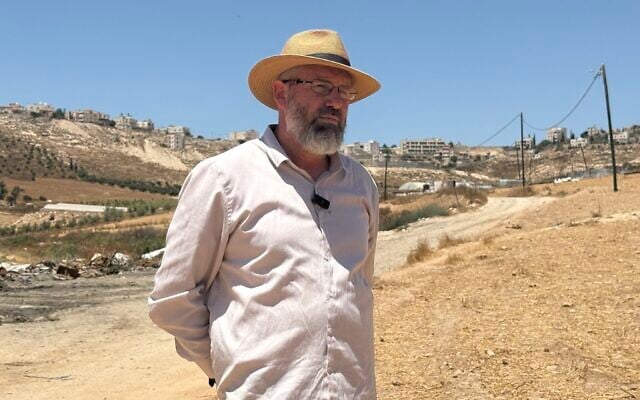
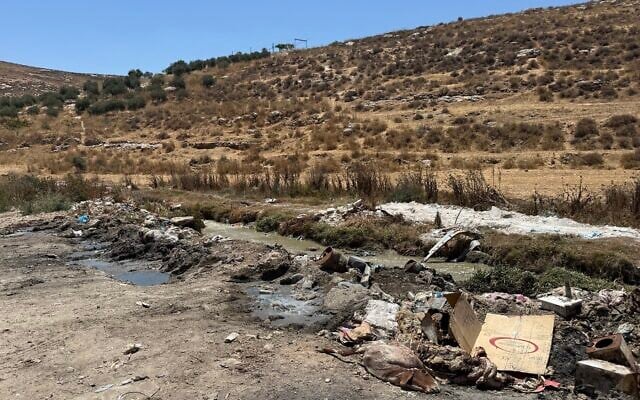
Below the Jewish settlement of Shim’a, dusty dirt tracks lead down into a valley below ad-Dhahiriya in Area A.
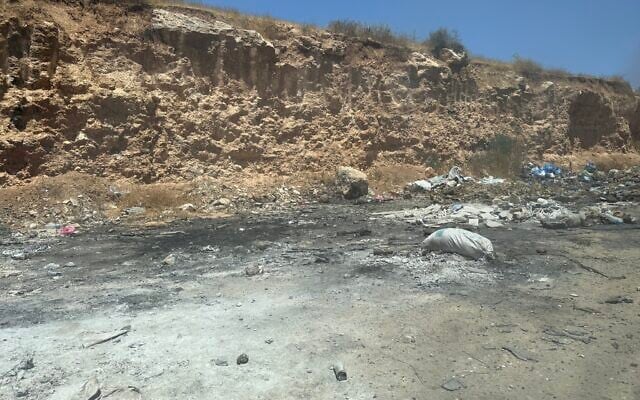
Here, sewage and rock dust collide with secondary pollution in the form of pirate waste dumps. Stream banks are littered with twisted scrap metal and rotting sheep carcasses, all leaching poison straight into the groundwater.
Kahn points a finger squarely at the Civil Administration, accusing officials of turning a blind eye out of fear that enforcement will create an international backlash. She said that this approach also helps keep marble costs down for Israelis.
“When you have jurisdiction but don’t take responsibility, you create a black hole within which bad things happen,” Kahn warned. “Governance is more important than sovereignty.”
Behind the scenes, the Civil Administration is working with the Palestinian Authority on two main plans. One envisions pipes parallel to the sewage system to siphon the abrasive stone slurry away to a special treatment facility to be built with international funds near the al-Fahs industrial zone, on Hebron’s outskirts, in Area C. The other is for a pipeline that will run parallel to, and downhill from, the stream. This will use gravity to collect sewage from the stream, from Otniel to the Green Line. From there, it will be sent to an expanded Shoket treatment plant.
A source from the Mount Hebron Regional Council who declined to be named said that the municipality was revoking building permits for polluting factories in the al-Fahs industrial zone and blocking off access for illegal slurry into sewage pipes, with the result that the rock dust problem had diminished substantially.
Meanwhile, the head of the council, which represents the interests of Israeli settlers living in the West Bank’s southern Judean Hills, placed the blame squarely on the Palestinians living in the vicinity.
“The problem in the Hebron Stream stems from the [Palestinians] discharging raw sewage directly into the stream, in violation of the agreements they are obligated to uphold,” said Mount Hebron Regional Council head Eliram Azulay. “This causes severe environmental damage and contaminates the water consumed by all residents of the Negev — Beersheba, Omer, Meitar, farmers in Bnei Shimon and as far as the Eshkol Stream. They all suffer from the pollution caused by the [Palestinians] in Hebron and the surrounding area.”
The Beersheba Municipality said it was leading the fight to keep the filth out of the stream running through the city and the park.
“I call on the State of Israel to take responsibility, carry out the wastewater treatment and recover all the costs from the Palestinian Authority, simply because they cannot be trusted to do it voluntarily,” Azulay said.
And while there may be extensive plans, the catch is that there are no confirmed budgets nor any timelines.
“Most of these plans remain plans,” said Bromberg, noting other projects to upgrade old and poorly functioning wastewater treatment plants elsewhere in the West Bank.

The war with Iran has been draining for all of us in Israel. But when I heard about a high casualty incident – ballistic missile impacts in Arad and Dimona that left nearly 200 people wounded – I drank a cup of coffee, packed a bag, and headed south.
There, I spoke with Shilgit, the head of an after-school program for underprivileged youth. Standing outside her destroyed center, Shilgit said it was a miracle that no children were hurt and spoke about the community coming together in the hours since.
As a Times of Israel reporter, I’m committed to telling stories of resilience like Shilgit’s. But my colleagues and I can't do this alone. If you value work like this, please consider joining our reader support group, The Times of Israel Community. Your financial support is essential to keep real human reporting like this going.
— Stav Levaton, military reporter

We’re really pleased that you’ve read X Times of Israel articles in the past month.
That’s why we started the Times of Israel – to provide discerning readers like you with must-read coverage of Israel and the Jewish world.
So now we have a request. Unlike other news outlets, we haven’t put up a paywall. But as the journalism we do is costly, we invite readers for whom The Times of Israel has become important to help support our work by joining The Times of Israel Community.
For as little as $6 a month you can help support our quality journalism while enjoying The Times of Israel AD-FREE, as well as accessing exclusive content available only to Times of Israel Community members.
Thank you, David Horovitz, Founding Editor of The Times of Israel










The Hebron Stream, flowing through the southern West Bank, is severely polluted with raw sewage and white sludge from stone-cutting factories, threatening the Mountain Aquifer and impacting communities as far as Beersheba. This ecological crisis stems from inadequate infrastructure, decades of population growth, and the complex jurisdictional divisions established by the Oslo Accords, which leave 60% of the West Bank under Israeli civil and security control.
“When one area is divided into three jurisdictions with two responsibilities, nobody takes responsibility,”
said EcoPeace Israel director Gidon Bromberg. Legal action has been initiated by environmental groups Green Now and Regavim, petitioning the High Court for the closure of polluting factories in Area C, while EcoPeace Middle East pursues diplomatic solutions. Despite various plans from the Civil Administration and local councils to address the pollution, including new pipelines and treatment facilities, these initiatives lack confirmed budgets and timelines, perpetuating the environmental degradation.
© All rights to the original article belong to the source. Din Online shows a headline, an excerpt and a link only. The objectivity rating is computed automatically and is an estimate only.
Discussion
No comments yet — be the first to comment.