‘Battle for the center’: Large majority of Israelis already know how they’ll vote — poll


Several months ahead of the October 27 national elections, the vast majority of Israelis have already decided whom they’re voting for, according to poll results released on Sunday by the Jewish People Policy Institute.
The latest JPPI survey, conducted this month, found that a majority (53%) of Israelis are already “completely sure” whom they’re voting for, while a further 29% are “fairly sure.” Only 14% said they’re still undecided, and the remaining 4% said they aren’t going to vote.
Among those who identified as on the left, 71% are already “completely sure” whom they’ll vote for, while among those on the right, 58% are. By contrast, only 44% of centrist voters said the same.
“In other words, the campaign’s real battlefield is focused on the center,” JJPI said in a press release.
Compared to the same survey a year ago, the results of this poll indicated a modest continuation of the Jewish Israeli public’s rightward shift, with 66% of Jewish respondents identifying as on the right, compared to 63% in July 2025.
Meanwhile, the share of Jewish voters who identified as “exactly in the center” grew from 10% in July 2025 to 13% in July 2026, while the share of those who identified as on the left shrank from 22% a year ago to just 19% this time.
Strikingly, only 3% of Jewish respondents this year said they identified as on the left. None, or a negligible number, identified as “far left.”
Among Arab respondents, about half identified as on the left, similar to last year, while the share of Arab voters who said they couldn’t find any place for themselves on the political map went down from 21% last year to 15% this time.
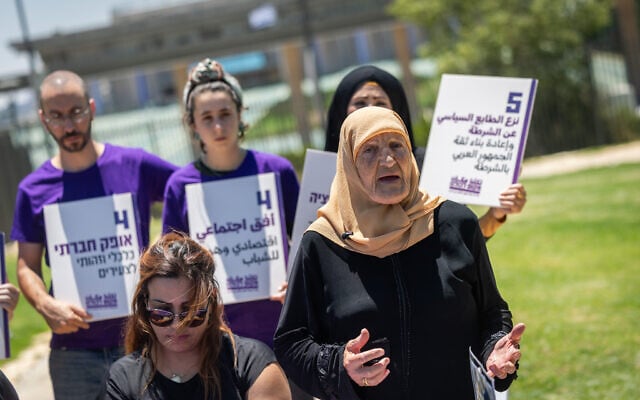
Asked what sort of coalition they’d like to see in the next Knesset, a plurality (27%) opted for a “change bloc” government that includes Arab parties. A further 8% opted for the “change bloc” but without Arab parties.
The “change bloc” refers to the constellation of Zionist parties currently in the opposition who oppose sitting with Prime Minister Benjamin Netanyahu.
Meanwhile, 16% of respondents said they’d opt for a right-wing bloc, along the lines of the current governing coalition, and 14% said they’d support a bloc like the current government but with the addition of centrist parties.
Sixteen percent said they’d support a broad coalition with elements from both the current coalition and the “change bloc,” but without Arab or ultra-Orthodox parties.
Eight percent said they’d prefer a left-right coalition that excluded Haredim but included Arabs; 5% percent of voters opted for a left-right coalition that included Haredim but excluded Arabs.
It was not clear from the figures released on Sunday how the remaining 6% of respondents answered.
Recent polls have shown that, if elections were held today, the current coalition would fail to form a government on its own; the Zionist opposition, composed of anti-Netanyahu parties but excluding Haredi and Arab ones, has consistently teetered on the edge of a majority.
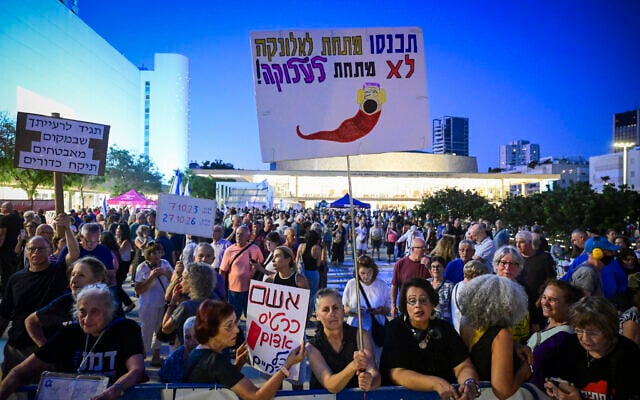
The JPPI survey found diversity among voters’ priorities going into the elections.
Some 28% picked security, while 18% picked relations between the government and the judicial system, 15% picked Israel’s progress as a more liberal state, and 13% picked unity and a reduction of internal fighting.
How the remaining 26% voted was not clear from the figures included in the press release Sunday.
Among right-wing voters, security and government-judicial relations were most important, at 40% and 30%, respectively.
Among voters who selected the latter issue, 41% support a right-wing coalition like the one governing today, while 29% support a similar coalition with the addition of centrist parties, suggesting that the typical voter for whom this is a key issue is relatively aligned with the current coalition.
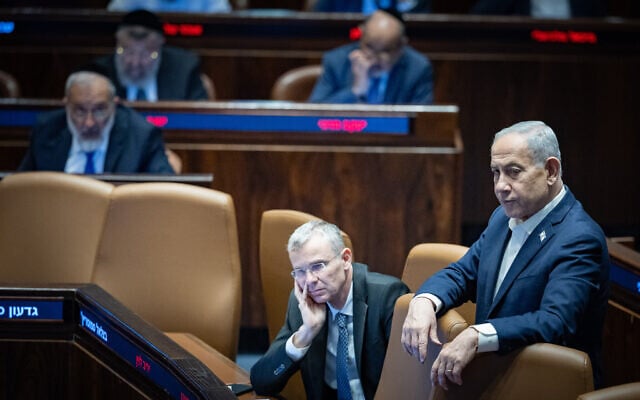
Among Arab respondents, 34% said security was the most important issue to them, while 26% picked the economy. The latter answer was far rarer among Jewish respondents, with only 5% of Jews saying the economy was the most important issue to them.
The Arab community has been devastated by a violent crime wave in recent years.
In a press release announcing the results of the poll, JPPI president Yedidia Stern said: “In previous surveys we published, we warned that the Israeli public saw the internal rift as its most central and dangerous enemy.”
“As such, we must strive for as broad as possible a coalition after the election, that can establish ‘rules of the game’ and set guidelines for what’s permitted and prohibited in the management of internal political conflicts,” Stern said, advocating a “thin constitution” formulated by experts and advanced by JPPI.
Currently, Israel lacks a formal written constitution, relying instead on a patchwork of quasi-constitutional Basic Laws.
The July 2026 survey, which has not yet been released in full, was conducted primarily by the TheMadad.com panel, with Afkar Research surveying Arab respondents, and the results were weighted according to voting pattern and religiosity to make them representative of the Israeli public.
The number of respondents and margin of error were not immediately available.

The war with Iran has been draining for all of us in Israel. But when I heard about a high casualty incident – ballistic missile impacts in Arad and Dimona that left nearly 200 people wounded – I drank a cup of coffee, packed a bag, and headed south.
There, I spoke with Shilgit, the head of an after-school program for underprivileged youth. Standing outside her destroyed center, Shilgit said it was a miracle that no children were hurt and spoke about the community coming together in the hours since.
As a Times of Israel reporter, I’m committed to telling stories of resilience like Shilgit’s. But my colleagues and I can't do this alone. If you value work like this, please consider joining our reader support group, The Times of Israel Community. Your financial support is essential to keep real human reporting like this going.
— Stav Levaton, military reporter

We’re really pleased that you’ve read X Times of Israel articles in the past month.
That’s why we started the Times of Israel – to provide discerning readers like you with must-read coverage of Israel and the Jewish world.
So now we have a request. Unlike other news outlets, we haven’t put up a paywall. But as the journalism we do is costly, we invite readers for whom The Times of Israel has become important to help support our work by joining The Times of Israel Community.
For as little as $6 a month you can help support our quality journalism while enjoying The Times of Israel AD-FREE, as well as accessing exclusive content available only to Times of Israel Community members.
Thank you, David Horovitz, Founding Editor of The Times of Israel







© All rights to the original article belong to the source. Din Online shows a headline, an excerpt and a link only. The objectivity rating is computed automatically and is an estimate only.
Discussion
No comments yet — be the first to comment.