‘Bring your sons from afar’: The decade-long operation to return Hadar Goldin’s body
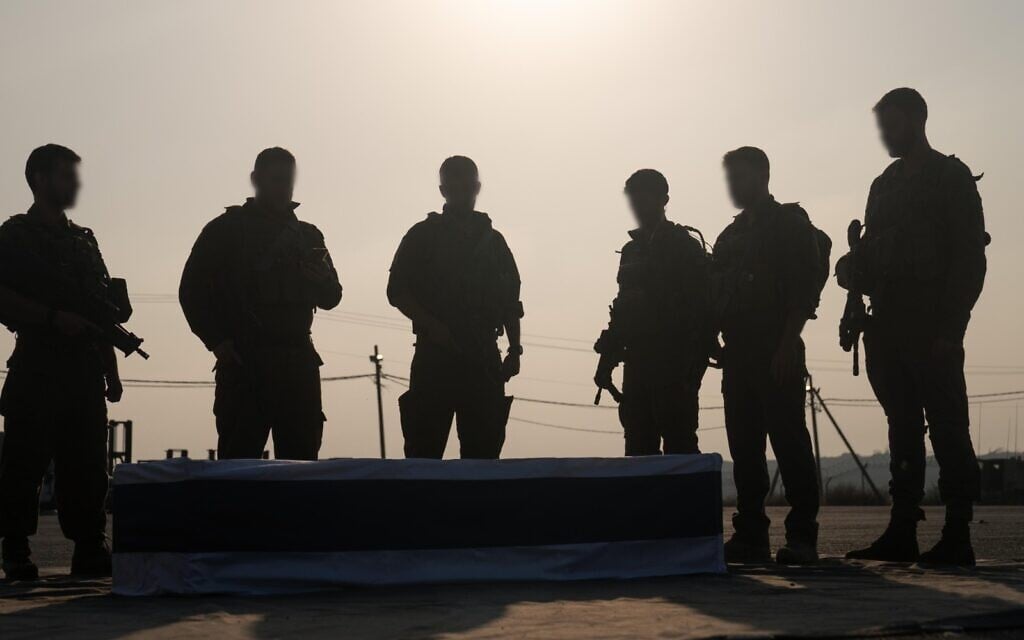

A secretive Israeli military intelligence unit spent a decade piecing together clues from special forces raids, tunnel operations, Hamas double agents and interrogations of captured Gazan medical officials to locate the body of Lt. Hadar Goldin, eventually aiding in his 2025 return for burial, according to a Saturday report.
Goldin, 23 years old at the time of his death, was killed in Gaza on August 1, 2014, during that year’s Gaza war, just over an hour after the start of a 72-hour humanitarian ceasefire. Another soldier, Oron Shaul, was killed and captured days earlier.
The next year, the Israeli military tasked Col. Mem (identified only by his first initial in Hebrew), a 51-year-old reservist officer, to build a small team to help locate the pair’s bodies and bring them back to Israel for burial, according to a Ynet report.
That unit became known as “Bring Your Sons From Afar,” a quote from the Book of Isaiah.
According to Ynet, Col. Mem had experience in hostage‑related investigations dating back to 2008, when the Shin Bet formed a special team to examine the 2006 abduction of soldier Gilad Shalit at the Gaza border. After holding several senior posts in the Intelligence Corps, Mem was called back to duty in 2015 by then–chief of IDF staff Lt. Gen. Gadi Eisenkot.
Mem created a small team with two reserve officers, identified by their initials Shin and Dalet. Over time, dozens of intelligence and operational specialists joined the effort.

“Pretty quickly we understood that our mission was to find a needle in a haystack,” Shin told Ynet.
Mem briefed Eisenkot on Hamas’s protocol for handling abducted soldiers, the report said. According to Hamas procedure, the abductors immediately transfer the body to a “separation cell,” which hides the hostage without revealing the location to the original kidnappers.
Mem told Eisenkot that his unit had intelligence that Goldin’s body was being held by Hamas’s Rafah Brigade.

A potential breakthrough then came when a Palestinian asset told the Shin Bet: “I know you contacted me because of the information I have about the location of Hadar Goldin’s body.”
But by the time the intelligence agency was able to reach the source of the information, Hamas had already compromised the asset, and tried to turn them into a double agent. The team had reached a dead end.
The team then shifted to detailed analysis of helmet‑camera footage from soldiers who had entered the tunnel systems under the area in Rafah.
The report said that the team noticed Arabic spray‑painted markings indicating the streets the tunnel ran beneath and the locations of its openings. Combined with a smoke‑mapping tactic, in which IDF engineering units pumped smoke into the tunnel and tracked where it exited, they narrowed the area where Goldin’s body was likely held.
They then assessed that Hamas might try to move Goldin’s body to a hospital or clinic to check his condition or refrigerate the body. They reviewed footage from hospitals in Rafah and identified a suspicious ambulance arriving at Youssef al‑Najjar Hospital shortly after the abduction. Several people were seen loading a large black bag into the vehicle from a house located directly above the tunnel route.

“I can’t say with certainty that it was a body, but you can see an elongated black bag,” Shin recalled to Ynet.
The team examined the hospital’s morgue and refrigeration capacity. “We checked the size of the morgue, what refrigerators were there, and activated every possible intelligence source,” Mem said.
This was the first time they identified a Hamas-affiliated doctor, Marwan al‑Hams, later the hospital’s director, as connected to the case.
Goldin was believed to be held in a tunnel whose entrance lay beneath a mosque in Rafah’s Yibna neighborhood. At the time, Israel’s political leadership did not consider a ground operation to retrieve him, even though the tunnel’s location was known, due to Prime Minister Benjamin Netanyahu’s stated policy of not escalating against Hamas in Gaza.
After the October 7, 2023, Hamas attack on southern Israel and the abduction of 251 people into Gaza, Mem rejoined the military’s hostages and missing persons headquarters, and the “Bring Your Sons Home” unit devoted most of its work to the larger effort to locate and return the hundreds of new captives.
Still, the unit urged the IDF not to bomb the area where Goldin’s remains were suspected to be held. Once the IDF began its major ground invasion of Rafah in May 2024, Mem joined special forces searching for the tunnel entrance. They found it: a multilevel underground system, of which soldiers in the elite Yahalom combat engineering unit reportedly said they had “never seen anything like it before.”

According to the military, the tunnel spanned over seven kilometers (4.3 miles), ran about 25 meters (82 feet) deep, and contained around 80 separate rooms, including spaces that Hamas operatives used for shelter for long periods of time, as well as for weapons storage and to plan attacks.
For months, troops searched room to room though the entire system. “We returned to the tunnel, dismantled the walls, and found nothing,” Mem said.
Shifting tactics again, Mem’s unit then turned to al-Hams, now the director of the Rafah hospital where Goldin’s body was believed to have been brought before being moved into the nearby tunnels.
Al-Hams, who had also served as the head of the Gaza Strip’s field hospitals, a position within the Hamas-run health ministry, was believed to have personally taken Goldin’s body down into the tunnel, preserved it, and locked it in a refrigerator behind an iron door, the report said
According to the IDF and Shin Bet, al-Hams was “involved in declaring the death” of Goldin following his abduction in the 2014 Gaza war, and was “suspected of knowing where he was buried” in the huge Hamas tunnel in the Rafah area.
Al-Hams was nabbed by undercover Israeli forces in July 2025 in southern Gaza’s Khan Younis, while he was visiting a Red Cross hospital in the area.
But during his interrogation, al-Hams revealed nothing, the report said, even after being brought back into the tunnel system by Israeli forces, who pressed him to tell them where Goldin’s body was being held.
According to the report, Israeli forces went as far so to arrest his daughter, a nurse at the Rafah hospital, in an attempt to get him to talk, though this also proved ineffective.
His daughter, Tasneem al-Hams, was released days later in the October 2025 hostage deal, which saw the release of all remaining living hostages who had been held in Gaza. The elder al-Hams was not released during the deal and is still in Israeli custody, though his exact location is unknown and he has not been charged.
Three weeks later, after Israel provided precise intelligence to Hamas of where his body was located, Goldin’s remains were returned on November 9, 2025.

He was the fifth‑to‑last hostage returned to Israel after October 7 and the final casualty of the 2014 war to come home.
In the following weeks, Hamas returned all deceased Israeli hostages, ending the October 7 hostage crisis and marking the first time that no Israelis, living or dead, were being held by terror groups in the Strip in over a decade.
Emanuel Fabian contributed to this report.

The war with Iran has been draining for all of us in Israel. But when I heard about a high casualty incident – ballistic missile impacts in Arad and Dimona that left nearly 200 people wounded – I drank a cup of coffee, packed a bag, and headed south.
There, I spoke with Shilgit, the head of an after-school program for underprivileged youth. Standing outside her destroyed center, Shilgit said it was a miracle that no children were hurt and spoke about the community coming together in the hours since.
As a Times of Israel reporter, I’m committed to telling stories of resilience like Shilgit’s. But my colleagues and I can't do this alone. If you value work like this, please consider joining our reader support group, The Times of Israel Community. Your financial support is essential to keep real human reporting like this going.
— Stav Levaton, military reporter

We’re really pleased that you’ve read X Times of Israel articles in the past month.
That’s why we started the Times of Israel – to provide discerning readers like you with must-read coverage of Israel and the Jewish world.
So now we have a request. Unlike other news outlets, we haven’t put up a paywall. But as the journalism we do is costly, we invite readers for whom The Times of Israel has become important to help support our work by joining The Times of Israel Community.
For as little as $6 a month you can help support our quality journalism while enjoying The Times of Israel AD-FREE, as well as accessing exclusive content available only to Times of Israel Community members.
Thank you, David Horovitz, Founding Editor of The Times of Israel


© All rights to the original article belong to the source. Din Online shows a headline, an excerpt and a link only. The objectivity rating is computed automatically and is an estimate only.
Discussion
No comments yet — be the first to comment.