Can they talk themselves into being comfortable with JD Vance?
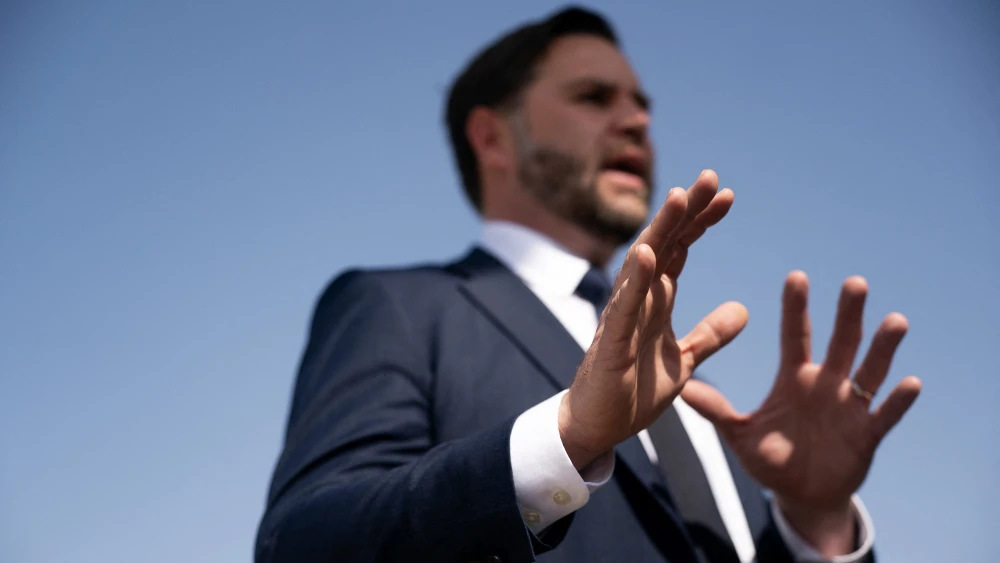

The last thing Jewish Republicans want is to find themselves in the same predicament as their Democratic counterparts. And if it means accepting a less-than-ideal candidate for president in 2028, then that is a pill they’re prepared to swallow so long as their party sticks to its basic principles and remains both opposed to antisemitism and committed to supporting the State of Israel.
As far as most are concerned, that’s the situation they face heading into the next presidential election cycle with Vice President JD Vance assuming the role of frontrunner in the GOP race. And if they’re far from completely satisfied with what Vance told an audience at the annual Republican Jewish Coalition National Leadership Summit in Las Vegas this week—and there’s no reason why they should be—they can at least console themselves that their situation is nothing like the one faced by the dwindling remnant of moderate pro-Israel Jews in the Democratic Party.

Indeed, if all anyone focuses on is what Vance said to the RJC (as opposed to what he didn’t say), then they may be right to consider that their place in the party is secure whether or not he succeeds President Donald Trump. What he told them could also lead them to believe that a prospective Vance administration would be—if not as sympathetic to Israel or as eager to fight campus antisemitism as Trump—committed to preserving the alliance and ideologically opposed to the toxic woke theories and practices that are driving Jew-hatred in 21st-century America. The points of agreement between Vance and politically conservative Jews are numerous, and his willingness to join them in expressing horror at what is happening on the other side of the aisle with the Democrats went a long way to assuring his listeners.
But the fact that Vance chose to exclude the press and forbid the recording of his remarks (even though, as both the vice president and the RJC knew would happen, myriad recordings of his appearance were made on private phones and then circulated widely on the Internet) was in and of itself a warning sign. That and the fact that Vance pointedly refused to address the most serious concerns about his candidacy and said some things that called into question the extent of Carlson’s influence on him made it obvious that what was going on wasn’t necessarily the start of a beautiful friendship. Instead, it may turn out to be a political shape-shifting act that could end badly for the Jews who talk themselves into believing that he’s a friend, rather than a potential adversary.
The veep certainly wants Jewish Republican campaign contributions and votes in 2028. But his appearance at the RJC, which was reportedly in response to their invitation and not at his request, should be seen as more an effort on the part of the group to remain relevant in the post-Trump era than a prospective presidential candidate coming to court them.
At the top of the list of issues with Vance are his close ties with the nation’s most prominent and arguably most dangerous antisemite: political commentator and podcaster Tucker Carlson. Vance pointedly refused to address the issue with the RJC, but any doubt about his refusal to disavow him was dismissed later in the week when he said as much in public and on the record.
The vice president frames the issue as both a matter of personal integrity and opposition to the troubling politicization of relationships in the era of Donald Trump. But while he can be applauded for his ideas about not blowing up friendships over politics and the toxic nature of cancel culture, this deliberately misses the point about his connection to Carlson.
The issue here isn’t about a political faction demanding that he be mean to an old pal. It’s about a deliberate stance in which, as he first made clear at the Turning Point USA AmericaFest last December, Vance won’t write off Carlson’s antisemitic followers. He may now speak of his disagreement with Carlson over many issues, including Israel, and, most recently, the former Fox News host’s endorsement of Michigan Democratic Senatorial nominee, Dr. Abdul El-Sayed, because of their mutual embrace of Jew-hatred.
But as long as Vance maintains that Carlson and his antisemitic followers must be included in the GOP “big tent”—a stance Trump doesn’t share—then Jews and the vast majority of pro-Israel Republicans who aren’t Jewish would be faced with a very different reality if he is elected president. Their views would be but one among many constituencies that a President Vance would consider, including those who view Jews with intense hostility, suspicion and even outright antipathy.
Nor should voters accept the notion that Vance considers his bond with Carlson to transcend political differences. No one should care if he doesn’t let disagreements with a close personal friend over tax rates, tariffs or even geostrategic issues like the war on Iran interfere with such a relationship. The problem is Vance’s apparent belief that Carlson’s rabid antisemitism, coupled with his platforming and endorsement of some of the most vicious tropes of Jew-hatred, falls within the proverbial Overton Window of issues about which reasonable people should be expected to agree to disagree.
People who spread antisemitism the way Carlson has done the past few years once he began podcasting on his own network after his firing from Fox News ought to be beyond the pale. And when a potential president signals that a rabid Jew-hater is still his buddy, it sends a message to the country and the world that prejudice against Jews is OK.
It’s true, as Vance alluded to at the RJC, that there is a growing constituency, especially among young conservatives who don’t view the U.S.-Israel alliance with the same instinctual support the way older Americans do. He’s not wrong that the pro-Israel community must find ways of reaching these people. But the issue isn’t only teaching them, as he noted, about the amazing benefits that the United States derives from its ties with Israel. It’s that all too many of them have been indoctrinated—either by the teachings of woke leftists who dominate the education system or the influence of people like Carlson—to believe that Israel and the Jews are intrinsically evil.
Vance assures us that he doesn’t share those beliefs, and we hope that’s true. And he was willing to denounce by name the neo-Nazi groyper Nick Fuentes (who has been platformed and given a softball interview by Carlson), though that may have more to do with the vile podcaster’s personal attack on the vice president’s family than anything else.
Still, by continuing to treat Carlson—and others who share his opinions or who have been influenced by them—as persons who shouldn’t be considered beyond the pale, Vance has been materially contributing to the mainstreaming and normalization of toxic ideas that he claims to oppose.
Also unaddressed in the RJC event, where he was tossed the softest of softball questions by former Minnesota Sen. Norm Coleman, was how Vance has emerged as the leading Israel critic in the administration during the current war on Iran. The vice president has variously accused Israel of trying to manipulate U.S. opinion on the war and echoed conspiracy theories about pedophile Jeffrey Epstein being connected to Israeli intelligence.
His words that disingenuously admonished Israelis—telling them they can’t “kill [their] way out of security threats”—also raised alarm bells about him in the pro-Israel community. He has further seemed to be taking a position on Tehran that resembled the Obama administration’s appeasement of the Islamist regime more than that of Trump’s position. But he wasn’t asked about any of that.
Also of concern was one thing he did say in the course of a convoluted attempt to show his opposition to antisemitism.
Vance confused the concept of a “blood libel” with that of “blood guilt.” A blood libel is when Jews are falsely accused of horrible crimes, such as the current accusation hurled by people like Carlson and his counterparts on the left that Israelis are committing a “genocide” against Palestinian Arabs in Gaza. Blood guilt has to do with the deicide myth in which Jews are wrongly held responsible for the death of the Christian messiah, something that has been used to justify antisemitism down through the ages.
By claiming that Jews are hated today because of “blood guilt,” rather than because of “blood libels,” it made it appear as if the highly educated and intellectual Vance knows very little about the subject. But since “blood guilt” is something that Carlson likes to talk about, it was more evidence that the podcaster has more influence on his close friend than those who want to minimize the relationship care to admit.
Where does that leave the Jewish Republicans?
Let’s start by conceding that the situation among them is nothing like what’s going on in the Democratic Party, where its intersectional left-wing base has made hatred for Israel a key organizing principle of their political efforts.
Jewish Republicans aren’t being purged the way their liberal counterparts have been treated by the party that the majority of American Jews still calls home. Leading Jewish Democrats like Senate Minority Leader Chuck Schumer have felt constrained to endorse antisemites like El-Sayed. Others, like Michigan Attorney General Dana Nessel, have sunk so low as to advise their fellow Jews that victory for the Democrats is so important that it was worth sacrificing the existence of Israel and the Jewish people as a whole to achieve it.
Jewish Republicans can console themselves that their party has rejected its antisemitic groyper wing in primaries. The GOP will be even more pro-Israel in the next Congress than in the current one due to those results. Meanwhile, the Jew-haters in the other party, including the increasingly dominant Democratic Socialists of America, are winning election after election and look to largely control the Democratic caucuses in the next Congress.
But should Vance be their nominee in 2028 and win, the influence of figures linked to Qatar, who are also supporting the vice president while also financing Carlson’s network, could wind up being a lot more important than the views of the RJC.
If so, then we may look back at the attempt to portray Vance as a friend of Israel and the Jewish people the same way we regard the sales job done by then presidential candidate Barack Obama in 2008 when he was wooing Jewish Democrats. He, too, had associations, beliefs and statements that rightly worried Jews and others who cared about the U.S.-Israel relationship. But so successful was his effort to pull the wool over the eyes of those who were eager to support him that even after eight years of Israel-bashing, appeasement of Iran and sowing the seeds of the Democrats’ current embrace of antisemitism, many Jews still revere him.
Indeed, so complete was his mastery of the art of persuasion that after a first term that alarmed the pro-Israel community, Obama was able to execute a Jewish charm offensive in 2012 before pivoting again to attempt a rapprochement with Iran.
History doesn’t repeat itself. Nor does it rhyme. The situation with Vance is different.
He is clearly not as invested in a view of Israel and the Jews that was connected to settler-colonialism ideology as was Obama. While Obama had mentors and people with influence in his orbit hostile to Jewish interests, like former terrorist Bill Ayers and the Rev. Jeremiah Wright, he didn’t have a close friend quite like Carlson. And Vance also doesn’t have Obama’s knowledge of Jewish politics and ideas. Unlike Trump, who knew the pro-Israel community well from a life spent in New York real estate (though he remains baffled by Jews who don’t prioritize support for the Jewish state), Vance is clearly at sea when it comes to understanding American Jews.
In one sense, the RJC’s effort to build bridges with Vance may be sound political strategy. Politics is always a matter of difficult choices, and there’s no question that the Democrats are—and likely will be for the foreseeable future—worse for the Jews. The Republican Party as a whole remains solidly pro-Israel and aligned against the antisemitism that has taken hold of their rivals.
If Vance wins, they need to be able to claim that they did their best to support him and be able to claim a place at the table in the next GOP administration. However, if Israel and Jew-haters are allowed to sit at the table alongside them, they will never be able to trust him or really feel at home in an administration where Carlson and his followers are also welcome.
Jonathan S. Tobin is editor-in-chief of JNS. Follow him: @jonathans_tobin.


Get the latest updates in our WhatsApp group.






Jewish Republicans are grappling with whether to support Vice President JD Vance as a potential 2028 presidential candidate, despite his close ties to political commentator Tucker Carlson. At the Republican Jewish Coalition (RJC) National Leadership Summit in Las Vegas, Vance reportedly avoided addressing concerns about Carlson's antisemitic views, and his remarks were not open to the press. While Vance expressed horror at the Democratic Party's stance and committed to preserving the U.S.-Israel alliance, his refusal to disavow Carlson, whom he considers a friend, raises significant issues for many Jewish Republicans. Critics argue that Vance's stance normalizes antisemitism and that his understanding of Jewish issues, such as confusing "blood libel" with "blood guilt," appears limited. Furthermore, Vance has been identified as a leading critic of Israel within the administration, making statements that have caused alarm in the pro-Israel community.
© All rights to the original article belong to the source. Din Online shows a headline, an excerpt and a link only. The objectivity rating is computed automatically and is an estimate only.
Discussion
No comments yet — be the first to comment.