Coalition secures $82.6m for ultra-Orthodox education; opposition alleges ‘theft’
Sam Sokol is the Times of Israel's political correspondent. He was previously a reporter for the Jerusalem Post, Jewish Telegraphic Agency and Haaretz. He is the author of "Putin’s Hybrid War and the Jews"

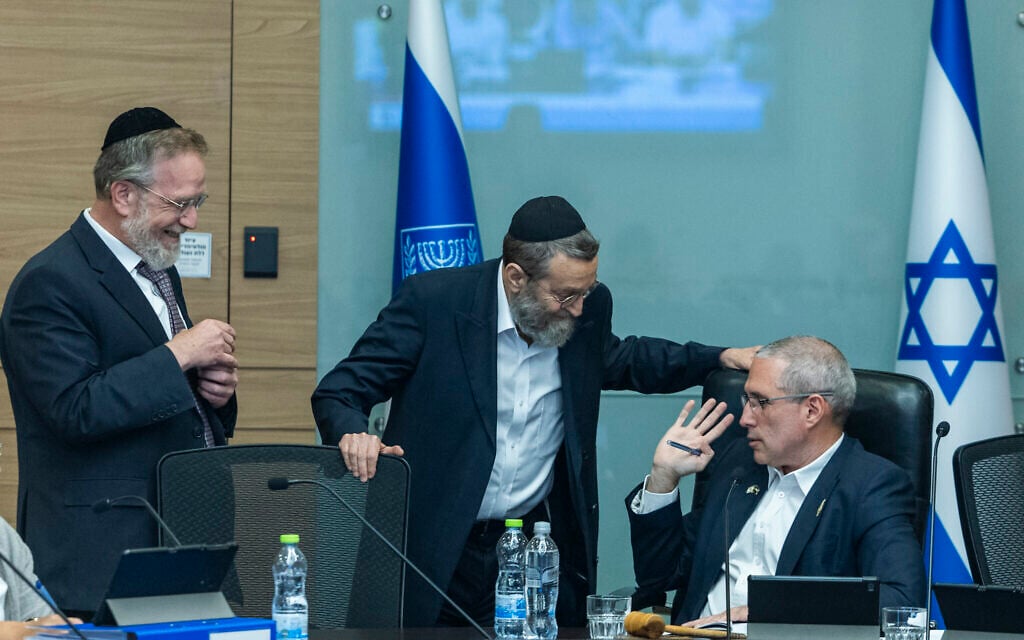
Following hours of acrimonious debate, the Knesset Finance Committee voted on Tuesday to approve the allocation of over a quarter billion shekels ($82.6 million) in coalition funds to the ultra-Orthodox education system despite a legislative recess that started last month.
The move drew immediate rebuke from the opposition, with Democrats MK Naama Lazimi telling the committee that the the funding was simply “theft from the serving public,” a reference to those who serve in the military and pay taxes.
Overall, the committee approved more than NIS 267 million ($88 million), including over NIS 12.5 million ($4 million) for Haredi culture as well as millions for transportation for students of Haredi party-affiliated school networks, teacher training and “coordination and liaison bodies” — an apparent reference to the Vaad HaYeshivot (Yeshiva Committee), a body that has encouraged draft evasion.
The funds also include some NIS 26 million ($8.5 million) for preventing Haredim from dropping out of yeshivas, despite a 2025 announcement that the government would no longer finance the education of ultra-Orthodox youths who are studying at so-called “drop-out yeshivas” and refuse to enlist in the IDF for their mandatory service.
Drop-out yeshivas are institutions designed to keep Haredi men who are not interested in full-time religious study within an ultra-Orthodox framework, to prevent them from leaving the community.
The committee also authorized funding for yeshivas that encourage military service as well as Haredi hesder yeshivas, which combine military service with Torah study and are largely affiliated with the national religious community.

Calling the vote a “significant achievement,” Degel HaTorah chairman Moshe Gafni stated that “even in these complex times, when the world of Torah and education is facing difficult challenges, it is our duty to continue to care for Israel’s children and the Haredi education system. The budgets approved today are important news… and will help correct distortions and close gaps that have persisted for years.”
The funding was approved despite the fact that only a small fraction of ultra-Orthodox boys’ elementary schools teach core curriculum subjects as required by law.
Opposition lawmakers on the Finance Committee had temporarily managed to block the massive funding allocations for Haredi education, as well as for the Settlements Ministry, with a filibuster in a marathon session last Wednesday that extended past the 10 hours allowed for parliamentary meetings during a recess.
The Knesset House Committee had designated the Wednesday session ahead of time as the last one of the recess period in which items could be put on the Finance Committee agenda without prior agreement between the opposition and coalition.

But on Sunday, after unspecified “heavy pressure” from the coalition, Knesset legal adviser Sagit Afik said the Finance Committee could reconvene to vote on the timed-out amendments.
The Finance Committee has previously sought to divert funds to Haredi institutions despite legal and procedural objections. In March, it approved nearly NIS 100 million ($32.75 million) for Haredi educational institutions as part of a broader NIS 1 billion ($331 million) transfer that had been frozen by the High Court of Justice in December, after opposition lawmakers argued that the government was funding schools that do not teach the core curriculum required by law.
Haredi parties demanded massive cash infusions following a landmark June 2024 High Court ruling that found the decades-long Haredi exemption from military service lacked legal basis. The ruling led to the abrogation of certain Haredi social benefits.
Several pieces of legislation aimed at enshrining the ultra-Orthodox military exemptions were pushed through in the final days of the Knesset, but they have since been frozen by the Supreme Court.
Tens of thousands of ultra-Orthodox men aged 18 to 24 are currently eligible for military service but have ignored conscription orders, despite manpower shortages in the army and widespread anger among the general population over an unequal sharing of the burden of defending the country.

The war with Iran has been draining for all of us in Israel. But when I heard about a high casualty incident – ballistic missile impacts in Arad and Dimona that left nearly 200 people wounded – I drank a cup of coffee, packed a bag, and headed south.
There, I spoke with Shilgit, the head of an after-school program for underprivileged youth. Standing outside her destroyed center, Shilgit said it was a miracle that no children were hurt and spoke about the community coming together in the hours since.
As a Times of Israel reporter, I’m committed to telling stories of resilience like Shilgit’s. But my colleagues and I can't do this alone. If you value work like this, please consider joining our reader support group, The Times of Israel Community. Your financial support is essential to keep real human reporting like this going.
— Stav Levaton, military reporter

We’re really pleased that you’ve read X Times of Israel articles in the past month.
That’s why we started the Times of Israel – to provide discerning readers like you with must-read coverage of Israel and the Jewish world.
So now we have a request. Unlike other news outlets, we haven’t put up a paywall. But as the journalism we do is costly, we invite readers for whom The Times of Israel has become important to help support our work by joining The Times of Israel Community.
For as little as $6 a month you can help support our quality journalism while enjoying The Times of Israel AD-FREE, as well as accessing exclusive content available only to Times of Israel Community members.
Thank you, David Horovitz, Founding Editor of The Times of Israel


The Knesset Finance Committee approved 82.6 million dollars in coalition funds for the ultra-Orthodox education system, drawing criticism from the opposition. MK Naama Lazimi called the funding "theft from the serving public." Additionally, the committee allocated 52 million dollars in direct funding and 47 million dollars in commitment authorizations to the Settlements Ministry. Left-wing activists protested these allocations, asserting the coalition was funding "Jewish terrorism." The committee also approved 109 million dollars for communities along the Lebanon border and 26 million dollars to the Religious Services Ministry. Degel HaTorah chairman Moshe Gafni called the vote a "significant achievement," stating, "it is our duty to continue to care for Israel’s children and the Haredi education system." The funding includes allocations for Haredi culture, transportation, teacher training, and preventing yeshiva dropouts, despite previous government announcements to cease funding for ultra-Orthodox youths who refuse military service.
© All rights to the original article belong to the source. Din Online shows a headline, an excerpt and a link only. The objectivity rating is computed automatically and is an estimate only.
Discussion
No comments yet — be the first to comment.