Cornell denounces student’s viral antisemitic remarks, but won’t bar him from campus
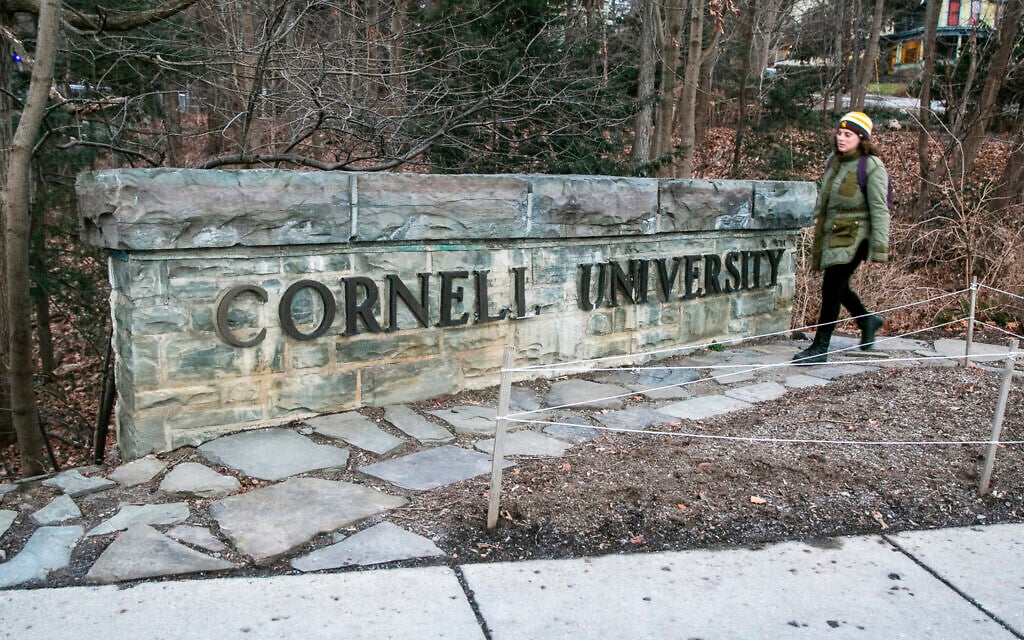
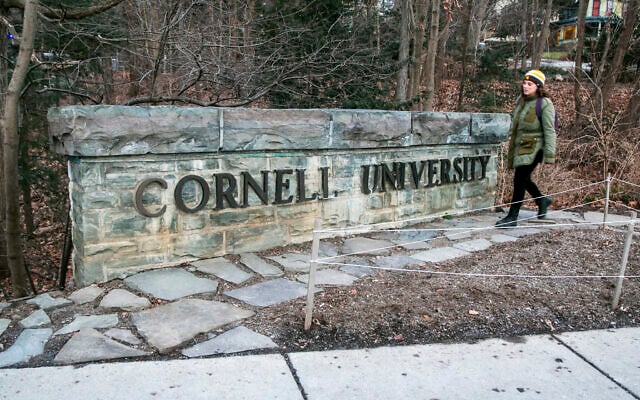
JTA — Cornell University is condemning viral antisemitic remarks made by an undergraduate student who appeared on “Piers Morgan Uncensored” earlier this week, but the school’s president says no further action is planned against the student.
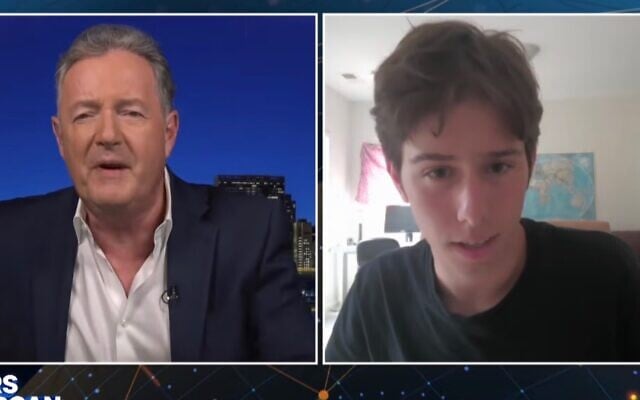
During his appearance, the student, Austin Franco, defended his statement in June that he did not want to work with Jews, saying that he did not like most of the Jews he had met. The remark was made in a private message that the company that received it publicized.

“As a university built on the solid foundations of our nation’s democratic freedoms, Cornell has an obligation to fiercely defend freedom of speech — even when we find that speech abhorrent,” Cornell’s president, Michael Kotlikoff, said in a statement issued late Wednesday, shortly after the Jewish Telegraphic Agency reached out to the school for comment on Franco.
“The student’s public comments invoked hateful generalizations and uninformed tropes with a long, ugly history of harm,” Kotlikoff said, adding that “antisemitism generally” is “detestable, ignorant, and fully at odds with the values of the Cornell community.”
Kotlikoff, who is Jewish, did not mention Franco by name in his statement, citing federal privacy law, nor did he specify which of Franco’s comments about Jews the school found objectionable.
His comments once again place Cornell on the front line in tensions over antisemitism at colleges and universities. The school reached a $60 million settlement with the Trump administration last year to resolve antisemitism claims and regain $250 million in funding that had been frozen over campus unrest in the wake of Hamas’s October 7, 2023, attack on Israel.
Cornell was one of the earliest schools to face antisemitism allegations after October 7, 2023, when a professor spoke at a pro-Palestinian rally and said he had been “exhilarated” by the Hamas-led attack against southern Israel, in which more than 1,200 people were killed and 251 were taken hostage.
But the latest incident involving Franco had little to do with the subsequent war in Gaza until Tuesday, when the student told Morgan on his YouTube show that he objected to Jews in part because of Israel, which he deemed “a genocidal country.”
The controversy over Franco, a rising junior at the Ivy League university in Ithaca, New York, began in June when he wrote in an internship application that he was “not interested in working for a jew.”
His name and remarks were publicized by the Jewish co-owners of Handshake, the tech company to which Franco had applied for an internship, though Franco has claimed he’d already turned down an offer. His comments prompted online backlash — including from Leo Terrell, the Trump administration’s antisemitism czar, who posted dozens of times about the 19-year-old.
Franco has garnered significant support from the far right, including through a crowdfunding campaign initiated by a YouTuber who had previously drawn criticism for saying he hoped to see “another Hitler.” Franco’s comments to Morgan included positive references to “America First,” the Trump-led nativist movement embraced by the far right.
Cornell had announced it was opening an investigation into Franco when his comments were first publicized. He remained in the headlines after he was secretly filmed by an apparent sting operation led by Accuracy in Media, a right-wing activist group that has targeted pro-Palestinian students and university heads the group deems antisemitic on other campuses. Franco told a hidden camera interviewer connected to the group last week that the university’s investigation had amounted to little and that he would be returning to Cornell.
Asked by Morgan Tuesday to explain his beliefs, Franco said that a Jewish friend of his at Virginia Tech University, where he was enrolled before transferring to Cornell, “said we should genocide all Palestinians.” He named other “bad experiences with Jews” he claimed to have experienced in college, focusing on Jewish campus figures he said had “made things up about me,” and said Jews had “made my life a living hell.”
As Morgan pushed Franco to admit he was antisemitic, the student insisted he was not.
“Not wanting to be around Jewish people does not mean you don’t like them,” he said, adding that one of his exes “was half-Jewish.” He returned to Israel later in the conversation, charging that it is a Jewish-led “genocidal country” that insists upon “killing Palestinians and reporters and dragging America into wars abroad.” He concluded, “No, I am not going to want to associate with those people.”
“This is a common sentiment that is held,” Franco said. “If you think this is just me, you are completely wrong.”
Morgan, for his part, concluded, “You kind of made yourself unemployable.”
Franco is facing more immediate consequences, he announced on X on Wednesday. “My parents are kicking me out,” he tweeted, drawing offers of support from a handful of prominent far-right personalities.
Like many other schools that faced unrest after October 7, Cornell has taken steps aimed at countering campus antisemitism while attempting to balance academic freedom concerns, in part as a result of its settlement with the Trump administration. The university commissioned an antisemitism task force and has undertaken several initiatives, including new campus climate surveys and stricter Title VI enforcement. It has also enforced a range of disciplinary actions against pro-Palestinian students.
But when it comes to Franco, one Jewish faculty member at Cornell theorized, the administration’s hands were tied.
“You sort of have to live with it,” Menachem Rosensaft, a visiting professor at Cornell Law School and former general counsel for the World Jewish Congress, told JTA. “He is engaging in obnoxious thought that is not harming anyone else.”
Rosensaft has been at the center of other antisemitism-related controversies at Cornell, including in 2024, when he prompted Kotlikoff to criticize another Jewish professor’s planned class on Gaza — an action that the school’s faculty union said was a violation of academic freedom.
In the case of Franco, Rosensaft argued that Cornell shouldn’t “turn him into a First Amendment martyr.”
But Rosensaft added that there could be grounds for discipline if Franco returned to campus and made harmful comments about Jews in the classroom or in other public spaces.
In 2025, Jonathan Greenblatt, the CEO of the Anti-Defamation League, praised Kotlikoff for what he called “a comprehensive approach to countering antisemitism.” An ADL spokesperson did not return a JTA request for comment on Cornell’s latest statement about Franco.
Franco himself has launched a second crowdfunding campaign to support his housing costs.
“I have reiterated that my parents do not share my views, and it seems they no longer wish to provide me with a home to live in,” he wrote in the description. “I know the road ahead will be difficult, but this is the path I chose. I could have lived a more conventional life, as my parents did, and perhaps in a different time I would have. However, that is not the world we live in today, and because of that, I chose a different path than most.”

The war with Iran has been draining for all of us in Israel. But when I heard about a high casualty incident – ballistic missile impacts in Arad and Dimona that left nearly 200 people wounded – I drank a cup of coffee, packed a bag, and headed south.
There, I spoke with Shilgit, the head of an after-school program for underprivileged youth. Standing outside her destroyed center, Shilgit said it was a miracle that no children were hurt and spoke about the community coming together in the hours since.
As a Times of Israel reporter, I’m committed to telling stories of resilience like Shilgit’s. But my colleagues and I can't do this alone. If you value work like this, please consider joining our reader support group, The Times of Israel Community. Your financial support is essential to keep real human reporting like this going.
— Stav Levaton, military reporter
We’re really pleased that you’ve read X Times of Israel articles in the past month.
That’s why we started the Times of Israel – to provide discerning readers like you with must-read coverage of Israel and the Jewish world.
So now we have a request. Unlike other news outlets, we haven’t put up a paywall. But as the journalism we do is costly, we invite readers for whom The Times of Israel has become important to help support our work by joining The Times of Israel Community.
For as little as $6 a month you can help support our quality journalism while enjoying The Times of Israel AD-FREE, as well as accessing exclusive content available only to Times of Israel Community members.
Thank you, David Horovitz, Founding Editor of The Times of Israel







Cornell University has condemned antisemitic remarks made by undergraduate student Austin Franco but will not bar him from campus, citing freedom of speech. Franco, who appeared on "Piers Morgan Uncensored," defended his June statement that he did not want to work with Jews, later adding that he objects to Jews due to Israel being a "genocidal country." Cornell President Michael Kotlikoff stated, "The student’s public comments invoked hateful generalizations and uninformed tropes with a long, ugly history of harm," but emphasized the university's obligation to defend free speech. This incident follows a $60 million settlement Cornell reached with the Trump administration last year over antisemitism claims. Franco has since announced his parents are kicking him out, prompting a crowdfunding campaign for housing.
© All rights to the original article belong to the source. Din Online shows a headline, an excerpt and a link only. The objectivity rating is computed automatically and is an estimate only.
Discussion
No comments yet — be the first to comment.