יום שישי, אוגוסט 21, 2026 עברית|English Log in Free sign-up
LIVE
Renowned IDF paratrooper, architect of Kurdish relations, Tzuri Sagi dies aged 92Eisenkot leaps ahead as Likud support falters, projected to win 26 Knesset seats – pollFreed hostages join tens of thousands for Selichot prayers at Western WallPentagon spokesperson says claims of US munitions shortage amid Iran war 'false' – reportICE allegedly accelerated Iranian deportations during US-Iran war, NIAC claimsCharter plane carrying 8 crashes near remote site in western Alaska – reportPeltola campaign mum about whether she stands by her pro-Israel record in the HouseIsraeli settler attacks shift to heart of territory earmarked for Palestinian stateEditor's Notes: In era of Jewish uncertainty, Israel must rework its relationship with DiasporaDiplomacy becomes essential national security tool to combat Turkey's growing strength- editorialDid Netanyahu’s ‘Islamic Republic’ barb harm UK ties?The Blogs: Israel Advocacy Must Be Bigger Than PoliticsRenowned IDF paratrooper, architect of Kurdish relations, Tzuri Sagi dies aged 92Eisenkot leaps ahead as Likud support falters, projected to win 26 Knesset seats – pollFreed hostages join tens of thousands for Selichot prayers at Western WallPentagon spokesperson says claims of US munitions shortage amid Iran war 'false' – reportICE allegedly accelerated Iranian deportations during US-Iran war, NIAC claimsCharter plane carrying 8 crashes near remote site in western Alaska – reportPeltola campaign mum about whether she stands by her pro-Israel record in the HouseIsraeli settler attacks shift to heart of territory earmarked for Palestinian stateEditor's Notes: In era of Jewish uncertainty, Israel must rework its relationship with DiasporaDiplomacy becomes essential national security tool to combat Turkey's growing strength- editorialDid Netanyahu’s ‘Islamic Republic’ barb harm UK ties?The Blogs: Israel Advocacy Must Be Bigger Than Politics
World

Did Netanyahu’s ‘Islamic Republic’ barb harm UK ties?
4h ago ·  Source: JNS 86Objectivity score86/100

Did Netanyahu’s ‘Islamic Republic’ barb harm UK ties?

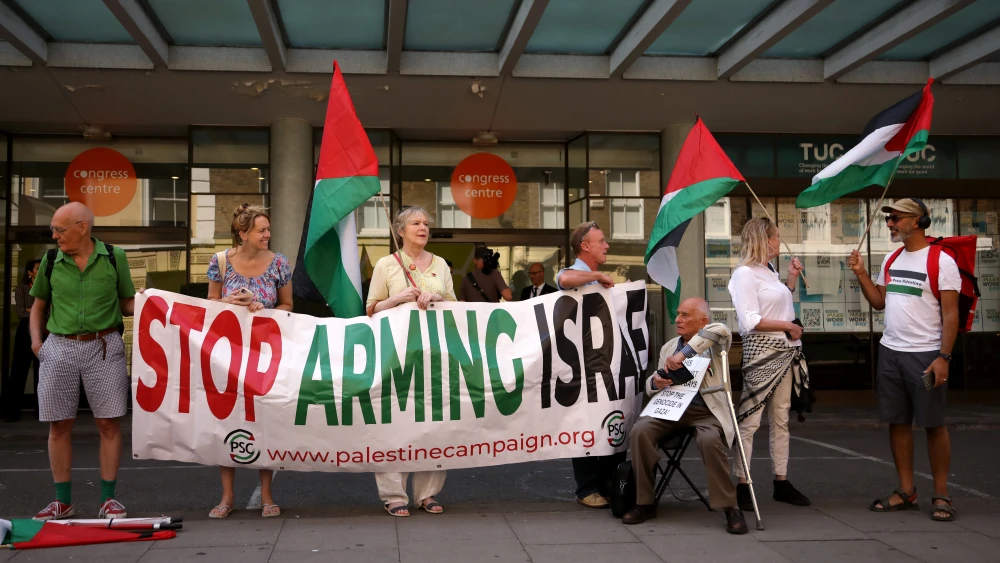
Anti-Israel protesters hold a banner and wave flags outside the Trades Union Congress ahead of Andy Burnham's arrival in London on July 17, 2026. Photo by Alishia Abodunde/Getty Images.
Canaan Lidor
Canaan Lidor

Following Israeli Prime Minister Benjamin Netanyahu’s sarcastic reference last week to the U.K. as “the Islamic Republic of Britain,” critics in both countries accused him of damaging bilateral relations at a sensitive time.

However, longtime observers of U.K.-Israeli relations told JNS this week that the controversy occurred at such a low point in bilateral ties that, rather than damaging them, Netanyahu’s remark merely reflected how the once-strong relationship had been hollowed out amid growing hostility toward Israel in Britain.

A U.K. government spokesman called Netanyahu’s remark “completely unacceptable,” adding that London had raised it with Jerusalem. Avi Dabush, an Israeli left-wing activist running for the Knesset with The Democrats Party, said Netanyahu had “mocked a critical ally” amid “unprecedented global isolation.” The Movement for Progressive Judaism in the U.K. also distanced itself from Netanyahu’s comments, saying he “doesn’t speak for U.K. Jews.”

Netanyahu’s remarks followed a long decline in relations that means the “U.K. is no longer a friend of Israel—and under Prime Minister Andy Burnham, we may become a foe,” Lord Stuart Polak, a Conservative member of the House of Lords, told JNS on Tuesday.

Thousands of people join an anti-Israel march leaving Exhibition Road in London on May 16, 2026. Photo by Guy Smallman/Getty Images.

Israel, he added, “hasn’t changed its position in relation to Britain. It’s Britain that’s decided to believe everything that’s being spouted about so-called genocides, and, as a result, the relationship has soured.”

Polak, who is Jewish, is a former member of the House of Lords’ E.U. Security and Justice Sub-Committee.

Samuel Hayek, the chairman of JNF UK, a major Zionist charity in Britain, said Netanyahu’s formulation was “a phrase that many Britons use about their country.

“It was said during an election campaign [in Israel], and as such, sure, it’s not helpful for promoting bilateral ties with the U.K. But has it hurt ties in any way? Has it changed anybody’s mind, here or there, after the Labour-led degradation of ties? I really don’t think so,” Hayek told JNS.

Steve Winston, managing director of the National Jewish Assembly, a U.K.-based organization dedicated to promoting Jewish life and supporting Israel, said that “Netanyahu’s comment will certainly not have been received well in Whitehall,” where “it seems that, regardless of policy etc, any Israeli leader will always come under fire.”

Still, Winston said, Netanyahu’s provocative statement reflected a desire to hit back at Britain only after relations had deteriorated to the point that they had become a shadow of their former self.

A fresh diplomatic row on Thursday illustrated that deterioration.

British Foreign Secretary Ed Miliband declared that “Britain will not stand back and accept the destruction of the two-state solution” after Israel published tenders for construction in the E1 corridor east of Jerusalem.

Israeli Prime Minister Benjamin Netanyahu attends a state ceremony reburying Shimon and Rivka Herzl, the grandparents of Theodor Herzl, founder of modern political Zionism, alongside their grandson on Mount Herzl, in Jerusalem. Their remains were brought back to Israel from Belgrade. Aug. 5, 2026. Photo by Chaim Goldberg/FLASH90.

Miliband said the impact of “settler violence and terrorism” had been “catastrophic” for Palestinian communities and vowed that Britain would introduce additional measures against Israeli government policies.

His Israeli counterpart, Gideon Sa’ar, rejected the remarks as “patronizing,” adding that Jews have the right to live throughout the Land of Israel, “just as the British have the right to live in London and throughout the United Kingdom.”

The exchange was the latest in a series of confrontations that began under the Conservative government and accelerated after Labour came to power.

The deterioration began immediately after Oct. 7, 2023, when the Conservatives were still governing under then-Prime Minister Rishi Sunak, Winston said. He cited calls driven by the opposition, which Labour then led, for the government to demand that Israel refrain from pursuing its campaign against Hamas in Gaza.

Relations deteriorated further after Labour’s Keir Starmer replaced Sunak as prime minister in 2024. Starmer had presented himself as a centrist after succeeding former Labour leader Jeremy Corbyn, a radical, anti-Israel left-winger who had been accused of fanning the flames of antisemitism in the U.K.

For the following two years, the Labour government repeatedly clashed publicly with Israel, Polak said. He attributed this policy partly to Britain’s changing political landscape and to efforts to appeal to new demographics amid large-scale Muslim immigration.

Starmer’s government also used increasingly forceful language about Israel, including a July 29, 2025, call for it to “stop the slaughter” in Gaza. The phrase echoed rhetoric used by anti-Israel protesters who had gathered by the thousands in London to demonstrate against the Jewish state.

In September 2025, Britain recognized a Palestinian state, alongside Australia and Canada. France also recognized one that year. The decision followed Britain’s suspension of roughly 30 arms-export licenses covering equipment deemed potentially usable in Israel’s military operations against Hamas in Gaza.

Britain's Prime Minister, Andy Burnham, speaks to the media, as he visits Wolverhampton Bus Station in Wolverhampton, England on Aug. 18, 2026. Photo by Hannah McKay - WPA Pool/Getty Images.

“When Britain recognized a Palestinian state while hostages remained in Gaza, rewarding terrorism, that was the decisive watershed moment,” Winston said.

Another nadir came in June 2025, when Britain sanctioned Israeli Finance Minister Bezalel Smotrich and National Security Minister Itamar Ben-Gvir, imposing travel bans and asset freezes over what it described as repeated incitement of violence against Palestinians.

Winston characterized the sanctions differently. Britain had long opposed Israeli settlement in Judea and Samaria, he said, but its decision to target senior elected Israeli officials over policies that did not directly concern the U.K. amounted to a diplomatic intervention that “made constructive dialogue very difficult.”

Despite the diplomatic deterioration and the partial suspension of arms-export licenses, commercial relations remained comparatively resilient.

Bilateral trade in goods remained steady at approximately $4 billion annually, according to Israeli government data. Divided roughly evenly between imports and exports, that commerce made the U.K. Israel’s eighth-largest individual trading partner in 2025, two places ahead of India.

An additional $2 billion in services was exchanged between Israel and the U.K. that year.

Although trade remained robust, Polak and Winston argued that the diplomatic deterioration was increasingly reflected in British institutions and society.

For months, British police did not intervene as calls to “globalize the intifada” echoed through the streets of London, Manchester and elsewhere, Winston noted. Protesters were allowed to demonstrate against Israel outside synagogues.

A separate controversy erupted in Birmingham after Israeli soccer fans were barred from a 2025 match between Maccabi Tel Aviv and Aston Villa. An independent review subsequently found that West Midlands Police had exaggerated the threat posed by the Israeli fans, relied on inaccurate information and failed to adequately consider the risks facing them.

The BBC, which has long faced allegations of promoting anti-Israel narratives, broadcast thousands of people at the Glastonbury music festival chanting “Death to the IDF” at the encouragement of Pascal Robinson-Foster, a rapper from the duo Bob Vylan.

Robinson-Foster also encouraged his listeners “not to give up your dreams,” even if they were now “working for Zionists,” as he said he had done earlier in his career.

The institutional controversies unfolded against the backdrop of a sharp rise in antisemitic violence and hate speech in Britain.

On Oct. 2, 2025, a jihadist attacked a synagogue in Manchester, killing two people.

The Community Security Trust, British Jewry’s antisemitism watchdog, recorded 1,662 antisemitic incidents in 2022. That figure rose to 4,298 in 2023, followed by 3,556 incidents in 2024 and 3,700 in 2025.

As the climate darkened toward Israel and “Zionists”—a term many British Jews interpret as an antisemitic euphemism for Jews—Netanyahu and others warned that the growth of antisemitism was linked to British government policies.

“They were accused of weaponizing antisemitism,” Winston said. “Yet many British Jews and others knew otherwise.”

The situation has caused some British Jews to question the future of their communities in the U.K. and, in some cases, to leave.

Last year, 872 Britons immigrated to Israel—a 40-year high, according to The Jewish Chronicle. In 2021 and 2022, Israel received 572 and 681 newcomers from the U.K., respectively.

“We have been concerned about what’s happening in the U.K. for quite a few years now,” Jeremy Jacobs, a former chief executive of the United Synagogue, told JNS in a May interview about his aliyah.

The United Synagogue supports 56 Orthodox synagogues in Britain.

“What happened after Oct. 7 only confirmed to us that leaving was the right decision,” Jacobs said.

Polak said he understood that sentiment but argued that the situation remained reversible, depending on what information was prioritized in the media and elsewhere.

“I do wonder whether there is a future here for my kids and grandkids. Of course, while they’re here, I’ll be here. If they go elsewhere, so will I,” he said.

“I’m very proud to be British. But I’m also very proud to be Jewish. We live a good life here. But some would argue that the writing’s on the wall. So that’s difficult.”

Ultimately, Polak said, “if you could get the right information across, and if the great people of Britain could be made to understand certain things, then, yeah, of course things could be changed.”

“British Jews have no future—or, in any case, no significant future—in the U.K.,” he said.

Hayek attributed that outlook to demographic change resulting from a low birthrate among native Britons and the arrival of millions of immigrants, many of them Muslim.

“U.K.-Israeli relations have ebbed and flowed, including in 1973, when the U.K. imposed an arms embargo,” he said. “But Britain is not the same Britain anymore. Millions of Muslims mean different politics. This is the direction. There will be no reversal. It will only get worse for bilateral ties with Israel and for British Jews.”

Dr. Abdul El-Sayed, a candidate for the U.S. Senate in the state of Michigan, at a campaign event at Michigan Technological University, Oct. 22, 2025. Credit: Conlan Houston/Flickr via Wikimedia Commons.
“The Guardian News” website homepage on a tablet. Credit: Anton Garin/Shutterstock.
A grade 11 Saudi textbook highlights agreements between Muhammad with Jews and Christians. Credit: IMPACT-se.

Get the latest updates in our WhatsApp group.

A group of American travel agents on a visit to Israel on August 17, 2026. Credit: Israeli Ministry of Tourism.
Danny Danon, Israeli Ambassador to the United Nations, in the Qatari Lounge in New York City, Aug. 19, 2026. Photo by Rikki Zagelbaum.
A military helicopter flies above a Syrian flag during the Syria Summer Family Festival in Damascus, Syria, on Aug. 9, 2026. Photo by Omar Albam / Middle East Images / AFP via Getty Images.
A hospital corridor. Credit: Sandy Torchon/Pexels.
תמונת סיקור
James Sinkinson. Credit: Courtesy.
Morton A. Klein. Credit: Courtesy.
💬 רוצים להגיב ולהצטרף לדיון? הצטרפו — חינם, ומקבלים גם את הדיג׳סט השבועי.
🗞️ In-depth summary

Israeli Prime Minister Benjamin Netanyahu's recent sarcastic reference to the U.K. as "the Islamic Republic of Britain" did not cause a rupture in bilateral ties but rather reflected years of diplomatic and social deterioration, according to British Jewish leaders and observers. While a U.K. government spokesman called the remark "completely unacceptable," many believe the relationship was already at a low point, with Lord Stuart Polak stating, "the U.K. is no longer a friend of Israel."

  • The decline in relations accelerated after October 7, 2023, and further under the Labour government led by Keir Starmer, marked by public clashes, increasingly forceful language against Israel, and Britain's recognition of a Palestinian state in September 2025.
  • Other significant events include Britain sanctioning Israeli ministers in June 2025 and a diplomatic row over Israeli construction tenders in the E1 corridor.
  • Despite the diplomatic strain, commercial relations remain robust, with bilateral trade in goods and services totaling approximately $6 billion annually.
  • However, the deterioration is increasingly reflected in British institutions and society, with a sharp rise in antisemitic incidents and a record number of British Jews immigrating to Israel.
Automatically generated summary based on the original article; quotes are from the source.
This story is based on reporting by JNS.
Read the full article at the source →

© All rights to the original article belong to the source. Din Online shows a headline, an excerpt and a link only. The objectivity rating is computed automatically and is an estimate only.

Related

Discussion

No comments yet — be the first to comment.

Add a comment