Election committee bans polling station workers from telling parties who has voted
Sam Sokol is the Times of Israel's political correspondent. He was previously a reporter for the Jerusalem Post, Jewish Telegraphic Agency and Haaretz. He is the author of "Putin’s Hybrid War and the Jews"

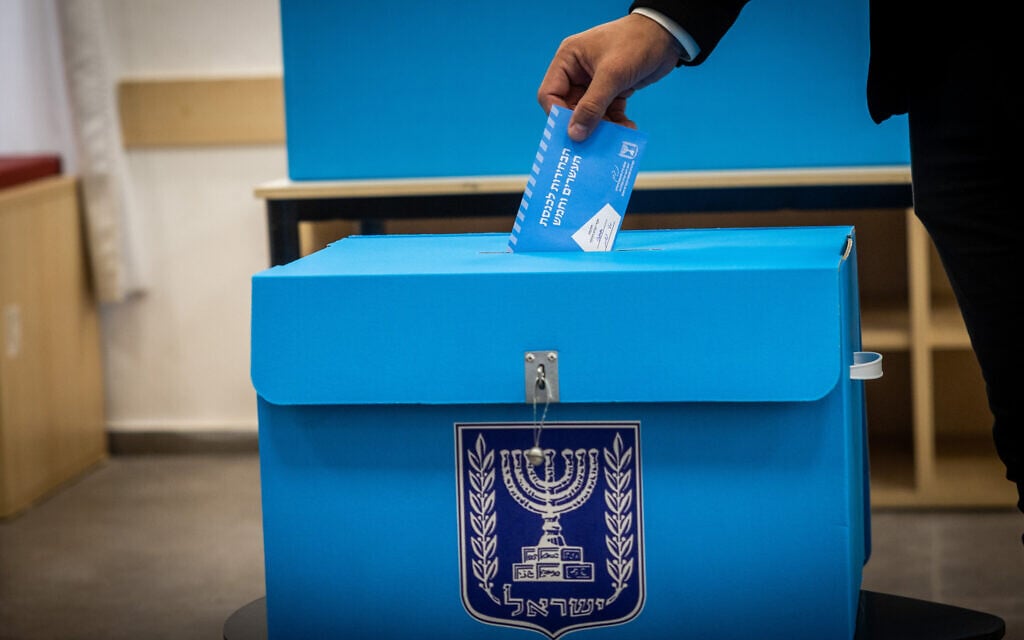
Deputy Supreme Court President Noam Sohlberg, who heads the Central Elections Committee, on Tuesday banned workers and party observers in the polls on October 27 from sharing information about who has voted.
A senior Likud official told Channel 13 news that the ban, which Sohlberg based on privacy and election secrecy concerns, was a “targeted elimination of the right wing,” as the ruling party and other factions have used dedicated apps to see which of their supporters voted and which needed prodding.
Likud and its coalition partners are now considering petitioning the High Court of Justice against the ruling, according to the network.
Sohlberg’s decision was in response to a petition by anti-corruption activist Shahar Ben Meir against parties’ use of apps to track who had come to the polls. The Central Election Committee said the petition was opposed by Likud and the allied Shas, United Torah Torah and Religious Zionism parties, while other factions did not weigh in on the matter.
The deputy Supreme Court chief accepted the petition, saying in a statement that noting voters’ identities “constitutes a violation of privacy and is not permitted under the provisions of the Privacy Protection Law.”
“Election laws do not authorize party representatives to transfer this information for the purpose of party activity, and in the absence of express authorization the transfer of information is prohibited,” Sohlberg said.

The Central Elections Committee is an independent state body responsible for managing parliamentary elections and protecting their integrity. It is chaired by a Supreme Court justice and comprises representatives of the various factions in the Knesset.
The committee is in charge of tallying votes and has the power to disqualify parties ahead of elections.
Likud has a history of questioning the integrity of top Central Elections Committee officials and, by extension, the body itself — including over several recent appointments. Some legal experts have expressed concern that Likud and its leader, Prime Minister Benjamin Netanyahu, could be laying the groundwork to either dispute the results, or to pressure the body into more favorable rulings.
Times of Israel staff contributed to this report.

The war with Iran has been draining for all of us in Israel. But when I heard about a high casualty incident – ballistic missile impacts in Arad and Dimona that left nearly 200 people wounded – I drank a cup of coffee, packed a bag, and headed south.
There, I spoke with Shilgit, the head of an after-school program for underprivileged youth. Standing outside her destroyed center, Shilgit said it was a miracle that no children were hurt and spoke about the community coming together in the hours since.
As a Times of Israel reporter, I’m committed to telling stories of resilience like Shilgit’s. But my colleagues and I can't do this alone. If you value work like this, please consider joining our reader support group, The Times of Israel Community. Your financial support is essential to keep real human reporting like this going.
— Stav Levaton, military reporter

We’re really pleased that you’ve read X Times of Israel articles in the past month.
That’s why we started the Times of Israel – to provide discerning readers like you with must-read coverage of Israel and the Jewish world.
So now we have a request. Unlike other news outlets, we haven’t put up a paywall. But as the journalism we do is costly, we invite readers for whom The Times of Israel has become important to help support our work by joining The Times of Israel Community.
For as little as $6 a month you can help support our quality journalism while enjoying The Times of Israel AD-FREE, as well as accessing exclusive content available only to Times of Israel Community members.
Thank you, David Horovitz, Founding Editor of The Times of Israel


Deputy Supreme Court President Noam Sohlberg, who chairs the Central Elections Committee, has prohibited polling station workers and party observers from sharing information about who has voted in the upcoming October 27 elections. This decision, made in response to a petition by anti-corruption activist Shahar Ben Meir, aims to protect voter privacy and election secrecy. Sohlberg stated that noting voters' identities "constitutes a violation of privacy and is not permitted under the provisions of the Privacy Protection Law."
Election laws do not authorize party representatives to transfer this information for the purpose of party activity, and in the absence of express authorization the transfer of information is prohibited.
A senior Likud official criticized the ban as a "targeted elimination of the right wing," as parties, including Likud, have used apps to track voter turnout. Likud and its coalition partners are reportedly considering petitioning the High Court of Justice against the ruling.
© All rights to the original article belong to the source. Din Online shows a headline, an excerpt and a link only. The objectivity rating is computed automatically and is an estimate only.
Discussion
No comments yet — be the first to comment.