Excitement sweeps Europe as millions view total solar eclipse
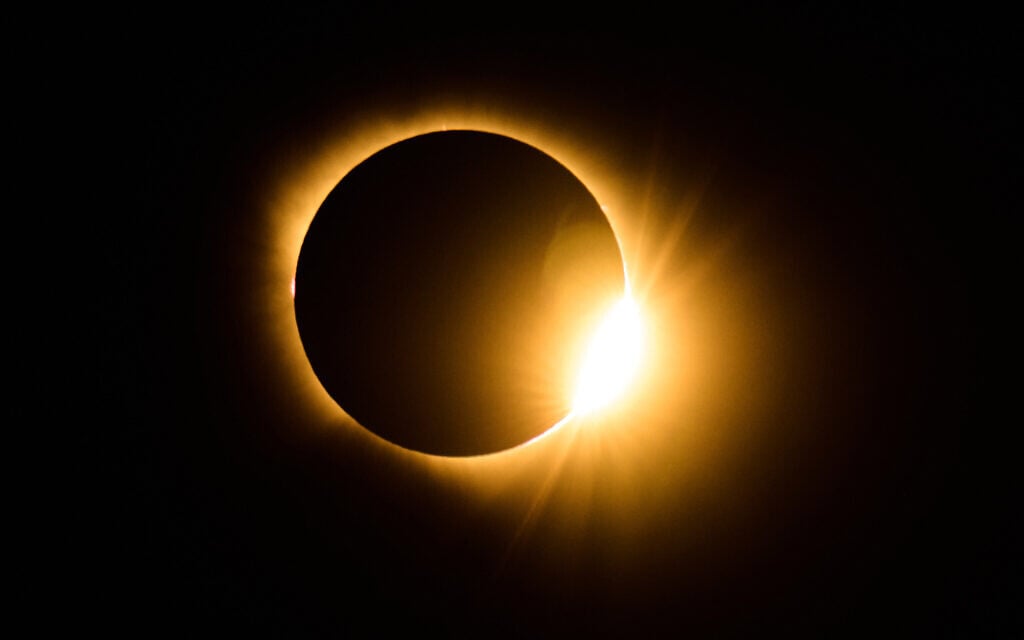
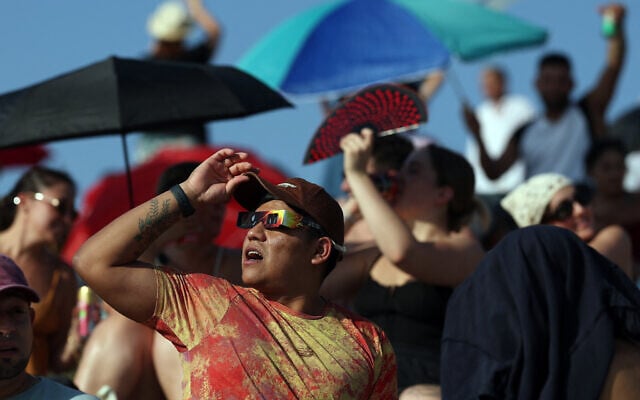
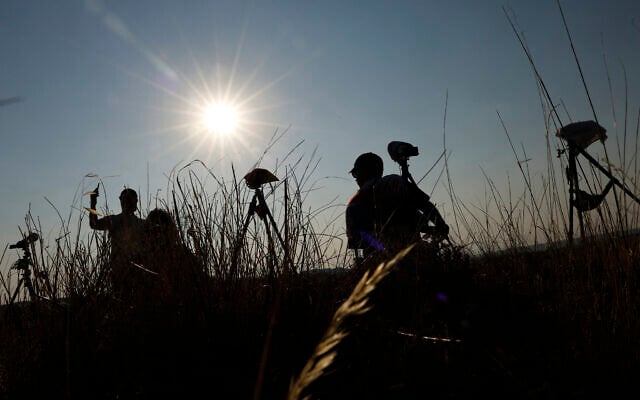
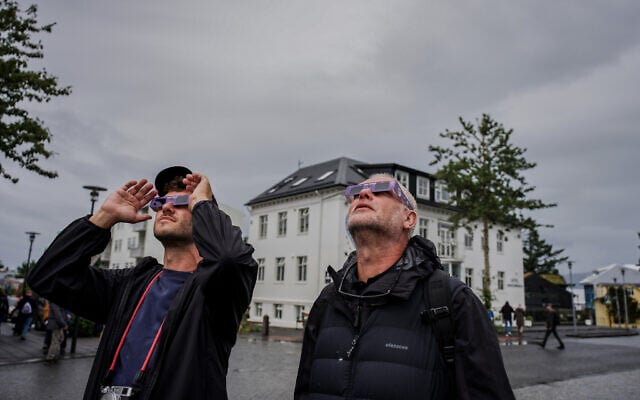
One of nature’s greatest spectacles — a rare total solar eclipse — began casting its shadow on Wednesday, briefly turning day into night in Russia’s remote Arctic north before heading toward mainland Europe.
The Moon first blotted out the Sun at the northernmost tip of mainland Russia at about 5 p.m. GMT (8 p.m. Israel time), leaving only the shimmering glow of its outer corona and eerie darkness.

As it passed down through parts of Greenland and Iceland, excitement built in Spain, where the eclipse’s narrow path cut diagonally from the northwestern Atlantic coast to the Mediterranean Sea, before fading at about 6:45 p.m. GMT (9:45 p.m. Israel time). The eclipse was not visible from Israel.
Tourists and enthusiasts thronged normally quiet Spanish villages, as mainland Europe has not experienced a total solar eclipse for 20 years while Spain has not witnessed one in more than a century.
Iceland’s capital, Reykjavik, however, has not seen a total solar eclipse since 1433.
“It’s the first time and it’s the last time, the only time I’m going to see an eclipse,” Yenny Guevera, a 50-year-old Peruvian living in France, told AFP excitedly in Burgos, northwest Spain.
“I like painting and I really like light,” said Mercedes Bua, a 51-year-old engineer awaiting the eclipse’s passage in a park in Colmenar Viejo, some 30 kilometers (19 miles) north of Madrid. “So I find it interesting to see how it’s going to look.”
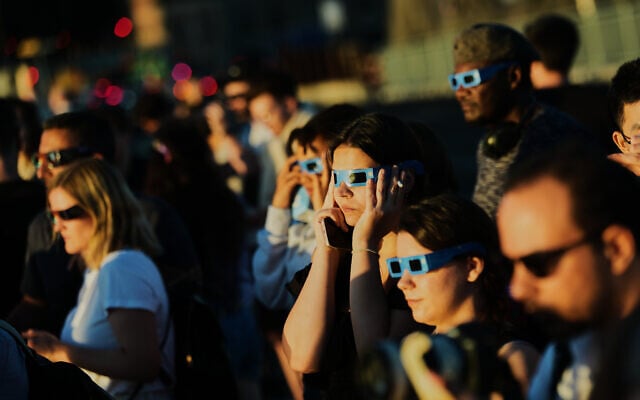
Supplies of special viewing glasses were in high demand as a partial eclipse was visible for millions more in most of Europe, Canada, the northern United States and northwest Africa.
Throughout human history, eclipses have stirred amazement, fear and reverence, as they appear to momentarily halt the normal course of nature.
The shadow or “umbra” cast by the alignment of Sun and Moon creates a strange twilight during which temperatures drop, shadows appear at strange angles and some animals go to sleep.
But the phenomenon is fleeting, lasting just minutes.
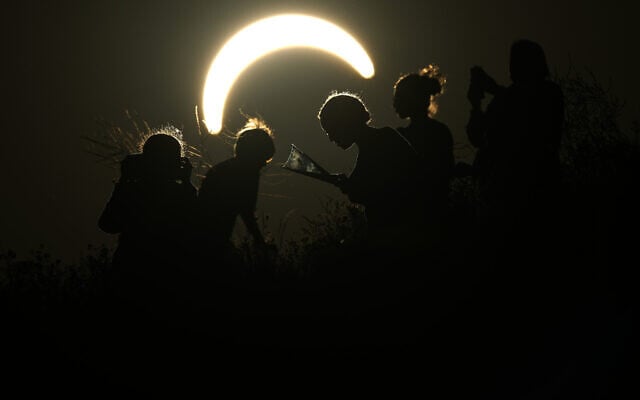
The partial eclipse — which occurs as the Moon starts and finishes crossing the Sun’s path, dimming its light — lasted around one hour and 45 minutes, while totality — when the moon completely covered the sun’s light — lasted around two and a half minutes.
Lucie Green, a British solar physicist who has travelled the world to witness eclipses, called it “a moving experience.” She watched from a boat off the island of Mallorca.
The event, livestreamed by both NASA and the European Space Agency, presented scientists with a rare opportunity to study the Sun’s atmosphere and its outermost layer, as they seek to uncover secrets about solar winds and our star’s magnetic field.
Eclipse fever gripped Spain, with government predictions that nearly 450,000 extra tourists could bring a 347-million-euro ($400-million) boost to the economy.
Interior Minister Fernando Grande-Marlaska said nearly 25,000 police officers had been mobilized to ensure the event goes off without a hitch, and the ministry said 350 official viewing sites had been set up across the sparsely populated interior, often referred to as “Empty Spain.”
Authorities limited or restricted access to another 123 sites because of environmental conditions or obstacles that could hinder an evacuation in the event of a wildfire.
“High temperatures, the accumulated dryness of vegetation, and the intense pressure on natural areas due to projected travel necessitate extreme preventive measures,” Grande-Marlaska said.
Another total eclipse will cross southern Spain and northern Africa in August 2027, while an annular eclipse — when the Moon is not big enough to completely blot out the Sun, creating a so-called “ring of fire” — is due to visit the Iberian Peninsula in 2028.
Times of Israel staff contributed to this report.

As a multimedia journalist, my job is to take the quality, fact-based journalism produced by The Times of Israel newsroom and make it accessible across every platform — from Instagram posts to podcasts to short-form videos.
This is how many, especially young people, consume news these days. But misinformation is rampant on social media. Our team at ToI produces accurate, responsible short-form reporting on Israel and the Jewish world.
If you believe in the importance of factual social media journalism, please consider joining our reader support group, The Times of Israel Community. Your financial support is essential to sustain responsible multimedia reporting.
— Gabriella Jacobs, multimedia journalist

We’re really pleased that you’ve read X Times of Israel articles in the past month.
That’s why we started the Times of Israel – to provide discerning readers like you with must-read coverage of Israel and the Jewish world.
So now we have a request. Unlike other news outlets, we haven’t put up a paywall. But as the journalism we do is costly, we invite readers for whom The Times of Israel has become important to help support our work by joining The Times of Israel Community.
For as little as $6 a month you can help support our quality journalism while enjoying The Times of Israel AD-FREE, as well as accessing exclusive content available only to Times of Israel Community members.
Thank you, David Horovitz, Founding Editor of The Times of Israel










A rare total solar eclipse captivated millions across Europe on Wednesday, briefly turning day into night. The phenomenon began in Russia's Arctic north around 5 p.m. GMT, before its narrow path traversed parts of Greenland, Iceland, and diagonally across Spain, concluding around 6:45 p.m. GMT. Mainland Europe had not experienced a total solar eclipse in 20 years, and Spain in over a century, leading to an influx of tourists and enthusiasts. Yenny Guevera, a 50-year-old Peruvian living in France, expressed her excitement, stating, "It's the first time and it's the last time, the only time I'm going to see an eclipse." The event provided scientists with a unique opportunity to study the Sun's atmosphere, while Spain mobilized nearly 25,000 police officers and set up 350 official viewing sites to manage the expected 450,000 additional tourists and a projected 347-million-euro economic boost.
© All rights to the original article belong to the source. Din Online shows a headline, an excerpt and a link only. The objectivity rating is computed automatically and is an estimate only.
Discussion
No comments yet — be the first to comment.