יום שישי, יולי 31, 2026 עברית|English Log in Free sign-up
LIVE
Poised to become Israel's youngest MK, Yonatan Shalev wants the October 7 generation to leadIDF kill terrorist who kidnapped Noa Argamani, Avinatan Or on October 7For Israel, an undramatic meeting between Netanyahu and Trump was enough – opinionSaudi Arabia may be planning sea, land assault on Houthis, Yemeni sources claim – reportGivati soldiers face swift punishment after mass walkout at Sde Teiman baseRamat Gan man arrested for smashing Channel 12 entrance, leaving death threat against media figuresParashat Eikev: The things we step onMy Word: 'Wholocide' is 'libelocide' – opinionIranian hackers suspected in cyberattack against over 30 Minnesota water systems – reportData shows Indonesia is still importing from Israel, in the middle of a genocide, until nowSpanish politicians, commentators accuse Israel of stirring chaos over Ceuta migration crisisUK singer Boy George pulls out of musical after pro-Israel song backlashPoised to become Israel's youngest MK, Yonatan Shalev wants the October 7 generation to leadIDF kill terrorist who kidnapped Noa Argamani, Avinatan Or on October 7For Israel, an undramatic meeting between Netanyahu and Trump was enough – opinionSaudi Arabia may be planning sea, land assault on Houthis, Yemeni sources claim – reportGivati soldiers face swift punishment after mass walkout at Sde Teiman baseRamat Gan man arrested for smashing Channel 12 entrance, leaving death threat against media figuresParashat Eikev: The things we step onMy Word: 'Wholocide' is 'libelocide' – opinionIranian hackers suspected in cyberattack against over 30 Minnesota water systems – reportData shows Indonesia is still importing from Israel, in the middle of a genocide, until nowSpanish politicians, commentators accuse Israel of stirring chaos over Ceuta migration crisisUK singer Boy George pulls out of musical after pro-Israel song backlash
Politics

God, land and politics: As Israel heads to elections, where do religious Israelis stand?
6h ago ·  Source: The Times of Israel 85Objectivity score85/100

God, land and politics: As Israel heads to elections, where do religious Israelis stand?

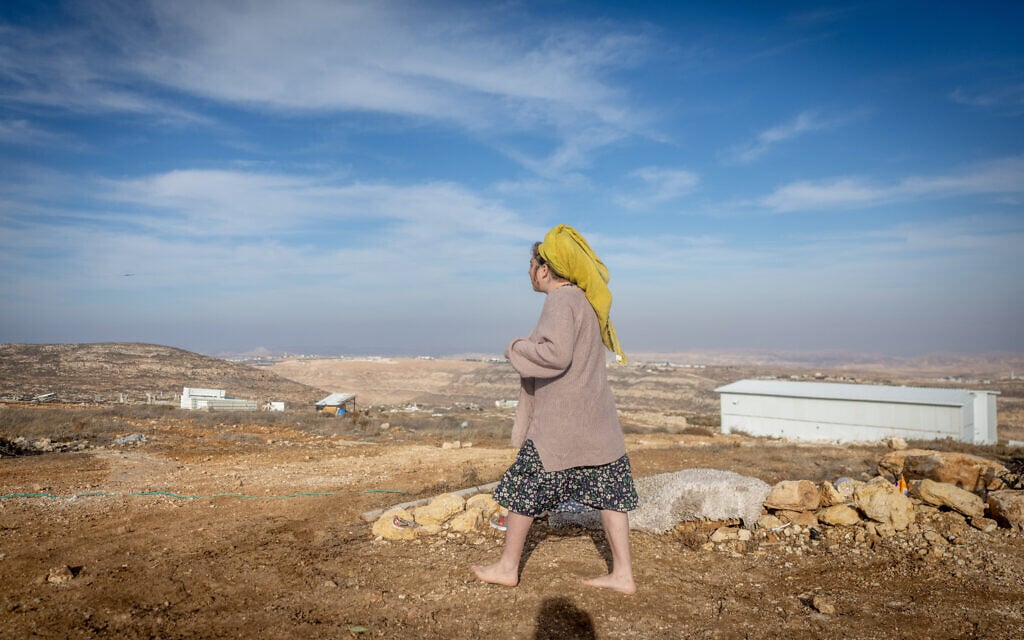
A woman walks near Tzur Misgavi, an illegal outpost in Gush Etzion, in the West Bank, November 17, 2025. (Chaim Goldberg/Flash90)

Rossella Tercatin is The Times of Israel's archaeology and religions reporter.

In August 2023, Agam Labs, directed by Hebrew University researcher Nimrod Nir, surveyed thousands of Israelis on a number of topics, including their political preferences. Less than two months later, the Hamas atrocities of October 7, 2023, marked a political cataclysm for the country. In its wake, the lab has continually surveyed some 2,000 Israelis, including participants from the original study.

According to Nir, while October 7 and the ensuing wars have had a huge impact on Israeli society at large, the religious community — a mix of Religious Zionism and Haredim — was probably least affected by these events politically.

“Their ideology and their political identification are attached to their religious beliefs, which are much more stable,” Nir said.

In the last election, held in November 2022, the party called Religious Zionism ran on a joint ticket with Otzma Yehudit and Noam, with all three explicitly touting their religious identity. Otzma Yehudit is the ideological heir to the banned Kach movement founded in the 1970s by American-Israeli rabbi Meir Kahane,who espoused racist anti-Arab views. Noam, which promotes an anti-LGBT agenda, has deep ties to prominent yeshivot of the so-called hardal faction within Religious Zionism, which combines a quasi-ultra-Orthodox lifestyle with hardline Zionism. Altogether, the combined slate won 14 seats, with its three factions formally separating once the elections were over.

In the past few years, Religious Zionism head Bezalel Smotrich and Otzma Yehudit head Itamar Ben Gvir, along with other coalition legislators from the Religious Zionist community, have become the sector’s most recognizable faces.

Their political agendas have largely focused on promoting West Bank settlements, in Smotrich’s case, and asserting Jewish power within and beyond Israel’s internationally recognized borders, in Ben Gvir’s.

However, to what extent do the religious hard-right politicians actually represent this Israeli demographic’s political and ideological identity?

תמונת סיקור

Nir maintained that in the past few years, despite the devastation brought on by the multifront war, the issue that has concerned Israelis the most is the tension between religion and state.

“Until six or seven years ago, the ideological and political division between right and left in Israel had to do with foreign policy issues, especially Israel-Palestine,” Nir said. “Now everything is more internal. [The fracture] is about religion and state and power struggles within.”

“Even in the middle of the Iran war, over 60% of respondents said the greatest threats to Israel’s existence were internal, not external,” he added. “They were more afraid of polarization than war.”

Surveys from both Agam Labs and other organizations highlight the ideological gap regarding religion and state between groups with different levels of religiosity.

According to a 2025 Hiddush Religion and State Report, only 17% of religious respondents favored the separation of religion and state, while 83% opposed it.

“Half or more of the [Religious Zionist] community has been going in the direction of radicalization,” according to demographer Sergio DellaPergola, professor emeritus at the Hebrew University of Jerusalem.

An Agam Labs survey from earlier this year shows that, when given several options to describe what the character of Israel should be, 26% of religious respondents preferred the country be run according to halacha, or Jewish law, compared to 0.9% of secular respondents. Another 53% of religious respondents said the country should be Jewish and democratic, but the Jewish aspect should outweigh the democratic one.

תמונת סיקור

Only about 15% of religious participants in total chose either a Jewish and democratic state where democracy takes precedence over religion, or a country with no specific national or religious character and full equality for all its citizens or communities. Over 80% of the survey’s secular respondents selected one of those two options.

The 2025 Israeli Democracy Index, released by the Israel Democracy Institute in November, found that 41% of religious respondents said the state’s democratic character was too strong compared to its Jewish character, while 14% said the opposite and 29% said the balance was correct.

A similar trend could also be observed in how the concept of democracy was understood.

Agam Labs revealed that almost 63% of the religious public identified democracy with majority rule, saying that once politicians are elected, they can do whatever they deem right, as opposed to 28% who said that democracy is a system that safeguards citizens’ fundamental rights with checks and balances. Among the secular public, only 14.5% chose the majority-rule option, and 77% chose checks and balances.

At the same time, the Religious Zionism party’s inability to represent the community from which it takes its name is evidenced by the fact that polls find the party struggling to reach the 3.25% threshold necessary to enter the Knesset in the upcoming national election, which is set for October 27.

תמונת סיקור

“The religious community represents around 12% of Israel’s adult population,” DellaPergola said. “The Religious Zionism party today does not reach 3% support, so the gap is evident.”

He also stressed that the number of Israelis who leave the religious lifestyle is not insignificant. This helps account for why the religious community has remained relatively stable at around 12% of Israel’s population over the last two decades, despite having a higher birth rate than secular Jewish Israelis.

“We should also remember that many of those who are less radical leave and are not considered religious anymore,” DellaPergola said.

Data from the Central Bureau of Statistics shared by Channel 12 shows that Israelis who identify as religious are not concentrated in a particular area of the country: 12% live in the West Bank, 15% in Jerusalem, 36% in central Israel, 19% in the north and Haifa, 17% in the south. Yet, the symbolism of the West Bank as the biblical heartland looms large in the community.

According to Nir, this means that the Israeli-Palestinian question remains a top priority for Religious Zionists.

“They are the only segment [of society] that still sees this as a major topic,” he said.

Agam Labs recently asked its panel what policy Israel should adopt toward settlements and outposts in Judea and Samaria, the biblical names for the West Bank used by many who see the areas as inseparable from the Jewish homeland.

Sixty-five percent of religious respondents said that Israel should extend its sovereignty over the territories, and 23% that it should continue expanding the major settlement blocs while curbing illegal outposts. Only 2.2% and 0.9%, respectively, chose the options of freezing the expansion of settlement blocs and preventing new outposts, or dismantling some of the outposts and settlements for the sake of security. Among the secular public, these options were the most popular, at 22.3% and 34%, respectively.

תמונת סיקור

The government has, under Smotrich, who holds a post within the Defense Ministry responsible for civilian issues in the West Bank, authorized a record number of new settlements. Since the coalition took office at the end of 2022, over 100 new settlements have been approved. By comparison, only six new settlements were formally greenlit by Israel in the 29 years prior.

At the same time, the government has failed to tackle a dramatic increase in settler violence against Palestinians.

IDF and Shin Bet data from earlier this year show that settler attacks rose by 27% in 2025 compared to 2024. The left-leaning Yesh Din registered 378 incidents during the recent 40 days of hostilities with Iran alone, with eight Palestinians killed and 200 injured.

The violence is ongoing. On July 24, two Israelis and four Palestinians were killed in a gunfight after clashes erupted when settlers illegally entered a Palestinian village in the northern West Bank. The deadly incident led to fears of reprisal attacks throughout the territory.

In the Israeli Foreign Policy Index of 2025 released by the think tank Mitvim in September, religious respondents, including the ultra-Orthodox, were the least likely to say they were in favor of sanctions imposed by several countries against violent settlers and organizations backing them.

Among the religious participants, 3% supported the sanctions unconditionally, 14% as long as they would not harm nonviolent settlers, 14% as long as they would not include sanctions against Israelis living inside the Green Line, and 69% opposed them. Among the secular public, only 24% opposed them.

תמונת סיקור

The tension surrounding the topic of settler violence toward Palestinians was evident at an event organized to denounce it, held by a group of concerned residents of the Gush Etzion settlement bloc at the flagship Har Etzion Yeshiva in Alon Shvut in April.

Set in a packed auditorium of hundreds of people, the vast majority of whom were wearing the crocheted kippot or colorful headscarves common among Religious Zionists, the event featured several speakers who spoke harshly against the attacks, including Maj. Gen. Avi Bluth, who heads the IDF Central Command in charge of the West Bank.

While the speakers all denounced the violence, some also praised agricultural outposts — illegal shepherding farmsteads that receive state support despite being used by extremist settlers as forward bases for terrorizing local Palestinians, according to critics.

תמונת סיקור

Rabbi Yaakov Meidan, one of the yeshiva heads and a prominent voice within the Religious Zionist community, expressed harsh condemnation of attacks, but also insisted that the farms need to be supported.

“There are extreme and terrible crimes committed by Jewish youth, and we must fulfill the mitzvah [commandment] of expelling the evil from our midst,” he said.

“At the same time, regarding the people who live there, if there is no understanding of the difficulties they are subject to, I am not sure we will be able to [achieve anything],” he added.

Meidan praised Smotrich and the government and expressed concern about what a different government’s settlement policies might be, after the October election.

תמונת סיקור

Surveys consistently show that members of the Religious Zionist community are also the most ardent supporters of Israeli control over and renewed settlement of Gaza.

According to data by Agam Labs, 57% of the religious public believes that Israel should annex Gaza and build settlements there, while another 20% support installing an Israeli governing body for the Strip. Less than 20% of religious respondents were in favor of leaving Gaza to be governed by a coalition of Arab countries (9.5%), the Palestinian Authority (1.1%), or a new Palestinian body (6.6%). At least one of the latter three options were supported by over 68% of the secular public, with only 7.7% backing annexation.

While they remain a statistical minority, there are Religious Zionists who interpret Judaism and politics in their own way, and they are increasingly speaking out and attempting to bring about change.

תמונת סיקור

Perhaps the clearest example is embodied by the Smol Emuni movement, translated as the “Faithful Left,” which describes itself as “a movement of activists across the religious spectrum who believe in advancing justice, peace, and equality in Israeli society.”

“I think what has developed over a long time, but especially since October 7, is a very new and dangerous brand of Judaism, and it’s immensely popular,” Mikhael Manekin, a co-founder of Smol Emuni, told The Times of Israel during an interview at a cafe in Jerusalem.

“It almost reaches an amoral understanding of the world where basically, you are allowed to do whatever you want to anybody, including theft and killing, in the name of how you define survival at any given point,” he said.

According to Manekin, part of the problem is that even those within the community who oppose this approach try to “moderate it” rather than propose a strong alternative.

תמונת סיקור

Smol Emuni is attempting to do exactly that, beginning with its decision to use the word “left” in its name — a deliberate challenge to a label that has become stigmatized with the country’s rightward shift following October 7.

Similarly, the movement openly advocates an end to what it describes as the occupation of the West Bank. (Israel maintains that the West Bank is a disputed territory even though, to a large extent, it applies the law of belligerent occupation in administering it.)

According to Manekin, the point for him and many others is not necessarily to become popular.

“I think this is what God wants me to do,” he said. “We’re not only guided by what makes the most sense practically.”

Several activities and groups operate under the umbrella of Smol Emuni, including a publishing house and journal, a beit midrash (study hall) program, networks for educators, parents, and youth, and seminars offering both Jewish learning and activism on the ground. Activists come from a broad religious spectrum, from ultra-Orthodox to traditional.

תמונת סיקור

Perhaps the most recognizable initiative of Smol Emuni is Bnei Avraham, or Sons of Abraham, a group of activists who go to the West Bank to do what is referred to as “protective presence,” acting as a buffer to protect Palestinian communities from settler violence.

According to Manekin, many of the activists in Bnei Avraham grew up in hardcore settler households themselves, and the youths descending on the Palestinian villages may well be their brothers, classmates, or friends.

“I think a lot of the work that we’re trying to do is not to explain to other people that we exist, but to explain it to ourselves, to tell ourselves that this is where we stand and this Torah is relevant and we take it seriously,” he said. “I’m not a very optimistic individual in general, but I am very hopeful that what we do works.”

תמונת סיקור

The war with Iran has been draining for all of us in Israel. But when I heard about a high casualty incident – ballistic missile impacts in Arad and Dimona that left nearly 200 people wounded – I drank a cup of coffee, packed a bag, and headed south.

There, I spoke with Shilgit, the head of an after-school program for underprivileged youth. Standing outside her destroyed center, Shilgit said it was a miracle that no children were hurt and spoke about the community coming together in the hours since.

As a Times of Israel reporter, I’m committed to telling stories of resilience like Shilgit’s. But my colleagues and I can't do this alone. If you value work like this, please consider joining our reader support group, The Times of Israel Community. Your financial support is essential to keep real human reporting like this going.

— Stav Levaton, military reporter

X
google
apple
facebook
timesofisrael
google
apple
facebook
timesofisrael
timesofisrael
google
apple
facebook
timesofisrael
check your email
X
X
Confirm Mail
Prime Minister Benjamin Netanyahu (left) and US President Donald Trump meet in the Oval Office on July 28, 2026. (GPO)
Members of the Israeli forces stand in guard on a road as Israeli settlers march through the Palestinian village of Sarra, near the West Bank city of Nablus, July 31, 2026. (AP/Leo Correa)
A woman walks near Tzur Misgavi, an illegal outpost in Gush Etzion, in the West Bank, November 17, 2025. (Chaim Goldberg/Flash90)
Members of the Saudi security forces take part in a military parade ahead of the Hajj pilgrimage in Mecca on May 21, 2026. (Zain Jaafar/AFP)
An IDF soldier is seen in a Hezbollah tunnel near the Beaufort Castle in southern Lebanon, July 7, 2026. (Emanuel Fabian/Times of Israel)
Palestinian motorists queue at a gas station while the city is experiencing a severe fuel shortage following the Israel Iran conflict, in Ramallah June 19, 2025. (AP Photo/Nasser Nasser)
תמונת סיקור
Prime Minister Benjamin Netanyahu (left), Ukrainian Foreign Minister Andrii Sybiha, and Ukraine President Volodymyr Zelensky (right) attend the funeral service for US Sen. Lindsey Graham at the Washington National Cathedral on July 28, 2026 in Washington, DC. (Chip Somodevilla/Getty Images/AFP)
A Palestinian stands next to a fire after brush was set ablaze on the roadside to prevent an Israeli settler attack in the West Bank village of Sinjil, July 17, 2026. (AP/Leo Correa)
Freed hostage Evyatar David arrives at his home in Kfar Saba, October 26, 2025. (Erik Marmor/Flash90)
A group of ultra-Orthodox males harass several off-duty soldiers walking in Jerusalem, July 30, 2026.(X screenshot)
Left: Likud MK Yuli Edelstein attends a Foreign Affairs and Defense Committee meeting at the Knesset in Jerusalem, December 9, 2025. (Yonatan Sindel/Flash90); right: Former Likud MK Gilad Erdan takes part in a ceremony for a bulletproof ambulance donated by the Harvest Christian Fellowship to Magen David Adom, at the Tower of David, in the Old City of Jerusalem, June 1, 2025. (Chaim Goldberg/Flash90)
Left to right: Troops of the Givati Brigade's Tzabar Battalion abandoned their base in southern Israel, July 30, 2026; weapons left behind by the troops; a sign belonging to troops that was smashed by their commander. (Social media, used in accordance with Clause 27a of the Copyright Law)
Illustrative: Israelis enjoy the beach in Tel Aviv during a heatwave, on April 24, 2024. (Avshalom Sassoni/Flash90)
Singer Boy George is interviewed on the floor of the New York Stock Exchange, June 15, 2026. (AP/Richard Drew)
Police arrest an ambulance driver in northern Israel on suspicion of espionage for Iran in June 2026. (Israel Police)
Harold Grinspoon received a warm welcome by the several hundred participants at PJ Library's conference, held in April 2026 in Springfield, Massachusetts. (Courtesy PJ Library via JTA)
Palestinian entrepreneur Bashar al-Masri in front of his residential project of Rawabi in the West Bank, on February 23, 2014. (Hadas Parush/Flash 90/File)
Then-Ibero-American Secretary Rebeca Grynspan speaks in Antigua, Guatemala, November 16, 2018. (AP/Oliver de Ros)
Military correspondent Emanuel Fabian joins host Amanda Borschel-Dan on today's Daily Briefing podcast. (ToI/CENTCOM)
From left foreground, Michigan state Rep. Donavan McKinney, US Rep. Alexandria Ocasio-Cortez, Michigan Democratic US Senate primary candidate Abdul El-Sayed, US Sen. Bernie Sanders, United Auto Workers President Shawn Fain, and US Rep. Rashida Tlaib, join hands following a campaign rally for El-Sayed, July 18, 2026, in Detroit. (AP Photo/Jose Juarez)
Meg Keene is helming Meg Keene Books, a new fiction imprint from Wicked Son, a Jewish publisher. (Courtesy Keene via JTA)
💬 Want to join the discussion and comment? Sign up — free, and get the weekly digest too.
🗞️ In-depth summary

A survey by Agam Labs, directed by Hebrew University researcher Nimrod Nir, indicates that while the October 7 attacks significantly impacted Israeli society, the political views of the religious community, including Religious Zionists and Haredim, remained largely stable due to their strong connection to religious beliefs. Despite the prominence of hardline politicians like Bezalel Smotrich and Itamar Ben Gvir, who advocate for West Bank settlements and Jewish power, recent polls suggest a disconnect between these leaders and the broader religious demographic. Demographer Sergio DellaPergola noted that the Religious Zionism party struggles to meet the electoral threshold, indicating a gap in representation.

  • Surveys reveal a significant ideological divide on the issue of religion and state, with 83% of religious respondents opposing separation.
  • When asked about Israel's character, 26% of religious respondents favored governance by Jewish law (halacha), and 53% preferred a Jewish and democratic state where the Jewish aspect takes precedence.
  • Regarding the Israeli-Palestinian question, 65% of religious respondents supported extending Israeli sovereignty over the West Bank, and 23% favored expanding major settlement blocs.
  • Religious respondents were also the least likely to support sanctions against violent settlers, with 69% opposing them.
Automatically generated summary based on the original article; quotes are from the source.
This story is based on reporting by The Times of Israel.
Read the full article at the source →

© All rights to the original article belong to the source. Din Online shows a headline, an excerpt and a link only. The objectivity rating is computed automatically and is an estimate only.

Related

World Full Article6h ago

Democrats show divisions on Israel amid competitive midterm elections

אנחנו משתמשים בקובצי Cookie ובנתונים כדי:אם הבחירה שלך היא 'אישור הכול', נשתמש בקובצי cookie ובנתונים גם כדי:אם הבחירה שלך היא 'דחיית הכול', לא נשתמש בקובצי cookie…

Source: Google News78

Discussion

No comments yet — be the first to comment.

Add a comment