Government document shows 650 youths living in illegal West Bank outposts
Jeremy Sharon is The Times of Israel’s legal affairs and settlements reporter

A recently published document by the Settlements and National Missions Ministry has shown that there are some 650 Israeli youths living mostly in illegal outposts in the West Bank.
The figures come from a call-for-applications document issued by the Settlements Ministry on May 27 this year, outlining how settlement regional councils can apply for ministry funding under a program supposedly designated to help at-risk Israeli youths in the illegal outposts in the West Bank.
The Peace Now organization, which campaigns against the settlements and which discovered the document, said, however, that the money made available specifically for residents of such outposts was instead just another way for the state to fund these illegal enterprises.
State funding for illegal settlement outposts is particularly controversial, due to the large-scale, systematic involvement of outpost residents in attacks against, and harassment of, local Palestinians, which have resulted in deaths, injuries, and the displacement of dozens of Palestinian communities since the current government took office in December 2022.
Critics such as Peace Now allege that the violence is part of a coordinated campaign to expel Palestinians from Area C of the West Bank, which is being supported and funded in numerous ways by the state.
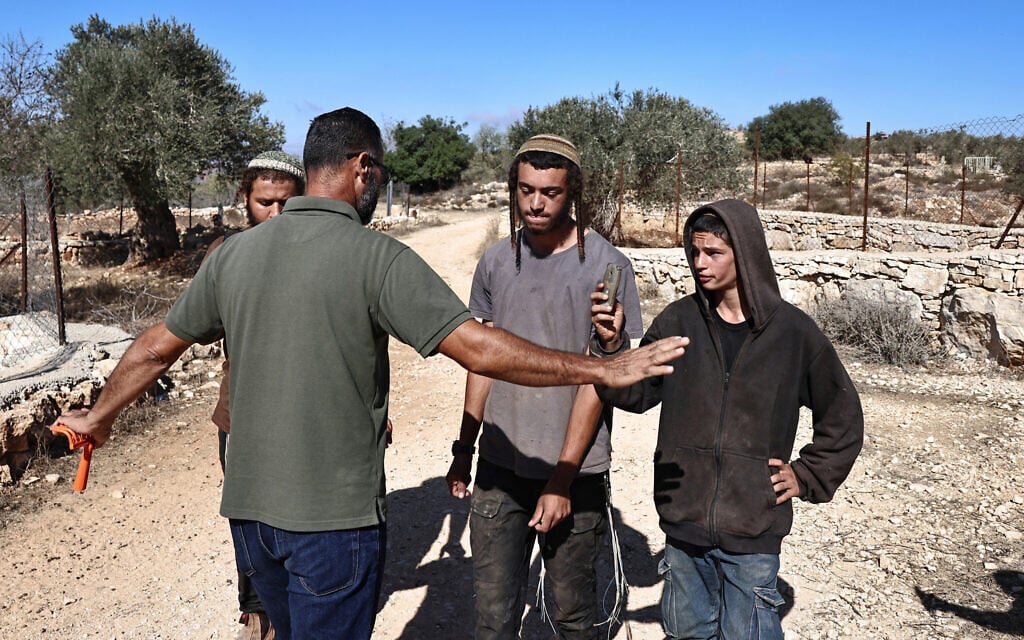
The majority of the 650 youths listed by the Settlements Ministry as living in outposts likely live in the estimated 204 illegal farming outposts spread across the West Bank, 130 of which were established since the current government entered office in December 2022.

The youths, often school dropouts, do volunteer work on these farms, regularly taking sheep and goats to pasture in large tracts of land in the West Bank, where they frequently, and deliberately, clash with local Palestinians.
According to Peace Now officials who discovered the document, the numbers provided mean that the total number of inhabitants of the outposts could lie between 1,000 and 1,200 people.
That figure is based on the total number of farming outposts and the fact that most such outposts usually have just one or two young couples living in them, together with a handful of youths.
Peace Now also estimates that in addition to the 650 youths living in outposts recognized and assisted by settlement regional councils, another 100 youths live in outposts that the regional councils have not had a hand in establishing, including in Area B of the West Bank, where Israelis are legally prohibited from living.
Accurate figures regarding the number of activists involved in the establishment and running of the farming outposts have been hard to come by, and the Settlements Ministry call for applications appears to be the only formal government document providing an insight into the number of inhabitants in these dwellings.
The call for application document from the Settlements Ministry, run by Minister Orit Strock of the ultranationalist Religious Zionist party, details various budget allocations available to settlement regional councils for the purposes of assisting youths who have dropped out of school and are in “at-risk situations” in the West Bank.
Among the available budgetary assistance is NIS 5.5 million ($1.8 million) for food, clothing and “economic expenses” for youths actually living in the outposts.
The document records the specific number of youths living in outposts by municipal region of the West Bank for the purposes of determining the available budget allocation.

According to the document, there are 225 youths living in outposts in the jurisdiction of the Benjamin Regional Council; 129 in the Samaria Regional Council; 120 in the Jordan Valley Regional Council; 99 in the Mount Hebron Regional Council; and 84 in the Gush Etzion Regional Council.
Funding is also available for the settlement regional councils to employ “coordinators” and informal councilors, and hire professionals for working with such youths, as well as the purchase of 4×4 vehicles for the goals of the program, presumably to reach the outposts, which are often on hilltops lacking paved access roads.
There has been much debate regarding the numbers of outposts, residents, and activists, against the background of the severe violence emanating from farming outposts over the last three years, during which time the number of such illegal settlements has mushroomed.
Prime Minister Benjamin Netanyahu asserted in December 2025 that violent settlers numbered just some 70 youths who he said were not even from the West Bank. Just last Sunday, however, he revised that figure upward to 150 “juvenile delinquents,” who he said were “brought into the West Bank.”
The government itself funds illegal farming outposts in several ways, including funding organizations that provide youth volunteers to work in the outposts through the Agriculture Ministry.
The Agriculture Ministry also funds illegal farming outposts through grazing subsidies to farm owners.

The war with Iran has been draining for all of us in Israel. But when I heard about a high casualty incident – ballistic missile impacts in Arad and Dimona that left nearly 200 people wounded – I drank a cup of coffee, packed a bag, and headed south.
There, I spoke with Shilgit, the head of an after-school program for underprivileged youth. Standing outside her destroyed center, Shilgit said it was a miracle that no children were hurt and spoke about the community coming together in the hours since.
As a Times of Israel reporter, I’m committed to telling stories of resilience like Shilgit’s. But my colleagues and I can't do this alone. If you value work like this, please consider joining our reader support group, The Times of Israel Community. Your financial support is essential to keep real human reporting like this going.
— Stav Levaton, military reporter

We’re really pleased that you’ve read X Times of Israel articles in the past month.
That’s why we started the Times of Israel – to provide discerning readers like you with must-read coverage of Israel and the Jewish world.
So now we have a request. Unlike other news outlets, we haven’t put up a paywall. But as the journalism we do is costly, we invite readers for whom The Times of Israel has become important to help support our work by joining The Times of Israel Community.
For as little as $6 a month you can help support our quality journalism while enjoying The Times of Israel AD-FREE, as well as accessing exclusive content available only to Times of Israel Community members.
Thank you, David Horovitz, Founding Editor of The Times of Israel


© All rights to the original article belong to the source. Din Online shows a headline, an excerpt and a link only. The objectivity rating is computed automatically and is an estimate only.
Discussion
No comments yet — be the first to comment.