Haredi turnout high in Likud primary, amid fears they won’t vote for party in general election

Sam Sokol is the Times of Israel's political correspondent. He was previously a reporter for the Jerusalem Post, Jewish Telegraphic Agency and Haaretz. He is the author of "Putin’s Hybrid War and the Jews"

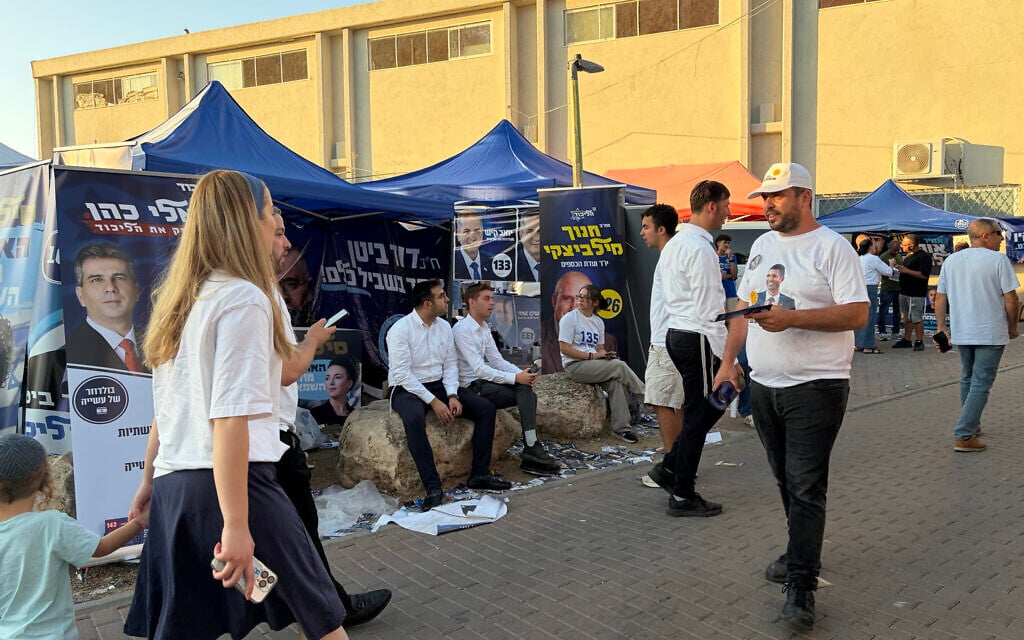
Many ultra-Orthodox voters cast ballots for the first time in a Likud primary on Monday, sparking alarm among some activists in Prime Minister Benjamin Netanyahu’s party who claimed the new members were influencing the makeup of a slate that they do not intend to support in the October 27 general election.
“I asked them: ‘Is there any chance you’ll vote for Likud (in October)?’ They said, ‘No, we’re voting for United Torah Judaism or Shas, but we want to come and [have] influence,'” Likud Central Committee member Eli Zilka told The Times of Israel, standing outside a polling station in the Jerusalem suburb of Beit Shemesh.
Zilka said Haredi turnout was exceptionally high in both Beit Shemesh and Jerusalem.
While some party activists echoed Zilka’s concerns, many of those actually vying for spots saw it differently, as they looked for votes wherever they could get them.
Earlier this year, Likud’s ultra-Orthodox wing wrote to Netanyahu, warning that activists affiliated with the Knesset’s Haredi parties — Shas and United Torah Judaism — were infiltrating their movement in an effort to unduly influence the party from the inside.
According to Channel 12, around 7,000 of Likud’s roughly 140,000 members are Haredi, with nearly all of the major Hasidic groups now represented within the party.
Even figures formally affiliated with the Haredi parties were said to participate in the effort, including an unnamed Bnei Brak city councilman who represents Agudat Yisrael, a UTJ faction, while running an organized bloc of Likud voters.

One of the few parties to determine its electoral lineup via primary, Likud has long prided itself on its internal democratic process. However, changes to the system this year, pushed by Netanyahu, shrank the number of open spots on the roster and turned the vote into an unusually hotly contested race as party politicians jockeyed for a good enough showing to secure a likely Knesset seat.
While vying for reelection, Likud politicians increasingly courted the Haredi public, with Netanyahu, ministers including Israel Katz, Yariv Levin, Gideon Sa’ar and Shlomo Karhi, and MKs David Bitan, Boaz Bismuth, Hanoch Milwidsky and Moshe Saada regularly attending Haredi events as they campaigned for support ahead of Monday’s primary.
While Netanyahu later tried to distance himself from efforts to exempt yeshiva students from military conscription, a key Haredi interest demanded by his ultra-Orthodox political allies in Shas and UTJ, Likud recently helped push through a pair of bills declaring Torah study a “foundational value” of the Jewish people and freezing arrests of Haredi draft evaders.

A push by Haredi voters to advance their interests within Likud may have an outsized influence on a primary in which only 53.5 percent of party members participated.
As more and more Haredim showed up at the polling station in Beit Shemesh on Monday, Zilka said that some of them had arrived with printed lists of candidates to support, including MK Bismuth, the chairman of the Knesset Foreign Affairs and Defense Committee, and Knesset Speaker Amir Ohana. Ohana placed second and Bismuth placed 15th after 90% of the vote was counted on Tuesday morning.
“They can have a huge impact on the slate. They make deals that allow them to wield influence, and they threaten MKs to [act] according to their agendas. So it’s really a foreign body inside Likud,” said Zilka, the party activist, alleging that Central Committee chair Haim Katz had blocked a move to require these new members to vote for the party if they cast ballots in the primary.

Likud city councilman Zvi Wolicki also noted the increased Haredi turnout, although he was more sanguine, telling The Times of Israel that they were joining the party “because they’re looking for a purer politics” and “an opportunity to express themselves” because they feel the Haredi parties are not listening to them.
Wolicki said that efforts to infiltrate Likud had been tried before and failed, so he was “not really worried about the long-term effect on the party.”
Multiple ultra-Orthodox voters refused to answer The Times of Israel’s questions about their participation in the primary, with the few who did insisting that they were party members of long standing, even while admitting that they were unlikely to vote Likud in October.
“Probably not. I don’t know yet,” replied one Haredi voter, when asked if he’d back Likud in the national vote, adding that he had been a Likud member for five years.
Another Haredi voter gave a similar answer to The Times of Israel outside a polling station in Jerusalem.

He said he would vote for whichever party would best represent “the wholeness of the Torah, the wholeness of the nation, and the wholeness of the Land of Israel.”
Some Haredi primary voters may have been paid to participate, the ultra-Orthodox Kikar HaShabbat news site reported on Monday, publishing a video of two young men admitting that they had received around NIS 400 ($134) to vote for specific candidates.
חגיגה דמוקרטית בליכוד pic.twitter.com/qKZQBG1qEk
— Roi (@Roi_) August 17, 2026
Ultra-Orthodox Israelis were not the only ones working to influence Likud from within. A senior aide to Heritage Minister Amichay Eliyahu of the far-right Otzma Yehudit party said Monday that he had convinced hundreds of people to register as Likud members ahead of the primary.
The effort by Israel Diskind, Eliyahu’s spokesman, was an unusual case of a prominent figure affiliated with one party becoming involved in another party’s primary election.
Speaking to The Times of Israel outside the Likud primary in Beit Shemesh, Diskind said he hoped the voters he registered would support candidates who demand more safety precautions at an annual Jewish pilgrimage that was the site of a disaster in 2021.
Diskind said that he’d convinced 324 people to join Likud, even though he was aware that not all of them will vote for the party on election day.

Diskind was motivated by a 2021 tragedy in which a crowd crush killed 45 Haredi men and boys, including Diskind’s brother, and injured over 100, as they traversed a slippery walkway at the annual Lag B’Omer pilgrimage in Meron. It was Israel’s deadliest peacetime civilian disaster to date. A state commission of inquiry blamed a number of senior officials, including Netanyahu, for the incident, and changes have been made to how the pilgrimage is run.
Diskind was formerly a spokesman for the bereaved families and has long been active regarding the issue.
He said he believes more fixes are necessary and blamed ultra-Orthodox lawmakers for failing their constituents. However, he stressed that he was not trying to push Likud to violate core principles of the political right, such as advocating for West Bank settlements, and said he was not trying to send a “Trojan horse” into the Likud party.
Ariela Karmel contributed to this report.

As a multimedia journalist, my job is to take the quality, fact-based journalism produced by The Times of Israel newsroom and make it accessible across every platform — from Instagram posts to podcasts to short-form videos.
This is how many, especially young people, consume news these days. But misinformation is rampant on social media. Our team at ToI produces accurate, responsible short-form reporting on Israel and the Jewish world.
If you believe in the importance of factual social media journalism, please consider joining our reader support group, The Times of Israel Community. Your financial support is essential to sustain responsible multimedia reporting.
— Gabriella Jacobs, multimedia journalist

We’re really pleased that you’ve read X Times of Israel articles in the past month.
That’s why we started the Times of Israel – to provide discerning readers like you with must-read coverage of Israel and the Jewish world.
So now we have a request. Unlike other news outlets, we haven’t put up a paywall. But as the journalism we do is costly, we invite readers for whom The Times of Israel has become important to help support our work by joining The Times of Israel Community.
For as little as $6 a month you can help support our quality journalism while enjoying The Times of Israel AD-FREE, as well as accessing exclusive content available only to Times of Israel Community members.
Thank you, David Horovitz, Founding Editor of The Times of Israel


Many ultra-Orthodox voters participated in the Likud primary, raising concerns among some party activists that these new members, who intend to vote for Haredi parties in the general election, were unduly influencing the Likud slate. A Likud Central Committee member, Eli Zilka, stated, "I asked them: 'Is there any chance you'll vote for Likud (in October)?' They said, 'No, we're voting for United Torah Judaism or Shas, but we want to come and [have] influence.'" Approximately 7,000 of Likud's 140,000 members are Haredi, and their participation, alongside efforts from a far-right party aide, significantly impacted the primary results. While some Haredi voters claimed they sought "purer politics" or felt their own parties weren't listening, others reportedly received payment to vote for specific candidates.
© All rights to the original article belong to the source. Din Online shows a headline, an excerpt and a link only. The objectivity rating is computed automatically and is an estimate only.
Discussion
No comments yet — be the first to comment.