Hebron-area vineyard sparks legal battle over land rights
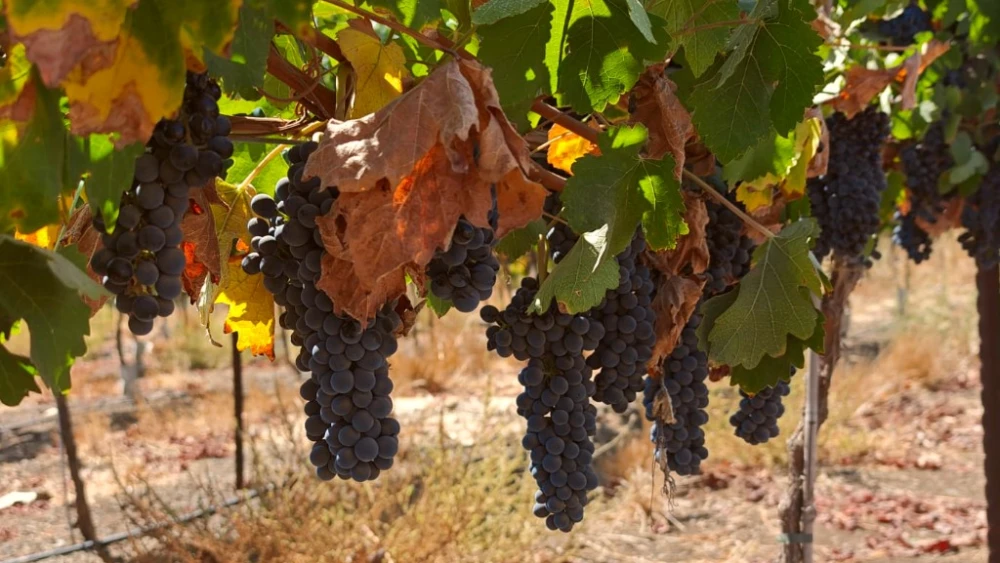
A small vineyard near Hebron has become the focus of a larger legal battle over land rights in Judea and Samaria, as an Israeli watchdog petitioned the Supreme Court for the removal of what it calls Palestinian agricultural encroachment.
The Regavim movement, an Israeli nongovernmental organization that monitors Palestinian land use and construction in Judea and Samaria, petitioned the court to order the immediate removal of an alleged agricultural encroachment spanning 0.68 acres on the outskirts of the Palestinian village of Qilqis, south of Hebron.

The petition names Defense Minister Israel Katz, the police and other military and Defense Ministry officials as respondents, asking them to enforce military orders directing authorities to remove people encroaching on state-owned land, demolish illegally built infrastructure and open criminal investigations into those responsible.
The IDF Civil Administration, named in Regavim’s petition, did not respond to TPS-IL’s requests for comment. The Civil Administration is responsible for coordinating civilian and administrative matters in Judea and Samaria.
According to aerial photographs and historical research submitted to the court, the site consists of rocky land in Area C, which is under both Israeli administrative and security control. Regavim says the alleged encroachment began in 2022, when local Palestinians carried out extensive excavation and land-preparation work. During the past year, a vineyard was planted, but enforcement authorities failed to respond to complaints.
At the center of Regavim’s petition is a broader dispute over the legal status of unregistered land in Judea and Samaria and the continued application of elements of Ottoman-era land law. Regavim argues that the absence of Israeli sovereignty and a comprehensive land-registration system creates conditions allowing Palestinians to establish claims or rights over large areas of land that are not formally registered as private property.
“Legally, that means the system relies on the laws of the last sovereign power to govern the territory, and in effect, the last sovereign was the Ottoman Empire,” Tamar Sikurel, spokesperson for Regavim, told TPS-IL. “And this is not limited to this particular issue. In other areas as well, Judea and Samaria are essentially the only place in the world where Ottoman planning and construction laws are still in effect. It is an outdated legal system designed for a reality that existed 100 or 150 years ago.”
Sikurel said that under the Ottoman legal framework, a person who continuously cultivates a piece of land for 10 years can acquire certain rights to it, although this does not necessarily mean the land is formally registered in that person’s name.
“The State of Israel and the Civil Administration have struggled with this issue, and so far, whenever the Civil Administration sees land being cultivated, it treats that situation as the status quo, almost as if the land were privately owned,” she continued.
Regavim estimates that this process has resulted in Palestinians gaining effective control over large areas of land.
“As a result, tens of thousands of acres, on the order of 125,000 acres, have been usurped across Judea and Samaria. These are enormous areas of land that have effectively become private property,” Sikurel said.
“This is one of dozens of cases we are now opening as part of a legal marathon focused on agricultural land,” she continued. “We want to push the state to change its policy, first by bringing the issue into public awareness and changing enforcement priorities. Ultimately, we want to eliminate recognition of this outdated Ottoman law, which is causing damage that could affect us for generations.”


Get the latest updates in our WhatsApp group.







An Israeli watchdog group, Regavim, has petitioned the Supreme Court to remove what it calls Palestinian agricultural encroachment on state-owned land in Judea and Samaria. The petition focuses on a 0.68-acre vineyard near Qilqis, south of Hebron, which Regavim claims was illegally established in 2022 on rocky land in Area C. The group argues that the absence of Israeli sovereignty and a comprehensive land-registration system, coupled with the continued application of outdated Ottoman-era land laws, allows Palestinians to claim rights over unregistered land. Tamar Sikurel, spokesperson for Regavim, stated, "Legally, that means the system relies on the laws of the last sovereign power to govern the territory, and in effect, the last sovereign was the Ottoman Empire." Regavim estimates that this process has led to Palestinians gaining effective control over approximately 125,000 acres across Judea and Samaria, and seeks to change state policy and enforcement priorities.
© All rights to the original article belong to the source. Din Online shows a headline, an excerpt and a link only. The objectivity rating is computed automatically and is an estimate only.
Discussion
No comments yet — be the first to comment.