His pelvis was made for walking. Hers? Not so much, claims study of Neanderthal bones
Zev Stub is the Times of Israel's Diaspora Affairs correspondent.
The reason men and women walk differently may derive from an evolutionary development that made human males more efficient walkers than their Neanderthal ancestors, according to a new Tel Aviv University study published in Scientific Reports.

While male pelvises have adapted over time to cushion the body from the impact of walking and minimize energy expenditure, women’s pelvises did not evolve the same way, due to constraints related to female reproductive systems. Female pelvises therefore remained anatomically similar to those of our Neanderthal ancestors who lived between 130,000 and 40,000 years ago, according to research led by Prof. Yoel Rak of TAU’s Department of Anatomy and Anthropology. The study was conducted in collaboration with researchers from Spain, the Technion, Bar-Ilan University and Ono Academic College.
The findings — admittedly based on a small sample size — may have new implications for the study of human anatomy, as well as for understanding the way gender roles developed over the millennia, Rak told The Times of Israel in a phone interview.
For decades, anthropologists struggled to understand the differences between the broad pelvic structure of Neanderthals and that of modern humans, Rak said. It was assumed the difference was linked to a wide birth canal designed to deliver infants with larger heads or longer gestation periods.
The discovery of two nearly complete male Neanderthal pelvises in recent decades — in the Kebara Cave in Israel in 1982 and in the Sima de los Huesos site in Spain in 2014 — was a breakthrough that made it possible for the first time to observe their similarities and differences with those of modern humans, he said.
“The Neanderthal pelvis was a mystery for many years,” Rak said. “But the moment we got two specimens, we were astonished to realize that they look like those of human females.”
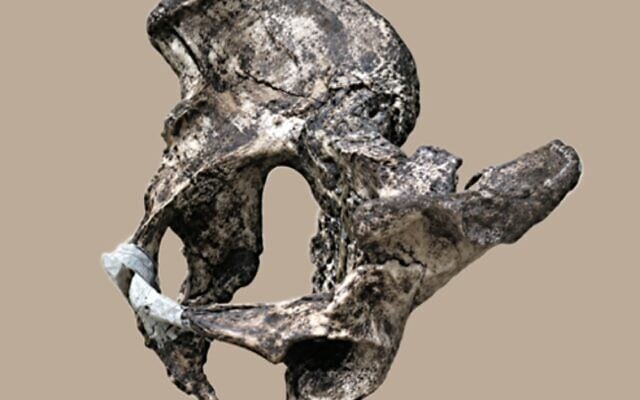
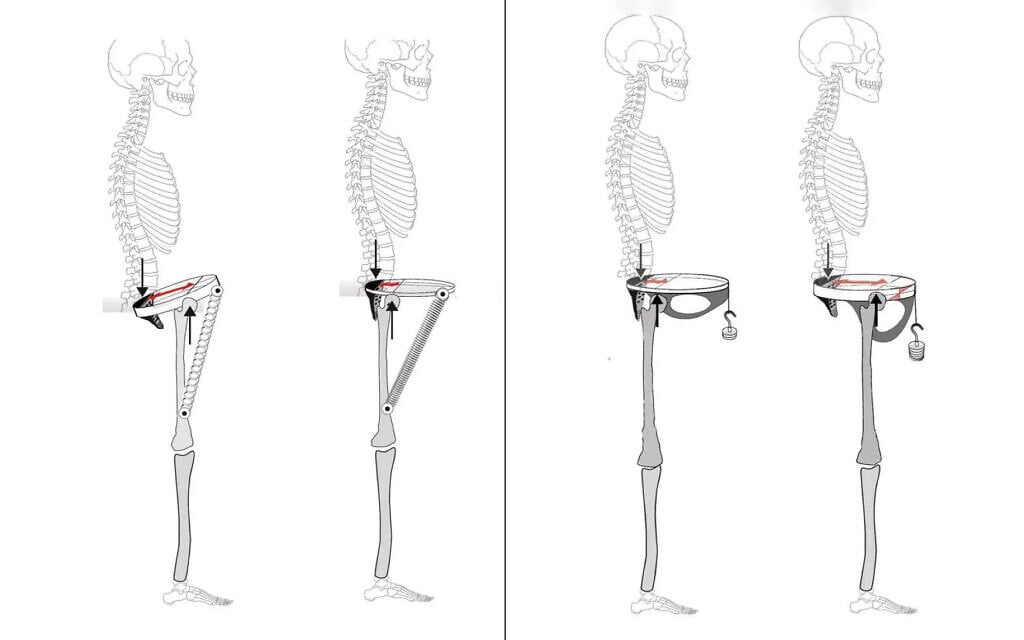
The research revealed that the key variation lay in the position of the acetabulum, or hip joint. In modern human males, the hip joints sit farther forward on the pelvic ring than in both modern human females and male Neanderthals.
With the acetabulum farther back, the body’s center of mass drops downward, traumatizing the joints and requiring energy to raise the body again in preparation for the next step, Rak explained. The design of the male pelvis puts the hips in front of the body’s line of gravity, giving them a unique biomechanical shock-absorbing mechanism that stores energy and makes long-distance walking more efficient, he said.
“[This] enables the thigh muscles to cushion the drop of the body’s center of mass, store potential energy during the step, and then release that energy immediately afterward– effectively ‘springing’ the body upward into the next step,” the report explained.
Human females, however, could not adopt all of these modifications, since childbirth requires a relatively shallow pelvis and a sufficiently wide birth canal. As a result, the female pelvis remained closer to the configuration found in male Neanderthals.
“This evolution made the male a perfect walking machine,” Rak said. “It meant that, in prehistoric times, men could go out for journeys of several days to hunt at an enjoyable, comfortable pace.”

In contrast, he said, women were not physically equipped to travel with such ease, and would more likely remain closer to the hearth.
“I don’t want to go into gender politics, but this suggests that the difference between males and females about 100,000 years ago may be to blame for the division of labor between the two sexes,” Rak said.
This implication stirred up ideological opposition from certain academics that made it difficult to publish the study, he added.
The discovery means that, while researchers have long been puzzled by the anomalies of the Neanderthal pelvis, it is actually the pelvis of the modern human male that deviated from the norm, Rak said.
Beyond the evolutionary claims, the finding has implications for modern medicine, biomechanics, musculoskeletal medicine, rehabilitation and injury prevention, he said, and may encourage researchers to reconsider how pelvic configuration affects load distribution, gait and lower-back or joint problems.
“From a clinical point of view, this research provides a completely different perspective of back pain and things like this, because we are talking about a mechanism that really nobody pointed out before us,” he said.
It also shows that even in well-researched fields like human anatomy, there is always the potential to learn more, Rak said.
“This is exciting because gross anatomy is a field where people believe everything has already been discovered,” Rak said. “These are things that [classic anatomists like] Vesalius and Galen never knew about.”

As a multimedia journalist, my job is to take the quality, fact-based journalism produced by The Times of Israel newsroom and make it accessible across every platform — from Instagram posts to podcasts to short-form videos.
This is how many, especially young people, consume news these days. But misinformation is rampant on social media. Our team at ToI produces accurate, responsible short-form reporting on Israel and the Jewish world.
If you believe in the importance of factual social media journalism, please consider joining our reader support group, The Times of Israel Community. Your financial support is essential to sustain responsible multimedia reporting.
— Gabriella Jacobs, multimedia journalist

We’re really pleased that you’ve read X Times of Israel articles in the past month.
That’s why we started the Times of Israel – to provide discerning readers like you with must-read coverage of Israel and the Jewish world.
So now we have a request. Unlike other news outlets, we haven’t put up a paywall. But as the journalism we do is costly, we invite readers for whom The Times of Israel has become important to help support our work by joining The Times of Israel Community.
For as little as $6 a month you can help support our quality journalism while enjoying The Times of Israel AD-FREE, as well as accessing exclusive content available only to Times of Israel Community members.
Thank you, David Horovitz, Founding Editor of The Times of Israel









A new Tel Aviv University study published in Scientific Reports suggests that differences in male and female walking efficiency stem from evolutionary changes in the male pelvis. Research led by Prof. Yoel Rak indicates that the male pelvis evolved to position hip joints farther forward, creating a biomechanical shock-absorbing mechanism that makes long-distance walking more efficient. This adaptation, which enables thigh muscles to "cushion the drop of the body's center of mass, store potential energy during the step, and then release that energy immediately afterward," was not adopted by females due to constraints related to childbirth, leaving their pelvic structure more akin to Neanderthals. The study, based on two nearly complete male Neanderthal pelvises, challenges previous assumptions about Neanderthal pelvic structure and has implications for understanding historical gender roles and modern musculoskeletal medicine.
© All rights to the original article belong to the source. Din Online shows a headline, an excerpt and a link only. The objectivity rating is computed automatically and is an estimate only.
Discussion
No comments yet — be the first to comment.