In a new book, Rabbi Leo Dee makes the ‘business case’ for Israel
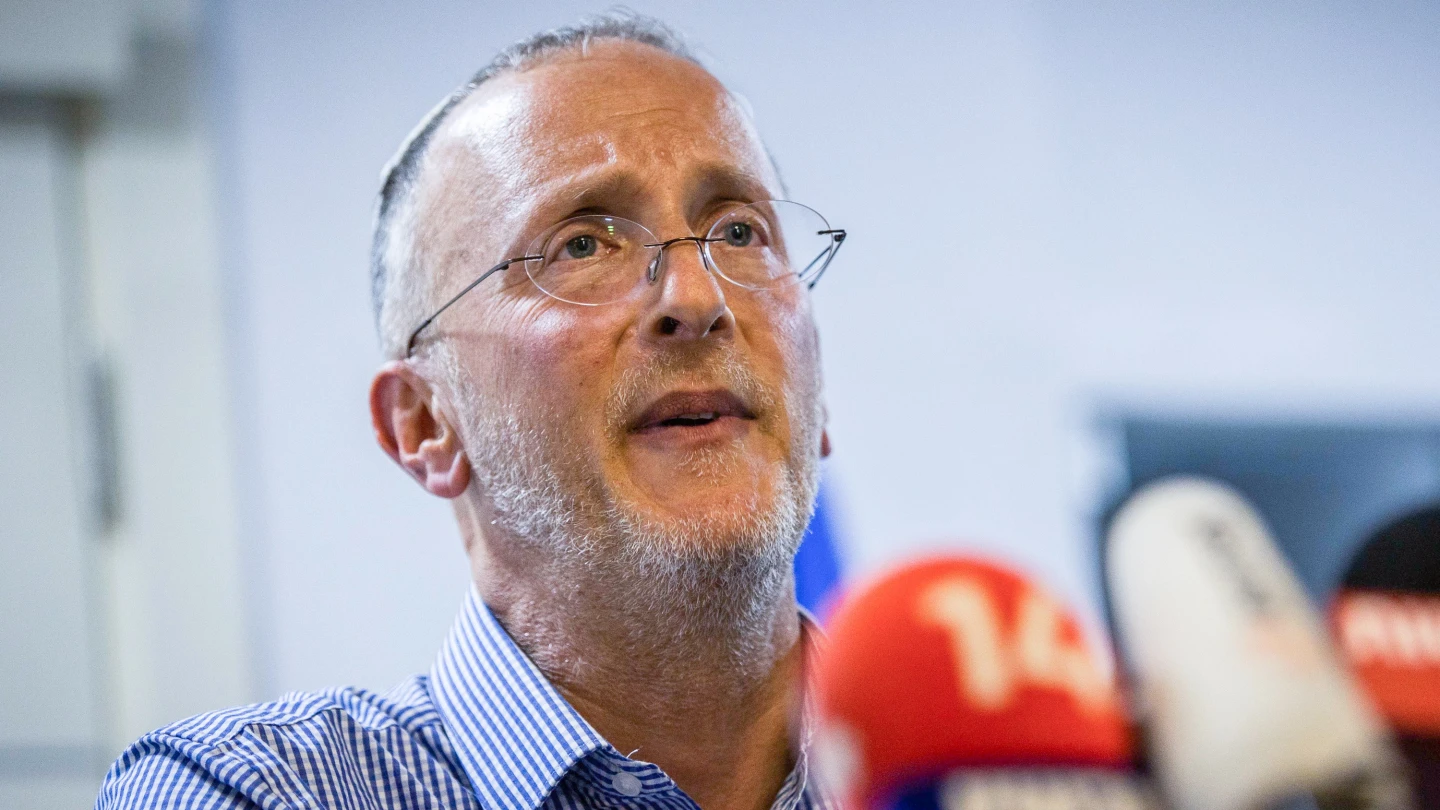
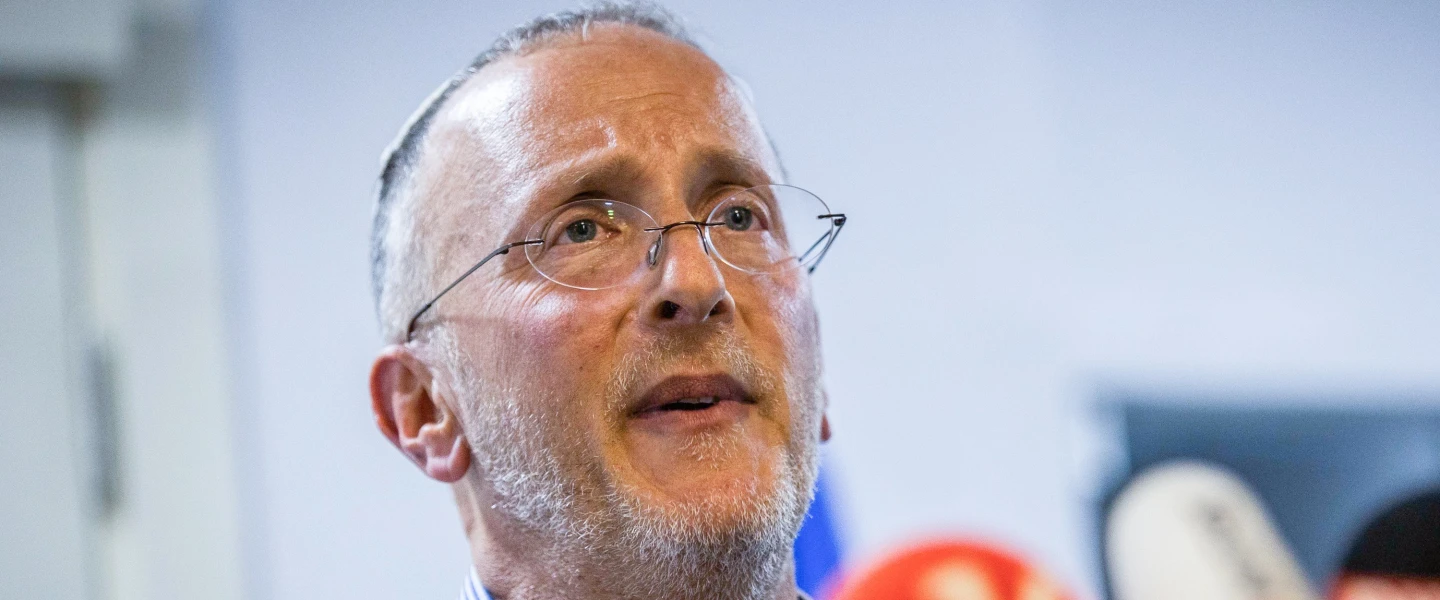
Israel is the best long-term investment a Jew can make, not only financially, but morally, strategically and spiritually, Rabbi Leo Dee argues in his new book.
“The goal of this book is not merely to build a business case for investing money in Israel,” Dee told JNS. “It is to build a business case for investing our lives in Israel as well.”
Dee, a British-born Israeli educator, rabbi and former venture capitalist whose wife, Lucy, and daughters Maia and Rina were murdered in a Palestinian terrorist attack in the Jordan Valley on April 7, 2023—with Lucy succumbing to her wounds three days later—discussed his book, The Business Case for Israel: Can You Afford Not to Be There? in an interview at the JNS News Hub in Jerusalem on Aug. 5.
The book is dedicated to his wife, Aliza, whom he married on Aug. 31, 2025. Dee lives with his family in Efrat, Gush Etzion, where he continues to write, teach and speak internationally on resilience, faith and Israel.
Published in July by Mosaica Press and available through Amazon and other major booksellers, Dee’s book challenges readers to view Israel through the lens of an investor. Applying the analytical tools of venture capital and private equity, he examines demographic, economic and strategic trends shaping the Jewish future and argues that investing one’s life in Israel may be the soundest long-term decision a Jew can make.
Rather than making a purely religious or ideological appeal for aliyah, Dee analyzes Israel as he once evaluated companies for investment, examining its strengths, weaknesses, opportunities and long-term prospects. He concludes that Israel is uniquely positioned for sustained economic, demographic and cultural growth.
The idea for the book grew out of dozens of speaking engagements in Jewish communities around the world after the Hamas-led terrorist attacks of Oct. 7, 2023, and his own family tragedy.
“After speaking so many times, I thought maybe I should write this down,” he said.
Before becoming a rabbi and immigrating to Israel, Dee spent a decade in London’s financial sector, rising to become a director of a billion-dollar private equity fund. He said the analytical framework he once used to assess companies inspired him to evaluate Israel in much the same way.
“If we looked at Israel as a company, what would be the market? What would be the product? What would be the management? What would be the employees? What would be the SWOT analysis?” he said. “What surprised me is what comes out of it is actually pretty compelling.”
(SWOT analysis is a decision-making technique that identifies the strengths, weaknesses, opportunities and threats of an organization or project.)
One encounter in Paris helped crystallize the book’s central message.
While returning from a speaking tour in the United States more than two years after Oct. 7, he and Aliza spent a day in the French capital expecting to enjoy some of its renowned kosher cuisine. Instead, they found themselves comparing it unfavorably to what they could get back home in Efrat.
Standing in the historic Jewish quarter (the Pletzl, in the heart of the Marais district) waiting for the Metro, Dee struck up a conversation with a French Jew wearing a cap instead of a kippah.
“I said, ‘Do you speak Hebrew?’ He said yes,” Dee recalled. “I said, ‘Why do you live here?’”
The man explained that France was his home, his family lived there and he spoke the language.
“I said, ‘You’re choosing to bring up your kids in a place where you have to hide your identity,’” Dee recalled. “‘You’ve got the best country in the world where you can bring them up freely as Jews, with all the best culture, and you’re choosing to be here.’”
The train arrived before the conversation could continue, but Dee said the exchange stayed with him. “I felt after that experience that I should write something,” he said.
‘The most dynamic country in the world’

Rather than encouraging investment capital alone, Dee said his goal is to persuade Jews to invest their lives in Israel. He believes many Diaspora Jews continue viewing Israel through an outdated lens dating back to the country’s early decades.
“When we were growing up, Israel was a third-world country,” he said. “Now Israel is really probably the most dynamic country in the world. Our minds are still set in that 1980s and 1990s scenario.”
He recalled arriving at Ben-Gurion Airport decades ago, when visitors disembarked into a modest terminal surrounded by open land before traveling to Jerusalem on a narrow highway. Many Jews abroad, he argued, still picture that Israel, despite its dramatic transformation into a global center of innovation and entrepreneurship.
To illustrate the point, Dee compared Israel’s trajectory to Apple’s rise over Kodak, arguing that investors who cling to outdated assumptions often miss transformational opportunities.
“The old world for Jews—the Americas, Britain, France, Argentina, Canada—those are the Kodaks,” he said. “Israel is Apple.”
Asked whether the Oct. 7 attacks made Israel a riskier place to build a future, Dee argued that they demonstrated precisely the opposite.
“I think the product of a country is its youth,” he said. “What we’re producing here is an incredible next generation.”
He contrasted the willingness of young Israelis to serve in the Israel Defense Forces with the anti-Israel demonstrations that erupted on university campuses across the West after Oct. 7, arguing that Israel’s younger generation has developed an unusually strong sense of national purpose.
“The future of the country depends on product development, which is youth development,” he said. “What you see here is a group of young people who are fighting with their lives for their culture, their religion and their country.”
Drawing on economic data cited in the book, Dee argued that Israel has consistently outperformed many Western markets over the past quarter century in both equities and real estate, while demographic trends point to continued long-term growth.
He said investors should focus less on current headlines and more on long-term trends.
“Great investors spend less time analyzing the past and more time identifying the trends that will shape the future,” he said.
Dee also cited Israel’s entrepreneurial culture as one of its greatest competitive advantages, particularly as artificial intelligence reshapes the global economy.
“The one skill that will matter most in the age of AI is entrepreneurialism,” he said. “The country with the greatest startups per capita is Israel.”
He argued that because Israel has long faced security and economic pressures, its entrepreneurs have learned to create products that solve essential problems rather than merely convenient ones.
“Everything here has to be a must-have,” he said. “We don’t have the luxury of producing things that are merely nice to have.”
‘The Jewish people belong in Israel’
The final chapters of the book return to Dee’s religious roots, arguing that the Hebrew Bible consistently presents the Land of Israel as the natural home of the Jewish people.
“The Bible is simply a book about a people who fall to the lowest level of degradation in Egypt and then come out of Egypt and come home,” he said. “The message is that the Jewish people belong in Israel.”
Dee said that while serving as a rabbi in Britain, he often focused sermons on the Torah’s moral teachings, but he came to realize after moving to Israel that its overarching narrative points to the return of the Jewish people to their homeland.
“If you look at the whole book as a whole, clearly the message is that the Jewish people belong in Israel,” he said. “We are basically the Israeli people in exile. We forgot about it for 2,000 years, but now we’re home.”
He also points to history as evidence that the center of Jewish life has shifted decisively to Israel.
For the first time in nearly 2,000 years, he said, a majority of the world’s Jews live in the Jewish state.
“Fifty percent of Jews are here now,” he said. “Within 20 years it’ll be 60%. Within 50 years it’ll be about 80%.”
Dee traces the movement of the Jewish people over the past 3,500 years—from Egypt to Babylonia, the Roman Empire, Spain and the United States—observing that Jews have historically gravitated toward the world’s leading powers. Today, he noted, that demographic center has shifted to Israel.
He leaves readers with a question rather than a definitive answer: Did Jews settle in those countries because they were already powerful, or did Jewish talent and enterprise help make them great?
“What does that mean now that most Jews are in Israel?” he asked. “Does that mean that Israel will become the new superpower in the next 20 years?”
While acknowledging that readers may reach different conclusions, Dee believes the demographic, economic and cultural trends all point in the same direction.
His message to Diaspora Jews is unequivocal. “There is no future for your children or your grandchildren in the Diaspora,” he said. “Those who are considering moving here—for themselves, for their assets and for their family’s future—should not leave it too late.”
He argued that aliyah will only become more difficult as Israel’s economy continues to strengthen and demand for housing rises.
“The longer you leave it, the more expensive it becomes,” he said. “Property prices here are going through the roof. The shekel has strengthened, and I believe that trend is set to continue.”
For Dee, the case for Israel transcends economics. Whether viewed through the lens of venture capital, demographics, Jewish history or the Bible, he believes the same conclusion emerges: The future of the Jewish people is being written in Israel.
“The goal of this book is to help people look at Israel with new eyes,” he concluded.




Get the latest updates in our WhatsApp group.
Test yourself on one question pulled from JNS reporting. New puzzles daily.






In his new book, "The Business Case for Israel: Can You Afford Not to Be There?", Rabbi Leo Dee, a British-born Israeli educator and former venture capitalist, argues that Israel represents the strongest long-term investment for Jews—economically, strategically, and spiritually. Dee, whose wife and two daughters were murdered in a Palestinian terrorist attack in April 2023, applies venture capital analytical tools to examine Israel's demographic, economic, and strategic trends. He contends that investing one's life in Israel is the soundest long-term decision, comparing Israel's trajectory to Apple's rise against Kodak, stating, "Israel is Apple." The book, published in July by Mosaica Press, also highlights Israel's entrepreneurial culture and the strong national purpose of its youth, concluding that the Jewish people's historical and demographic center has decisively shifted to Israel.
© All rights to the original article belong to the source. Din Online shows a headline, an excerpt and a link only. The objectivity rating is computed automatically and is an estimate only.
Discussion
No comments yet — be the first to comment.