Israeli cyber startup raises $113m to secure and control autonomous AI agents
Sharon Wrobel is a tech reporter for The Times of Israel

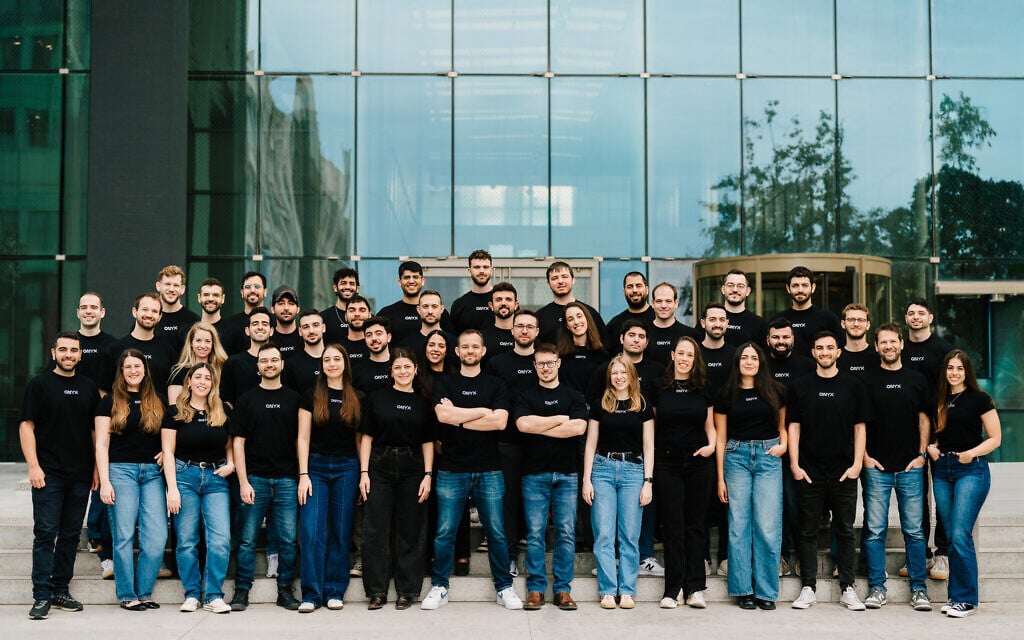
Israeli cyber startup Onyx Security announced on Thursday that it has nabbed $113 million in funding to build a platform that lets humans stay in control, as advanced autonomous systems and smart artificial intelligence agents ramp up in the workplace.
The funding round comes four months after Onyx emerged from stealth with $40 million in financing from investors. The latest round, which values the startup at about $640 million, was led by Bessemer Venture Partners. Other investors, including Cyberstarts, TCV, Conviction, FirstMark, Vintage Investment Partners, QuantumLight and G Squared also joined. To date, the startup has raised $153 million.
Onyx was founded in 2024 by Maxim Bar Kogan, a former officer in the IDF’s cyber intelligence Unit 8200 and former vice president of product and engineering at Mixtiles, together with Gil Elbaz, a former AI architect at US chip giant Nvidia, who previously served as a senior algorithm developer in the Israeli Air Force’s operational technology unit.
Bar Kogan and Elbaz said they teamed up to develop a platform to secure and control AI agents, as advanced AI systems are adopted faster than traditional enterprise security systems can keep up.
“In 2025, less than one percent of all actions were performed by AI agents,” said Bar Kogan, CEO of Onyx. “A year from now, most actions inside the enterprise will be. And not long after that, entire companies will run as autonomous agent operations, making the decisions humans used to make about capital allocation, energy grids, patient care, and supply chains.”
“That raises a fundamental question: How can organizations ensure that every action they take is legitimate?” Bar Kogan said.

By the end of 2026, the deployment of AI agents across workflow applications is forecast to increase up to 40%, according to a Gartner report. The rapid shift to agentic AI and adoption of autonomous assistants that have access to critical systems, execute workflows, manipulate data and make decisions with limited human intervention or IT oversight is creating new operational risks — opportunities for a new wave of security startups.
Using proprietary AI models, Onyx has been building what it calls an AI control plane designed for companies to see every AI agent they are running, set the rules for what those autonomous assistants can or can’t do, and enforce those rules in real time. The platform’s guardian agent identifies a risky or malicious action and decides in real time whether to approve, redirect, or block it, pulling in a human only when needed, the startup said.
“The industries that carry the weight of critical infrastructure need this first: energy, financial services, healthcare,” said Bar Kogan. “These are the sectors where an agent making the wrong decision at production speed does not produce a headline; it produces an outage, a market event, or a life at risk.”
Onyx is tapping into the market for agentic AI security, which is projected to grow from $1.65 billion in 2026 to 13.52 billion by 2032, according to research firm MarketsandMarkets.

“As AI agents become an integral part of mission-critical enterprise workflows, organizations need confidence that these systems operate safely, consistently and in accordance with corporate policy,” said Cyberstarts Managing Partner Hila Zigman. “We believe this will become one of the most significant cybersecurity categories of the coming decade.”
Onyx said the new funding will be used to train the next generation of the startup’s proprietary models and to expand business development and footprint across the US and additional global markets.
The startup employs more than 80 people across Israel, the US and Canada, working with multiple Fortune 500 companies. Most recently, AI giant Anthropic announced in June that it had integrated Onyx’s technology to help enterprises adopt AI securely. The startup said its technology secures more than 1.1 million agents for customers.

The war with Iran has been draining for all of us in Israel. But when I heard about a high casualty incident – ballistic missile impacts in Arad and Dimona that left nearly 200 people wounded – I drank a cup of coffee, packed a bag, and headed south.
There, I spoke with Shilgit, the head of an after-school program for underprivileged youth. Standing outside her destroyed center, Shilgit said it was a miracle that no children were hurt and spoke about the community coming together in the hours since.
As a Times of Israel reporter, I’m committed to telling stories of resilience like Shilgit’s. But my colleagues and I can't do this alone. If you value work like this, please consider joining our reader support group, The Times of Israel Community. Your financial support is essential to keep real human reporting like this going.
— Stav Levaton, military reporter

We’re really pleased that you’ve read X Times of Israel articles in the past month.
That’s why we started the Times of Israel – to provide discerning readers like you with must-read coverage of Israel and the Jewish world.
So now we have a request. Unlike other news outlets, we haven’t put up a paywall. But as the journalism we do is costly, we invite readers for whom The Times of Israel has become important to help support our work by joining The Times of Israel Community.
For as little as $6 a month you can help support our quality journalism while enjoying The Times of Israel AD-FREE, as well as accessing exclusive content available only to Times of Israel Community members.
Thank you, David Horovitz, Founding Editor of The Times of Israel


© All rights to the original article belong to the source. Din Online shows a headline, an excerpt and a link only. The objectivity rating is computed automatically and is an estimate only.
Discussion
No comments yet — be the first to comment.