Israel’s Haredi sector needs a third path
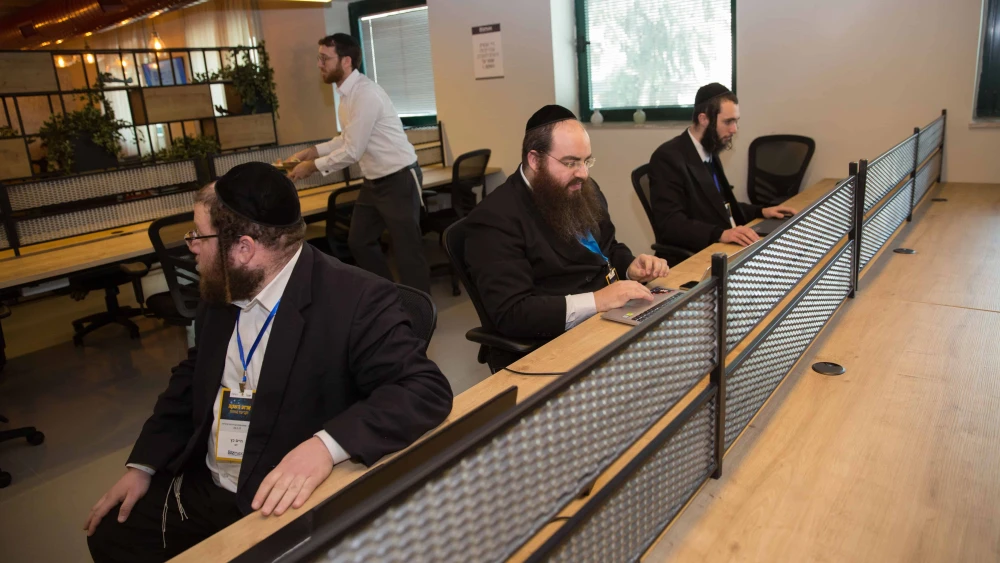

I had the privilege of making aliyah about two years ago, my decision largely prompted by the terrorist attacks in southern Israel on Oct. 7, 2023. Like so many Jews in the Diaspora, I watched what was happening and felt that whatever challenges Israel faced, it was where I belonged. I wanted to be with my people, instead of watching from thousands of miles away.
But after my arrival, I came to an unexpected realization: Some of the greatest threats to Israel’s future lay not with the enemies surrounding its borders but from the divisions within them.

Israeli society feels increasingly polarized. Nowhere is that tension felt more than within the Haredi community.
For many Haredi new immigrants to Israel (olim), particularly those coming from the United States and other Western countries, there is a profound sense of not quite belonging.
We arrive culturally Haredi. We are comfortable in Haredi shuls, schools and neighborhoods. We share a commitment to Torah, halachah and a traditional way of life. Yet many of us discover that the Haredi society we encounter in Israel is substantially different from the one in which we grew up.
In America—and, in fact, most Haredi communities outside Israel—there is nothing contradictory about being deeply committed to Torah while taking financial responsibility for one’s family. In Israel, such choices often carry a social price.
A man who enters the workforce, pursues professional training or wants to chart a somewhat more pragmatic path can find himself feeling like a second-class member of the community. For an oleh already struggling with a new language, new culture and new economic reality, that can be particularly alienating.
The result is a painful kind of homelessness.
The same disconnect exists in attitudes toward the State of Israel and the Israel Defense Forces.
Most American Haredim don’t describe themselves as ideological Zionists. There was nevertheless a basic emotional identification with Israel and with the Jews defending it. We davened for our brothers and sisters. We raised and gave money, we worried, and we prayed every time soldiers went out to battle. We understood that the men and women standing on Israel’s front lines were our blood.
Since moving here, I have been troubled by what appears to be growing anti-Zionist rhetoric within parts of the mainstream Haredi world—positions that once seemed associated primarily with the most extreme factions increasingly find an audience much closer to the center. That development should concern everyone who cares about both the Haredi community and the State of Israel.
But it’s only half of the story. Simultaneously, something else is happening.
A growing population of working Haredi Israelis has emerged, alongside communities and institutions searching for a more practical relationship with the state. They are not abandoning Torah, nor are they becoming Religious Zionists. They are asking a different question: How can we remain completely committed to a Haredi way of life while recognizing that we also have responsibilities as citizens, fathers, and members of our immediate communities and the larger Jewish people?
That may prove to be one of the most important developments in Israeli society.
We need a framework where working isn’t viewed as failure. In which supporting one’s family is honorable. In which learning Torah remains central without pretending that every man is destined to spend his entire life in full-time learning. In which engagement with the state does not require abandoning Haredi identity. And in which gratitude toward soldiers risking their lives to protect us is not treated as a theological concession.
Nowhere is that need more urgent than in the debate over the draft. The current situation is unsustainable—politically, socially and morally.
At the same time, attempts to force the entire Haredi population into a singular framework that does not recognize legitimate religious concerns will only deepen resistance and polarization.
There is another option. For generations, the Haredi world has recognized the distinction between those genuinely dedicated to full-time Torah study and those who are not. If we refuse to make that distinction in practice, we risk undermining the Torah world we are trying to protect.
When everyone is declared a full-time learner, regardless of his actual circumstances, the public eventually stops believing that the exemption is about protecting Torah study at all. Israel needs great talmidei chachamim. The Jewish people need yeshivahs and kollels. We should defend serious Torah learning unapologetically and uphold it unequivocally.
But defending Torah does not require defending a system in which someone who is no longer engaged in full-time learning is told that his only legitimate option is to remain outside both the workforce and national service.
As a community, we should be capable of saying two things at once: those genuinely devoted to Torah learning should be able to continue learning, and those who are not should take responsibility through an appropriate military or national service framework, as well as productive participation in society. Doing so would not destroy the Torah world. It may be the only way to preserve it for the next generation.
Another consequence born of this status quo receives far too little attention: aliyah.
Among Haredi Jews in the Diaspora, aliyah rates remain strikingly low compared with the enormous emotional connection many feel toward Eretz Yisrael. When I speak to people considering a move to Israel, one concern repeatedly arises: They’re nervous about entering the Israeli Haredi system.
They want to live in Israel and want their children to grow up here. They want to be part of the future of the Jewish people. But they fear having to choose between the Haredi identity and lifestyle they practice, and the practicalities of raising a family.
Imagine if there was another option on the table. Imagine an Israel with a confident, flourishing Haredi community that combines uncompromising commitment to Torah with economic responsibility, respect for those who protect the country and a thriving relationship with the state.
Imagine telling a Haredi family in New York, London or Antwerp that they don’t have to choose between their values and life in Israel—that there is a place for them here. The impact would be enormous.
It would bring badly needed talent into Israel’s workforce. It would reduce resentment among Israeli society. It would provide an honorable framework for thousands of young Haredi men who don’t belong in a full-time learning program but also don’t want to abandon their community. Most importantly, it could give an entire generation a sense that they have a home.
Oct. 7 reminded Jews worldwide that whatever our disagreements, our futures are intertwined. The response to that realization cannot only be a military one. It has to also be a social one.
The Haredi community now faces a crossroads. Its members can retreat further inward, allowing extremism and alienation to grow on one side and resentment toward Haredim to grow on the other. Or they can build something stronger: a serious form of Haredi Judaism rooted firmly in Torah while recognizing the realities and responsibilities of Jewish sovereignty.
For Haredi olim like me, that’s not an abstract ideological debate. It is a question of whether we can truly feel comfortable in the country we crossed an ocean to call home. And for Israel, it may be an opportunity far greater than realized.



Get the latest updates in our WhatsApp group.






The article argues for a "third path" for Israel's Haredi sector, advocating for a model that integrates Torah commitment with economic responsibility and engagement with the state. The author, a Haredi oleh from the U.S., notes a disconnect between the Haredi communities abroad, which often balance religious life with work, and the Israeli Haredi society, where entering the workforce can carry a social cost. This also extends to attitudes towards the IDF and the state, with growing anti-Zionist rhetoric troubling many.
- The author suggests that a framework is needed where working is honorable, supporting one's family is valued, and gratitude towards soldiers is not a theological concession.
- This "third path" would address the unsustainable draft debate by distinguishing between those genuinely dedicated to full-time Torah study and those who are not, allowing the latter to participate in national service or the workforce.
- Such a change could significantly increase aliyah rates among Haredi Jews from the Diaspora, who often fear choosing between their Haredi identity and the practicalities of raising a family in Israel.
- Ultimately, this approach aims to strengthen Haredi Judaism by rooting it firmly in Torah while acknowledging the realities and responsibilities of Jewish sovereignty, fostering a sense of belonging for a new generation.
© All rights to the original article belong to the source. Din Online shows a headline, an excerpt and a link only. The objectivity rating is computed automatically and is an estimate only.
Discussion
No comments yet — be the first to comment.