Katz boasts of ending administrative detention for Jews, increasing its use against Arabs


Defense Minister Israel Katz boasted on Tuesday of having ceased signing off on administrative detention orders against Jewish suspects, while significantly increasing the draconian tool — which allows for a suspect to be held without charge — against Arab suspects.
The same day, Katz also touted Israel’s destruction of historic villages in southern Lebanon amid its war against Hezbollah, as he appeared to boost his right-wing talking points ahead of the upcoming national election on October 27.

“I cancelled on my own initiative all administrative detention orders against settlers in the West Bank,” Katz said during a Likud campaign event in the Ariel settlement.
He said there were more than 20 such orders on the books when he entered his post as defense minister in late 2024.
Katz acknowledged the severity of an administrative detention order, saying that it allows Israeli authorities to detain people, “without a trial, without representation, without information and without [granting them any] rights.”
“I called the head of the Shin Bet at the time and informed him that this [policy] was canceled,” he said to applause from the crowd. “But which administrative detention orders do I sign — and many of them? I sign [administrative detention orders for] incidents of Palestinian terror.”

He added that he also has approved the use of administrative detentions against Arab Israeli citizens, including Bedouins from the Negev, allegedly involved in the smuggling of drones, and residents of the Galilee who are allegedly tied to terror groups.
“Why? Because this is terror activity. Why didn’t I sign against settlers? Because it’s not terror activity,” Katz claimed.
Earlier Tuesday, Katz announced that he had ordered the end of an administrative restraining order against Tal Yinon Dardik, a settler who allegedly stripped a Palestinian victim, zip-tied his genitals and paraded him around the village of Khirbet Humsa in March.
Dardik denies taking part in the incident. The restraining order sought to bar Dardik from entering the West Bank. After refusing to be placed under house arrest outside of his settlement farm, he was placed in a detention cell, where he embarked on a hunger strike for more than three weeks.
Speaking at a conference also on Tuesday hosted by the right-wing Channel 14 TV station, Katz said Israel had completely destroyed 24 historic villages in southern Lebanon whose residents were operating on Hezbollah’s behalf.
“Twenty-four Lebanese villages that were hundreds of years old — with Shiite residents who acted as enemies [of Israel] on behalf of Hezbollah and threatened our borders and our residents — we destroyed all of the buildings,” Katz said at the conference.
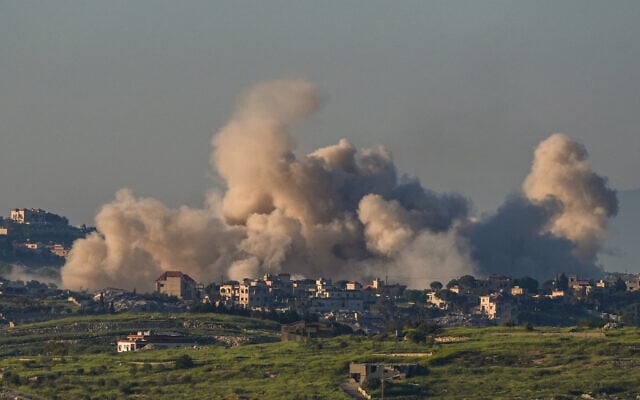
“Not one house at a time. The entirety of those villages — their demolition has been completed. We’re talking about 15,000 to 20,000 homes. All 24 of these villages have been destroyed and Bint Jbeil, which is beyond this area [of southern Lebanon] has been destroyed,” Katz said.
“We have 700 square kilometers in southern Lebanon — from the coastline until the Beaufort Castle and the foothills of the Hermon. We’re preventing infiltrations into Israeli towns, we’re preventing the firing of anti-tank missiles at Israeli towns, and the IDF continues to operate [in southern Lebanon], demolishing tunnels,” he added.
Katz said a similar strategy has been used by the IDF in Gaza where it has flattened much of the territory that was riddled with Hamas terror tunnels.
“Today, there is no Shejaiya. There is no Jabalia. All those terrible places… no longer exist,” he said. “Today, the mayor of Sderot told me, ‘I don’t see any houses [when I look toward Gaza]. I see the shoreline,” Katz continued. “We have destroyed Gaza.”

The war with Iran has been draining for all of us in Israel. But when I heard about a high casualty incident – ballistic missile impacts in Arad and Dimona that left nearly 200 people wounded – I drank a cup of coffee, packed a bag, and headed south.
There, I spoke with Shilgit, the head of an after-school program for underprivileged youth. Standing outside her destroyed center, Shilgit said it was a miracle that no children were hurt and spoke about the community coming together in the hours since.
As a Times of Israel reporter, I’m committed to telling stories of resilience like Shilgit’s. But my colleagues and I can't do this alone. If you value work like this, please consider joining our reader support group, The Times of Israel Community. Your financial support is essential to keep real human reporting like this going.
— Stav Levaton, military reporter

We’re really pleased that you’ve read X Times of Israel articles in the past month.
That’s why we started the Times of Israel – to provide discerning readers like you with must-read coverage of Israel and the Jewish world.
So now we have a request. Unlike other news outlets, we haven’t put up a paywall. But as the journalism we do is costly, we invite readers for whom The Times of Israel has become important to help support our work by joining The Times of Israel Community.
For as little as $6 a month you can help support our quality journalism while enjoying The Times of Israel AD-FREE, as well as accessing exclusive content available only to Times of Israel Community members.
Thank you, David Horovitz, Founding Editor of The Times of Israel









Defense Minister Israel Katz announced a policy shift regarding administrative detention, stating he has ceased signing such orders for Jewish suspects while increasing their use against Arab suspects, including those from the Negev and Galilee. Katz, speaking at a Likud campaign event, claimed there were over 20 administrative detention orders against settlers when he took office in late 2024, all of which he canceled. He justified this by asserting that settler activities are not “terror activity,” unlike those of Palestinians and Arab Israelis. Katz also highlighted Israel’s destruction of 24 historic villages in southern Lebanon, stating, “The entirety of those villages — their demolition has been completed.” He further mentioned similar actions in Gaza, asserting, “We have destroyed Gaza.”
© All rights to the original article belong to the source. Din Online shows a headline, an excerpt and a link only. The objectivity rating is computed automatically and is an estimate only.
Discussion
No comments yet — be the first to comment.