Likud politicians ready to battle for shrinking number of spots in Monday primary

Sam Sokol is the Times of Israel's political correspondent. He was previously a reporter for the Jerusalem Post, Jewish Telegraphic Agency and Haaretz. He is the author of "Putin’s Hybrid War and the Jews"

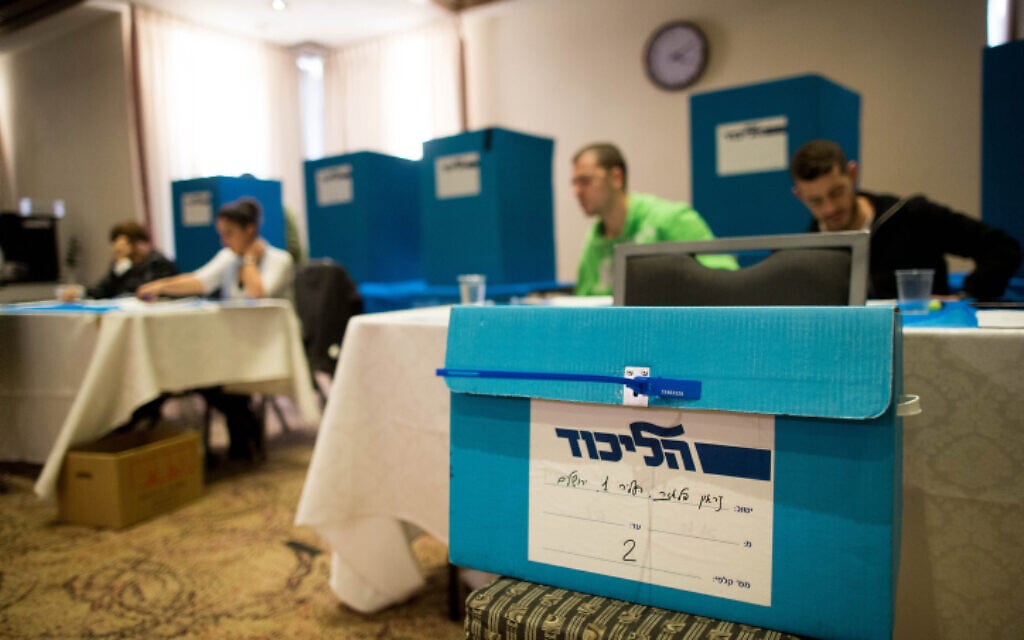
Polling stations will open across the country Monday for the 140,000 members of Prime Minister Benjamin Netanyahu’s Likud party to choose candidates for the party’s election slate, a closely watched contest that could heavily influence the character of the next government should the pro-Netanyahu bloc win in October..
ThirdReality Zigbee Smart Plug Review: Power Monitoring & Range Extending in 2026
See the review →
One of the few parties to determine its electoral lineup via primary, Likud has long prided itself on its internal democratic process. However, changes to the system this year pushed by Netanyahu shrinking the number of open spots on the roster have turned the vote into an unusually hotly contested race as party politicians jockey for a good enough showing to secure a likely Knesset seat.
The results of the vote, which is going ahead after apparent efforts by Netanyahu to cancel it were quashed, will also offer insight into whether Likud will continue sliding to the right and consolidate under Netanyahu, or whether it will bring moderates to the fore in a display of deepening internal dissatisfaction with Likud’s long-serving leader.
With about two and a half months before the general election, the field is crowded with Likud newcomers competing against incumbent MKs, many of whom are not expected to again win a seat in the upcoming Knesset.
Public opinion polls have consistently shown Likud getting 22-24 seats in the October 27 election, down from its current 32. A decision last month by the Likud Central Committee significantly expanded Netanyahu’s control over the party’s Knesset slate, granting him the power to place eight figures of his choosing in reserved slots among the top 29 places on the list.
That motion passed despite rare public dissent from within Likud, led by MK David Bitan, who argued it would push incumbent lawmakers down the list in favor of handpicked apparatchiks who will feel beholden to the premier.
Apart from his own spot atop the slate, which is not up for grabs in this vote, Netanyahu now controls the 3rd, 5th, 9th, 11th, 15th, 18th, 26th and 29th slots, giving him unprecedented influence over the party’s slate.

Foreign Minister Gideon Sa’ar, Likud Central Committee chair Haim Katz and political newcomer Oren Dobronsky have already been handed three of the eight earmarked slots — while Defense Minister Israel Katz was given an additional ninth reserved spot.
Netanyahu has also sought to influence the primary vote as seen in the public backing he gave to former Otzma Yehudit MK Almog Cohen, who recently announced his candidacy in a joint video with the prime minister.
Likud MK Eliyahu Revivo announced last week that he would not run for reelection because “the current election system and reserved spots make it extremely difficult for MKs to secure a realistic spot on the slate once again,” meaning a spot within the number of seats a party is realistically expected to win. The higher up on the slate, the better a candidate’s chances of making it into the Knesset.
In a recent poll of over 1,000 Likud members conducted by the Agam Institute, Knesset Speaker Amir Ohana came in first, followed by firebrand MK Tally Gotliv, Knesset Foreign Affairs and Defense Committee chairman Boaz Bismuth and Energy Minister Eli Cohen. Israel Katz came in at number 13 and Haim Katz at 35, the Maariv daily reported.
While the survey offered a sense of the temperature among many Likud voters, it did not include those whose votes are determined by internal deals or bloc loyalties, which play a large role in determining the final tally.
According to Hebrew media reports, the premier’s push for reserved slots was based on concerns that the primary could elevate candidates who are highly popular among the Likud base — including Gotliv and ministers Shlomo Karhi and May Golan — but who internal party polling suggests are less appealing to moderate right-wing and swing voters whose support could prove decisive in the upcoming national election. It was also reportedly motivated by Netanyahu’s desire to settle scores with internal critics such as Economy Minister Nir Barkat.

Speaking with The Times of Israel, Gotliv denied that Netanyahu was looking to push her out, insisting that any reports to the contrary are “delusional fake news.”
“The prime minister has always had between three to five agreed-upon reserved spots. There is a vote on it, which makes it democratic. There was a vote by all Central Committee members regarding the reserved spots, and there was agreement,” Gotliv said. “I expect the voters to place me as high as possible on the Likud slate, because the significance of my ranking on the list is receiving the trust of the public to become Israel’s justice minister.”
Arguing that Netanyahu will form the next government, Gotliv said that even those who fall too low on the list to enter the Knesset initially will be able to do so after the election under the so-called Norwegian Law, which allows ministers and deputy ministers from large factions to resign from the Knesset, with their seats then filled by other members of their parties.
Netanyahu’s push for control could also stem from efforts to combat growing ultra-Orthodox influence in the party, former Likud MK Sharren Haskel told The Times of Israel on Sunday, referring to recent reports that thousands of Haredi activists have been joining the party. Haskel recently split from the party in protest over its support of legislation protecting Haredi draft dodgers from prosecution.
The competition for the remaining spots on the list became even tighter on Tuesday, when the Tel Aviv District Court upheld a ruling by the party’s internal tribunal canceling a Likud Central Committee vote that allows sitting and former Knesset members, ministers and deputy ministers to compete for slots reserved for candidates from specific regions.

For decades, Likud made slots reserved for candidates from certain districts available only to those who had not already served in the Knesset, using it as a tool to diversify its ranks and give new faces a chance to make it into the Knesset. Netanyahu heavily campaigned for the Likud Central Committee to approve a change that would allow current and former lawmakers, ministers, and deputy ministers to vie for those spots as well.
Speaking with The Times of Israel, Gidon Ariel, a member of Likud’s 4,500-member Central Committee, contended that the main issue with the upcoming primary is not the number of reserved seats granted to Netanyahu but the fact that the vote was only announced in early June, giving new candidates little chance to make themselves known.
“They just pushed it off much too long,” Ariel said. “I barely know who are running for the seats. There are so many people that did not get a chance to present themselves to the general electorate of Likud that it’s very difficult for me to vote for anybody who is not a member of Knesset already… I usually like to give new people chances but if I don’t know anybody, then how can I vote for them?”
Ariela Karmel contributed to this report.

As a multimedia journalist, my job is to take the quality, fact-based journalism produced by The Times of Israel newsroom and make it accessible across every platform — from Instagram posts to podcasts to short-form videos.
This is how many, especially young people, consume news these days. But misinformation is rampant on social media. Our team at ToI produces accurate, responsible short-form reporting on Israel and the Jewish world.
If you believe in the importance of factual social media journalism, please consider joining our reader support group, The Times of Israel Community. Your financial support is essential to sustain responsible multimedia reporting.
— Gabriella Jacobs, multimedia journalist

We’re really pleased that you’ve read X Times of Israel articles in the past month.
That’s why we started the Times of Israel – to provide discerning readers like you with must-read coverage of Israel and the Jewish world.
So now we have a request. Unlike other news outlets, we haven’t put up a paywall. But as the journalism we do is costly, we invite readers for whom The Times of Israel has become important to help support our work by joining The Times of Israel Community.
For as little as $6 a month you can help support our quality journalism while enjoying The Times of Israel AD-FREE, as well as accessing exclusive content available only to Times of Israel Community members.
Thank you, David Horovitz, Founding Editor of The Times of Israel


© All rights to the original article belong to the source. Din Online shows a headline, an excerpt and a link only. The objectivity rating is computed automatically and is an estimate only.
Discussion
No comments yet — be the first to comment.