Likud touts ‘celebration of democracy’ despite party members’ reduced say on slate

Sam Sokol is the Times of Israel's political correspondent. He was previously a reporter for the Jerusalem Post, Jewish Telegraphic Agency and Haaretz. He is the author of "Putin’s Hybrid War and the Jews"

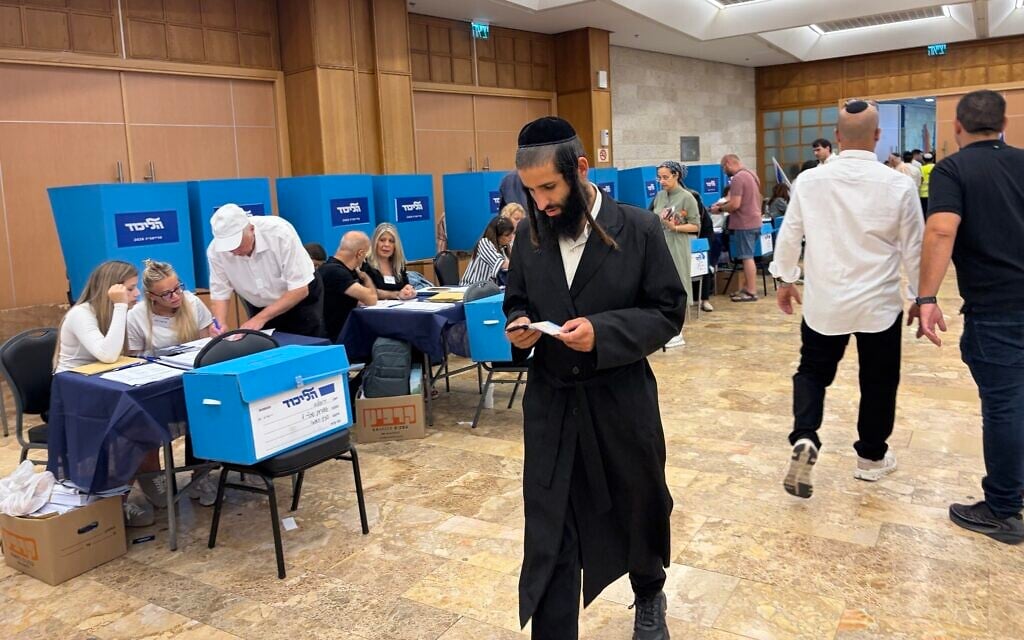
Likud members hustled into Jerusalem’s International Convention Center on Monday afternoon, passing by a dense network of stands distributing campaign literature in support of individual candidates, on their way to cast ballots in the party’s primary. The vote was one of the few being held in advance of Israel’s general election on October 27, with the leaders of most parties unilaterally selecting their Knesset slates, but this year Prime Minister and Likud leader Benjamin Netanyahu has been able to reserve more slots than ever before on the slate for preferred choices of his own.
As campaign jingles blared on loudspeakers and activists handed out stickers, lawmakers and ministers circulated, shaking hands with voters and fielding questions from political reporters. Standing outside the convention center, one young woman wearing shiny blue and white pants walked on stilts, waving a flyer backing Justice Minister Yariv Levin.
With internal party mechanisms allowing Netanyahu increased control of the Likud slate, this year’s primary, the first in four years, is both less significant and more hotly contested than in the past.
The changes gave Netanyahu control of nearly one-third of the first 30 slots on the party list, plus his own spot at No. 1 and a reserved place for Defense Minister Israel Katz. With polls showing Likud garnering 22 to 24 seats in the general election, down from its current 32, dozens of candidates have now found themselves in a game of musical chairs in which there are suddenly just a handful of seats left to grab.
Even with few newcomers expected to crack the Likud leaderboard, many of those currently in the Knesset have no realistic chance of retaining their seats.
Yet despite fierce opposition from some elements of the party, those legislators present in Jerusalem on Monday had little to say against Netanyahu’s increasing domination of the party slate — which has risen from only two prime ministerial reservations in 2015 when the practice began — even as these changes have decreased their own chances of reelection.

Asked if he thought giving the party leader so much control over its list harms Likud’s democratic nature, Energy Minister Eli Cohen told The Times of Israel that “these are eight reserved spots out of the top 32 positions, meaning 75% were chosen democratically.”
Likewise, MK Amit Halevi described the day as “a celebration of democracy” while MK Ariel Kallner claimed that the move to give the prime minister so many reserved seats was itself accepted democratically. “The party central committee made this decision, and from here, we move forward.”

A recent Channel 12 poll of Likud voters asking who they supported out of the party’s current crop of elected lawmakers and cabinet ministers found that Halevi and Kallner only received 3.3% and 1.3% support respectively, while Cohen got 10.1%.
Unlike in the general election, primary voters choose 12 candidates, rather than just one, though they do not rank their choices. Many voters have been known to follow pre-formulated candidate lists provided by special interest blocs or figures they support, and in the past, a mini-industry has formed around so-called vote bundlers who broker candidates’ inclusion on lists.
Such lists are also used to torpedo candidates. Though Economy Minister Nir Barkat snagged 17.8% support in that recent TV poll, reports suggest that the premier is seeking to use the primary to settle scores with Barkat and other internal critics.
According to a Channel 12 report last week, Barkat, who won popularity as mayor of Jerusalem before entering national politics, was a co-leader of a failed attempt to replace Netanyahu through a no-confidence vote immediately following Hamas’s October 7, 2023, attack. Asked about the tensions, a pro-Barkat activist manning the minister’s booth denied that report, stating that “he always supported the prime minister and the prime minister supports him.”

The premier’s push for reserved slots was reportedly based on concerns that the primary could elevate candidates who are highly popular among the Likud base but less likely to garner support in the general election. One such candidate was apparently MK Tally Gotliv, although the firebrand lawmaker denied this in a recent conversation with The Times of Israel.
During the course of Monday afternoon, Gotliv claimed that some polling stations were putting out “fake ballots without my name!!”
“Stay alert. Likud functionaries and vote brokers are panicking over the power of the free votes. Update me directly. A polling station with a fake ballot will be disqualified,” she wrote in a post on X, referring to organized groups within the party that control blocs of votes.
Indeed, a recent poll of so-called free voters who planned to cast ballots unencumbered by such blocs found Gotliv among the most popular candidates, along with Knesset Speaker Amir Ohana.
Like the general election, Likud’s primary vote is only held in person and not online. While there were sizable crowds in Jerusalem, the Likud primary polling station in Tel Aviv’s cavernous Heichal Shlomo arena stood nearly deserted with just under six hours left until polls were set to close at 9 p.m., possibly reflecting the party’s lack of popularity in the liberal city, or members’ dissatisfaction with the primary’s waning importance in forming the party’s slate.
Stands in support of various candidates in front of the venue were mostly empty and activists standing outside the polling station rushed at the small number of voters present to loudly proclaim the virtues of their chosen contenders.

As of 4:30 p.m., 26.44% of Likud voters had cast ballots at 107 polling stations, 1.4 percentage points higher than at the same time of day in 2022, a Likud spokesman said.
According to the Israel Democracy Institute, turnout in the three most recent Likud primaries averaged approximately 57% at the end of the day.
One group that showed up to vote at the Jerusalem Convention Center on Monday was the Haredi community. According to Channel 12, ultra-Orthodox activists ramped up recruiting fellow Haredim to the party ahead of the primary. The report estimated that 7,000 of Likud’s roughly 140,000 members are Haredi.
Speaking with The Times of Israel outside the polling station, one veteran Haredi member of Likud indicated he would not necessarily support the party in the general election.
Rather, he said, he would vote for whichever party was best in terms of “the wholeness of the Torah, the wholeness of the nation, and the wholeness of the Land of Israel.”

As a multimedia journalist, my job is to take the quality, fact-based journalism produced by The Times of Israel newsroom and make it accessible across every platform — from Instagram posts to podcasts to short-form videos.
This is how many, especially young people, consume news these days. But misinformation is rampant on social media. Our team at ToI produces accurate, responsible short-form reporting on Israel and the Jewish world.
If you believe in the importance of factual social media journalism, please consider joining our reader support group, The Times of Israel Community. Your financial support is essential to sustain responsible multimedia reporting.
— Gabriella Jacobs, multimedia journalist

We’re really pleased that you’ve read X Times of Israel articles in the past month.
That’s why we started the Times of Israel – to provide discerning readers like you with must-read coverage of Israel and the Jewish world.
So now we have a request. Unlike other news outlets, we haven’t put up a paywall. But as the journalism we do is costly, we invite readers for whom The Times of Israel has become important to help support our work by joining The Times of Israel Community.
For as little as $6 a month you can help support our quality journalism while enjoying The Times of Israel AD-FREE, as well as accessing exclusive content available only to Times of Israel Community members.
Thank you, David Horovitz, Founding Editor of The Times of Israel


© All rights to the original article belong to the source. Din Online shows a headline, an excerpt and a link only. The objectivity rating is computed automatically and is an estimate only.
Discussion
No comments yet — be the first to comment.