Maine rabbis issue joint call for peace, urge politicians to stop calling Gaza war ‘genocide’


JTA — Every congregational rabbi in Maine has signed onto a statement calling for peace and urging the state’s political leaders to stop using the term “genocide” to describe Israel’s war in Gaza, following a Democratic primary in which several candidates made the accusation.
But the 11 rabbis also indicated that they, too, were unsatisfied with matters in the Middle East and called on Israeli and Palestinian leaders to work toward a peaceful future.

“We call upon Maine’s leaders, and particularly its political leaders, to reject the irresponsible usage of the term in describing the Israel-Hamas War,” said the statement released on Friday. “We also call upon Israeli and Palestinian leaders to end the cycle of violence and to create a better world for both Palestinian and Israeli children.”
The statement, titled “A Call for Peace and Responsible Rhetoric,” argued that using the genocide term as a “political slogan does not advance peace in the Middle East.” The term “erases essential moral and legal distinctions, diminishes the meaning of genocide, and inflames hatred for the local Jewish community,” the rabbis said. Israel vehemently rejects the accusation.
“Compassion for Palestinians does not require the adoption of hateful and misleading language,” they continued. “Advocating for peace does not require participation in a ‘Holocaust inversion’ against the Jewish community. And political leadership does not require demonizing one community in the service of another.”
The statement came after Troy Jackson, a former logger and state Senate president, secured the Maine Democratic US Senate nomination Saturday at the party’s nominating convention to replace Graham Platner, a staunch Israel critic who dropped out of the race earlier this month. Platner faced a rape allegation, which he denies. Jackson will now run against Republican incumbent Sen. Susan Collins in November’s general election. Both parties view the race as key to controlling the Senate.

Platner routinely used the word “genocide” to describe Israel’s actions. And ahead of the convention to replace him, Jackson and several other Democratic hopefuls who later exited the race began using the term to describe Israel’s war in Gaza for the first time, a shift that drew scrutiny from some Jewish leaders and voters in the state.
The use of the term has become a “currency for acquiring power and position in Maine’s Democratic party,” Rabbi Rachel Isaacs, the leader of Beth Israel Congregation in Waterville, who also signed the statement, told the Jewish Telegraphic Agency.
“Too many Maine Democrats are cynically willing to trade in that currency at the expense of our safety and dignity,” she said in an emailed statement. “We decided we needed to say something collectively, both about the specious and dangerous nature of the claim, and about how much damage has been done to our families and congregants.”
The statement Friday was spearheaded by the Jewish Community Alliance of Southern Maine and signed by every congregational rabbi in the state, including Rabbi Bill Siemers of the Conservative Congregation Beth Israel in Bangor and Rabbi Erica Asch of the Reform Temple Beth El in Augusta. (Rabbis affiliated with the Chabad movement in Maine did not appear on the signatory list.)
Zach Schwartz, the director of the Jewish Community Relations Council at the Jewish Community Alliance of Southern Maine, said the federation hoped the “unity displayed here in Maine can inspire Jewish communities across the US to also unite in a similar way.”
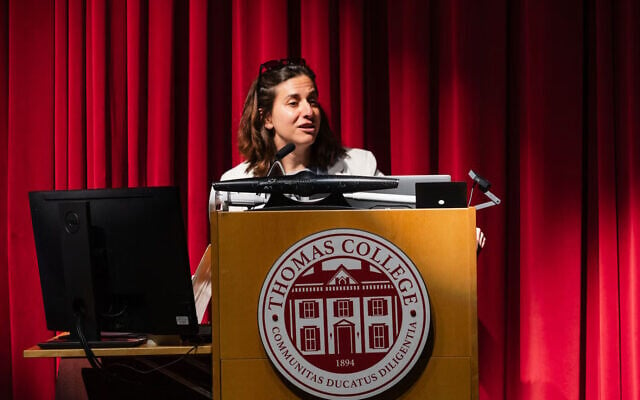
Rabbi Josh Stanton, the associate vice president of interfaith and intergroup initiatives for Jewish Federations of North America, also hailed the joint statement.
“Maine’s Jewish clergy are setting an important example with their call to put aside inflammatory rhetoric and look to the common good,” Stanton said in an emailed statement. “At a time of rising polarization and declining civil discourse, the Jewish Community Alliance of Southern Maine’s efforts to unify the community around this important message are a mark of true leadership.”
Isaacs told JTA that she hoped Jackson would “support, understand, and advocate for all of Maine’s citizens, including the totality of Maine’s diverse Jewish community.”
“Work with us to figure out how to express outrage and legitimate critique of Israel’s government without succumbing to language that you might not know is an ancient antisemitic trope, or dismissing the security needs of Israel’s citizens,” Isaacs said of her message to Jackson. “Please have the courage to forge your own path, and not follow in the footsteps of Graham Platner, a man who should have never been normalized, endorsed, or empowered.”

The war with Iran has been draining for all of us in Israel. But when I heard about a high casualty incident – ballistic missile impacts in Arad and Dimona that left nearly 200 people wounded – I drank a cup of coffee, packed a bag, and headed south.
There, I spoke with Shilgit, the head of an after-school program for underprivileged youth. Standing outside her destroyed center, Shilgit said it was a miracle that no children were hurt and spoke about the community coming together in the hours since.
As a Times of Israel reporter, I’m committed to telling stories of resilience like Shilgit’s. But my colleagues and I can't do this alone. If you value work like this, please consider joining our reader support group, The Times of Israel Community. Your financial support is essential to keep real human reporting like this going.
— Stav Levaton, military reporter

We’re really pleased that you’ve read X Times of Israel articles in the past month.
That’s why we started the Times of Israel – to provide discerning readers like you with must-read coverage of Israel and the Jewish world.
So now we have a request. Unlike other news outlets, we haven’t put up a paywall. But as the journalism we do is costly, we invite readers for whom The Times of Israel has become important to help support our work by joining The Times of Israel Community.
For as little as $6 a month you can help support our quality journalism while enjoying The Times of Israel AD-FREE, as well as accessing exclusive content available only to Times of Israel Community members.
Thank you, David Horovitz, Founding Editor of The Times of Israel










All congregational rabbis in Maine have issued a joint statement urging the state's political leaders to cease using the term "genocide" to describe Israel's war in Gaza. The statement, titled "A Call for Peace and Responsible Rhetoric," argues that using the term as a "political slogan does not advance peace in the Middle East" and "inflames hatred for the local Jewish community." This initiative follows a Democratic primary where several candidates, including Graham Platner and Troy Jackson, used the term, a move Rabbi Rachel Isaacs described as a "currency for acquiring power and position in Maine’s Democratic party." The rabbis also called on Israeli and Palestinian leaders to work towards a peaceful future.
© All rights to the original article belong to the source. Din Online shows a headline, an excerpt and a link only. The objectivity rating is computed automatically and is an estimate only.
Discussion
No comments yet — be the first to comment.