Mapping antisemitism, a website helps Jewish jet-setters avoid turbulence
Zev Stub is the Times of Israel's Diaspora Affairs correspondent.
Shay Yaish left his tech job a year ago, with plans to strike out on his own with a new startup. Frustrated with his inability to come up with an idea for his venture, he told his wife he needed a vacation to help him think. And that’s when it hit him.

“With all the antisemitism around the world, we started searching for safe places for Israelis to visit,” he said. “And then I thought: Why isn’t there a website online where I can find this information easily?”
That idea led Yaish to create Safe for Jews, a Hebrew and English website that uses artificial intelligence, government travel advisories, and community reports to rate the relative safety of countries and cities for Jewish travelers.
Hundreds of people now look at the site every day for help deciding where to vacation, he said.
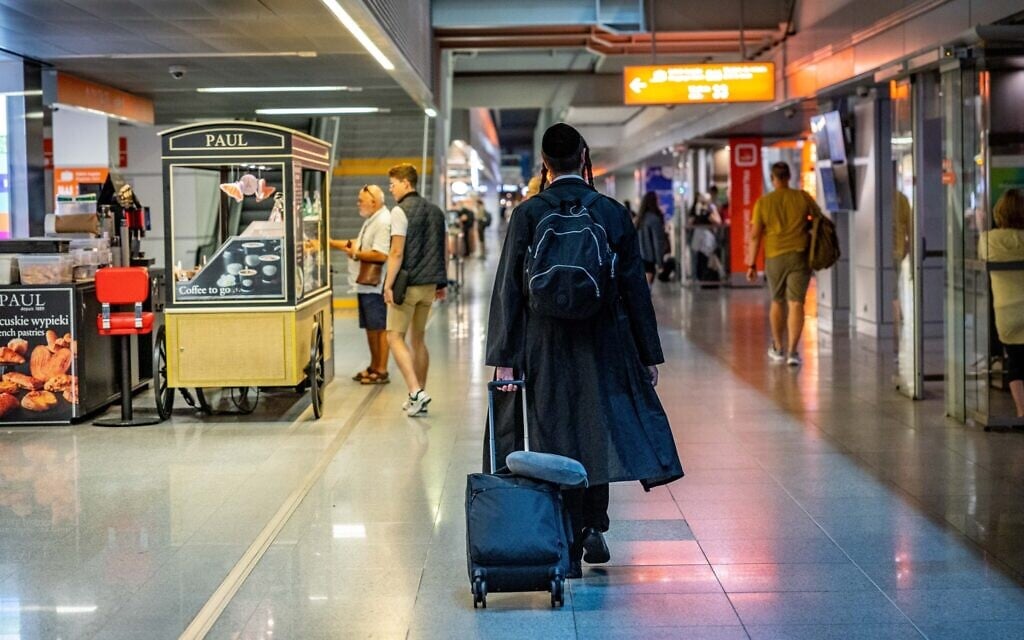
Traveling while Jewish, especially identifiably so, has always been fraught in certain parts of the world. A rise in global antisemitism in the wake of the October 7, 2023, attacks and international anger over Israel’s response in Gaza have seemingly shrunk the number of places Jews from Israel or abroad can reasonably expect to feel safe from antisemitic attacks or harassment.
Many travelers now think twice before traveling to parts of the world where anti-Jewish and anti-Israel sentiment is especially high, or at least make sure to hide any external symbols that could mark them as Jewish.
“When I first created this site, I thought that anti-Israel hatred would be trendy for a bit,” Yaish said. “I wouldn’t have imagined it would still be like this today.”
Yaish, 34, was born in Tiberias and now lives in Pardes Hanna. He described himself as a “developer at heart” who has been coding since he was 16 years old.
He developed Safe for Jews with the help of AI tools, and uses AI to update the site with news about antisemitic incidents. It also draws from Israel’s official travel advisories for different countries — which are not always based on antisemitic attitudes or threats against Jews — as well as reports submitted by the site’s users, to generate a travel advisory and summary of relevant information for travelers.
“It’s not just ‘is this country safe?’ but ‘what’s happening in the specific region I’m planning to visit, and what kind of incidents have been reported there recently?'” Yaish said.
Everything is compiled automatically using AI, Yaish said, although he checks the output every few days to make sure the information looks correct. Because it relies on AI and reports scraped from the web, its advisories are not always up to date or based on rigorous research.
The site advises users not to rely solely on its advice.
“We have a disclaimer on the site reminding users that this is not an official rating, and that we take no responsibility for decisions made using the site,” Yaish noted. “People still have to do their own research and use good judgment.”

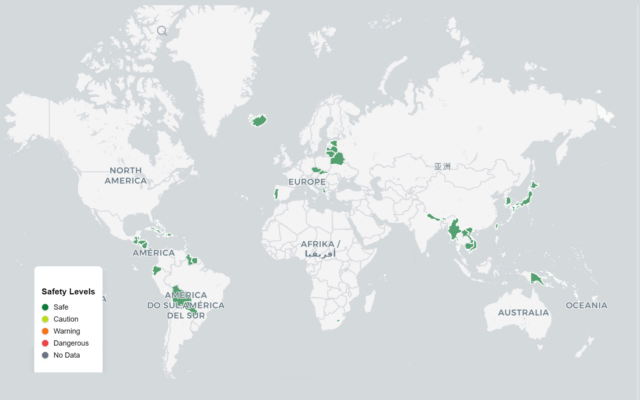
The list of safe places for Jews to visit has decreased in size over time, the website shows. Among the countries with the highest safety classifications are Eastern European countries like the Czech Republic, Albania, Lithuania and Belarus, South American countries like Bolivia, Paraguay, and Ecuador, and far eastern countries like Japan, Vietnam, and Cambodia.
Nepal, Iceland and Cyprus are also classified as safe, as are remote and exotic destinations like the Marshall Islands, Micronesia, Palau and Tuvalu.
“There are a lot of places that people haven’t heard of,” Yaish admitted.
Many common destinations, like the United States, Australia, and most of Europe, are labeled “caution” on the website, with a note that “Jewish/Israeli symbols should be kept to a minimum.”
Other countries that have seen more virulent antisemitic activity, including Spain, Canada, the UK, South Africa and Russia, are marked “warning,” with a reminder to stay alert and avoid identifying as Jewish or Israeli. A number of mostly Muslim nations, including Iran, Afghanistan, and Egypt, are labeled “dangerous.”

The different levels are meant to reflect the ever-changing realities on the ground and the complex tensions that many Jews feel when they travel, Yaish said.
“I have friends who might feel comfortable saying they are Israeli when they are in Cyprus, but if they are in, say, Spain, they try to hide their identities,” Yaish said. “It depends on the country and their comfort level.”
Currently, Yaish doesn’t make any money from the site, which launched a year ago. In the future, he hopes to expand it into a hub for Jewish travelers to find Jewish-friendly hotels, kosher restaurants, and other resources to meet their specific needs.
But for now, guiding Jewish travelers through the chaos of global antisemitism is challenging enough.
“Things are really confusing now for Israelis who want to travel,” Yaish said. “People just want to figure out where they can go without taking a risk.”

As a multimedia journalist, my job is to take the quality, fact-based journalism produced by The Times of Israel newsroom and make it accessible across every platform — from Instagram posts to podcasts to short-form videos.
This is how many, especially young people, consume news these days. But misinformation is rampant on social media. Our team at ToI produces accurate, responsible short-form reporting on Israel and the Jewish world.
If you believe in the importance of factual social media journalism, please consider joining our reader support group, The Times of Israel Community. Your financial support is essential to sustain responsible multimedia reporting.
— Gabriella Jacobs, multimedia journalist

We’re really pleased that you’ve read X Times of Israel articles in the past month.
That’s why we started the Times of Israel – to provide discerning readers like you with must-read coverage of Israel and the Jewish world.
So now we have a request. Unlike other news outlets, we haven’t put up a paywall. But as the journalism we do is costly, we invite readers for whom The Times of Israel has become important to help support our work by joining The Times of Israel Community.
For as little as $6 a month you can help support our quality journalism while enjoying The Times of Israel AD-FREE, as well as accessing exclusive content available only to Times of Israel Community members.
Thank you, David Horovitz, Founding Editor of The Times of Israel





Shay Yaish launched Safe for Jews, a Hebrew and English website, to help Jewish travelers identify safe destinations amid rising global antisemitism. The platform utilizes AI, government travel advisories, and community reports to rate countries and cities, providing summaries of relevant information and recent incidents. Yaish developed the site after realizing the need for an accessible resource to find safe places for Israelis to visit, stating, "Why isn't there a website online where I can find this information easily?"
- The site classifies countries into categories like "safe," "caution" (e.g., US, Australia, most of Europe, where Jewish/Israeli symbols should be minimized), "warning" (e.g., Spain, Canada, UK, where travelers should stay alert and avoid identifying as Jewish), and "dangerous" (e.g., Iran, Afghanistan, Egypt).
- Eastern European, South American, and Far Eastern countries, along with remote destinations, are often listed as safer.
- While AI compiles information, Yaish manually checks the output, and the site includes a disclaimer advising users to conduct their own research.
- Yaish hopes to expand the site into a comprehensive hub for Jewish travelers, offering resources like Jewish-friendly hotels and kosher restaurants.
© All rights to the original article belong to the source. Din Online shows a headline, an excerpt and a link only. The objectivity rating is computed automatically and is an estimate only.
Discussion
No comments yet — be the first to comment.