יום רביעי, ספטמבר 9, 2026 עברית|English Log in Free sign-up
LIVE
John Malkovich to return to Israel with satirical theatrical-musical showWhat to watch this week: Gal Gadot speeds through The Runner, Hearsay delivers gripping thrillerHollywood’s Jews take sides in Mark Ruffalo-Paramount antisemitism rowIMPACT's Digital Defender 102 workshop helps Jews aged 55 and up fight online antisemitismUS, China to discuss AI safety risks, cooperation on monitoring AI-directed cyberattacksHouthis escalate fighting in Yemen, eyeing control over Mocha Port, Bab al-Mandab Strait – reportHow Israel became the Left’s organizing target for grievance coalitions – opinionFrom Saul's failure to David's reckoning, 'Human Kingship' examines the dangers of power – reviewWater sector 'fully stable' following assessment, reservoirs to be filled over weekendWater crisis in Israel raises fears over impact of Gaza sewage – The Spokesman-ReviewPalestinian football returns after nearly 3-year pause due to Israel’s genocideJohn Malkovich brings 'The Music Critic' to Israel in rare international bookingJohn Malkovich to return to Israel with satirical theatrical-musical showWhat to watch this week: Gal Gadot speeds through The Runner, Hearsay delivers gripping thrillerHollywood’s Jews take sides in Mark Ruffalo-Paramount antisemitism rowIMPACT's Digital Defender 102 workshop helps Jews aged 55 and up fight online antisemitismUS, China to discuss AI safety risks, cooperation on monitoring AI-directed cyberattacksHouthis escalate fighting in Yemen, eyeing control over Mocha Port, Bab al-Mandab Strait – reportHow Israel became the Left’s organizing target for grievance coalitions – opinionFrom Saul's failure to David's reckoning, 'Human Kingship' examines the dangers of power – reviewWater sector 'fully stable' following assessment, reservoirs to be filled over weekendWater crisis in Israel raises fears over impact of Gaza sewage – The Spokesman-ReviewPalestinian football returns after nearly 3-year pause due to Israel’s genocideJohn Malkovich brings 'The Music Critic' to Israel in rare international booking
World

Mecca defense pact ‘sidesteps the United States and Israel’
אוג 13, 2026 ·  Source: JNS 86Objectivity score86/100

Mecca defense pact ‘sidesteps the United States and Israel’

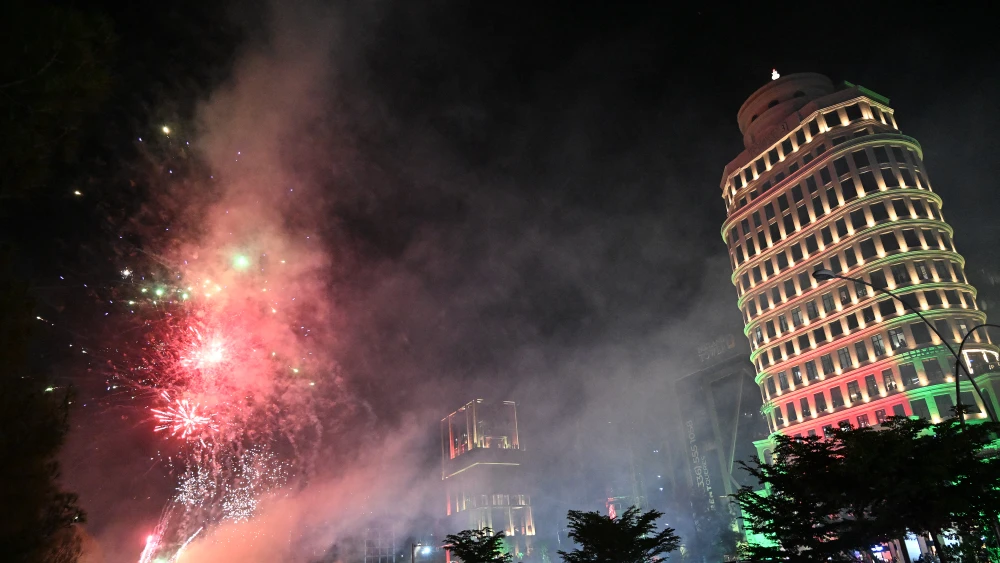
Fireworks explode over Islamabad as part of celebrations to mark the signing of a trilateral defense agreement between Saudi Arabia, Pakistan and Turkey in Islamabad on Aug. 9, 2026. Photo by Aamir QURESHI/AFP via Getty Images.
Yaakov Lappin
Yaakov Lappin

A mutual defense pact signed on Aug. 7 by Turkey, Saudi Arabia and Pakistan signifies the rise of a Sunni bloc that could adopt new postures toward both Iran and Israel, observers in Israel told JNS in recent days.

Meir Ben-Shabbat, the chairman of the Misgav Institute for National Security who is a former Israeli national security adviser and head of the National Security Council, said the newly signed Mecca Joint Defense Agreement “symbolizes several things.”

These include “the rise of a strong central Sunni axis that sees itself as capable of serving as a counterweight to other regional forces; an understanding among the states of this axis that the Iranian threat is apparently not expected to disappear in the foreseeable future and requires preparation for scenarios of its development; a desire to create an arrangement that is not dependent on the United States and bypasses Israel, an arrangement that can of course realize political ambitions and cross-continental economic partnerships and is not purely security-related.”

Ben-Shabbat stressed the expansion of Turkish influence reflected in the Mecca pact as part of Turkish President Recep Tayyip Erdoğan’s regional aspirations. He also noted a striking absence from the new grouping: the United Arab Emirates.

The UAE “did not join this arrangement,” Ben-Shabbat noted.

The former national security adviser said Israel’s response should focus on strengthening its own partnerships.

“Alongside efforts against Iran and its proxies, in the face of this emerging step, Israel needs to continue and advance its cooperation with India and the Emirates in parallel with cooperation with the eastern Mediterranean states, and of course be alert to Erdogan’s conduct in the arenas close to us,” he said.

Dr. Brandon Friedman, director of research at the Moshe Dayan Center for Middle Eastern and African Studies at Tel Aviv University, told JNS that the pact reflects a shared perception among its three signatories that “both Israel and Iran are potentially destabilizing threats” to them.

“The Pakistan-Saudi defense pact was signed in the immediate aftermath of Israel’s attack on Doha last September 2025,” Friedman said, adding that direct Iranian strikes on two of the three signatories during the current war reinforced the logic behind expanding that arrangement.

“Both Turkey and Saudi Arabia have been attacked by Iran during the current war,” Friedman noted.

Egypt’s absence from the pact, despite Turkish invitations, stems from the binding mutual-defense clause clashing with Cairo’s existing web of relationships, Friedman assessed.

“Egypt is uncomfortable with the NATO-like binding element of the pact that demands it would respond to an attack on the other members,” he said.

“This would put it in an untenable position regarding its relationship with UAE, a crucial investor in its economy, which has had disputes with Saudi Arabia, and potentially also regarding its peace treaty with Israel,” Friedman said, adding that Cairo’s economic ties elsewhere compound the problem.

“India is also a major trade and economic partner for Egypt, and this binding defense pact would create problems in the event of renewed India-Pakistan hostilities,” he said.

The Mecca Joint Defense Agreement was formally signed on Aug. 7, 2026, by Saudi Crown Prince Mohammed bin Salman, Turkish President Recep Tayyip Erdoğan and Pakistani Prime Minister Shehbaz Sharif.

According to an Aug. 7 Reuters report, the pact declares that “an armed attack against any of the three would be regarded as an attack on all.” Turkish Vice President Cevdet Yilmaz reportedly said the agreement “was not aimed at any specific country,” while a Turkish official described it as purely defensive and said it did not supersede existing agreements with other states.

The pact builds on the earlier Strategic Mutual Defense Agreement signed between Pakistan and Saudi Arabia on Sept. 17, 2025. Pakistani Foreign Minister Ishaq Dar said on Aug. 9 that the pact was “purely defensive in nature” and remained open to other countries willing to uphold its principles, according to the Associated Press.

Mamdani Shavuot David Niederman
The coastal patrol ship USS Tempest (PC 2) transits the Strait of Hormuz, Dec. 2, 2020. Credit: Petty Officer 2nd Class Matthew Riggs/U.S. Navy.
State Department

Get the latest updates in our WhatsApp group.

The Golden Gate Bridge in San Francisco. Credit: Pexels.
Venezuelan Representative to the U.S. Felix Plasencia boards an American Airlines flight to Caracas at Miami International Airport on April 30, 2026, marking the first direct flight between the two nations in seven years. Photo by Chandan Khanna/AFP via Getty Images.
Mamdani
Democratic candidate for U.S. Senate, Minnesota Lt. Gov. Peggy Flanagan, speaks during a volunteer appreciation event at Black Heart of Saint Paul in St. Paul, Minnesota on August 8, 2026. Photo by Stephen Maturen/Getty Images.
Israeli Prime Minister Benjamin Netanyahu speaks during the transfer of the remains of Theodor Herzl's grandparents to Mount Herzl, Aug. 5, 2026. Credit: YouTube/WZO.
Harold Rhode
תמונת סיקור
💬 רוצים להגיב ולהצטרף לדיון? הצטרפו — חינם, ומקבלים גם את הדיג׳סט השבועי.
🗞️ In-depth summary

A mutual defense pact, the Mecca Joint Defense Agreement, was signed on August 7, 2026, by Turkey, Saudi Arabia, and Pakistan, signaling the rise of a Sunni bloc. Israeli observers view this as a strong central Sunni axis, capable of counterbalancing other regional forces and preparing for the Iranian threat, according to Meir Ben-Shabbat, former Israeli national security adviser. He stated the agreement "symbolizes several things," including a desire for an arrangement independent of the United States and bypassing Israel, with potential for political and economic partnerships. Dr. Brandon Friedman of Tel Aviv University noted the pact reflects a shared perception that "both Israel and Iran are potentially destabilizing threats." Egypt's absence is attributed to the pact's NATO-like binding mutual-defense clause, which conflicts with its existing relationships and economic ties, particularly with the UAE and India. The agreement, described as purely defensive, builds on a prior Pakistan-Saudi Arabia pact and is open to other countries.

Automatically generated summary based on the original article; quotes are from the source.
This story is based on reporting by JNS.
Read the full article at the source →
🏷

© All rights to the original article belong to the source. Din Online shows a headline, an excerpt and a link only. The objectivity rating is computed automatically and is an estimate only.

Related

Discussion

No comments yet — be the first to comment.

Add a comment