New Colombian president, who has pledged to restore ties with Israel, takes office


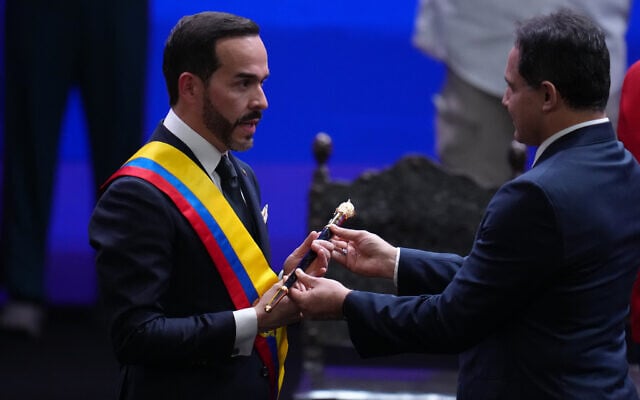
Conservative Abelardo de la Espriella was sworn in as Colombia’s president Friday, not in the capital as is the tradition, but in the volatile southwestern city of Cali in a move meant to signal his hard-line approach to illegal armed groups operating in the region.
De la Espriella, 48, succeeds Gustavo Petro after winning a close runoff election on June 21 against the outgoing president’s ally, Senator Iván Cepeda.
De la Espriella, who has never held public office before, ran as an outsider, financing his campaign with the fortune he amassed as a lawyer and businessman. His inauguration, held at a university auditorium before Congress, marks a further shift to the right in the region.
Israel’s Foreign Minister Gideon Sa’ar, King Felipe VI of Spain, acting US Attorney General Todd Blanche, FIFA President Gianni Infantino and Latin American presidents including Argentina’s Javier Milei, Ecuador’s Daniel Noboa and Chile’s José Antonio Kast all attended.
After the ceremony, de la Espriella plans to travel to a military battalion in Cali to address the troops. He aims to boost the morale of the service members and simultaneously warn the illegal armed groups operating in the area that they must surrender or face being declared “military targets.”
De la Espriella, who calls himself “El Tigre” or “The Tiger,” has pledged to tackle the persistent violence in Colombia by breaking with Petro’s policy of negotiating with armed groups, arguing that the peace process has failed.
Security became the main challenge of the swearing-in ceremony. Authorities deployed several checkpoints to search vehicles, looking for potential suspects or explosives.
Illegal economies, such as drug trafficking and illegal mining, are disputed among groups like the dissident factions of the now-defunct Revolutionary Armed Forces of Colombia that did not accept the peace agreement signed a decade ago, the Clan del Golfo cartel, and the National Liberation Army guerrilla group.
De la Espriella, a Colombian-American citizen, comes to power after receiving the backing of US President Donald Trump and as regional concerns grow about crime, immigration and the economy.
“His rise to power will reinforce this rightward shift across much of Latin America and consolidate a regional bloc of conservative governments against a dwindling number of left-wing administrations,” Glaeldys González, an analyst with the International Crisis Group for the Andes, told The Associated Press.
De la Espriella has said that his government will unite Colombia with the “Shield of the Americas,” a regional coalition to fight drug trafficking that emerged from the summit held by Trump in March.
He also announced that he will resume diplomatic relations with Israel — which were cut by Petro amid the Israel-Hamas war in Gaza — and sever them with Cuba and Nicaragua, which de la Espriella considers “tyrannies.”
Mi amigo, @ABDELAESPRIELLA, quien asumirá mañana como presidente de Colombia, es un líder decidido e inspirador. Su elección es una gran noticia para su país, pero también para la relación entre Israel y Colombia. De la Espriella es un gran amigo del pueblo judío y del Estado de… pic.twitter.com/6HVLKj3LHM
— Gideon Sa'ar | גדעון סער (@gidonsaar) August 7, 2026
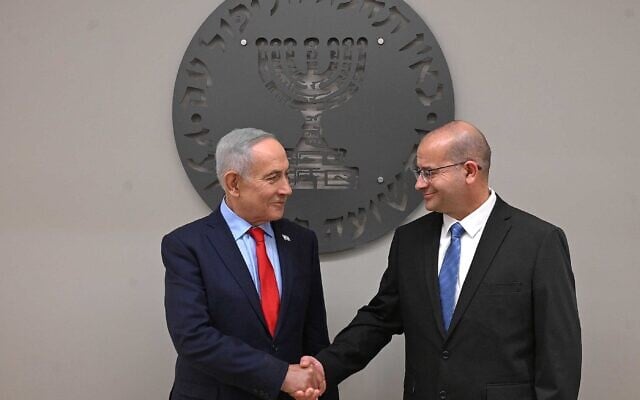
Ahead of the inauguration, de la Espriella met with Sa’ar, whose office said they held a three-hour private meeting and lunch at de la Espriella’s office in Barranquilla.
They discussed ways to strengthen bilateral diplomatic, security and economic relations, according to the Israeli readout.
Sa’ar thanked de la Espriella for his decision to move Colombia’s embassy to Jerusalem, telling him, “You have laid a brick in the walls of Jerusalem.”
The two last met in Buenos Aires in November.
In Sa’ar’s Washington, DC, meeting with Colombia’s incoming Foreign Minister last month, Omar Bola Escobar, the two agreed on restoring full diplomatic relations, appointing ambassadors, lifting visa requirements, and relocating Colombia’s embassy to Jerusalem.
They also agreed to renew Colombian coal shipments to Israel and for Bogota to withdraw from South Africa’s case against Israel at the International Court of Justice.
Sa’ar also held a meeting in Cali with freshly inaugurated Vice President Jose Manuel Restrepo, which senior members of the new Colombian cabinet unexpectedly joined.
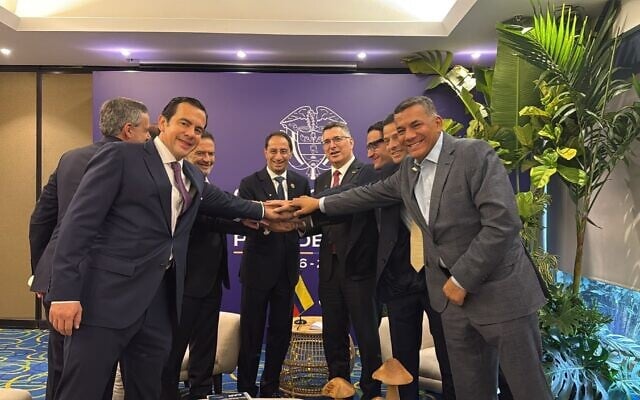
The new foreign, defense, finance, justice, environment and trade ministers showed up at the meeting, Sa’ar’s office told The Times of Israel.
“You designated 2026 as a year for expanding its ties with Latin America,” said Restrepo. “For Colombia, 2026 will be marked by the deepening and strengthening of its relationship with the State of Israel.”
De la Espriella will face robust opposition from Petro, who at first refused to recognize his electoral victory and insisted on alleged fraud, claiming that results from thousands of tally sheets were manipulated by programmers. The accusations of fraud have been dismissed by international observers as well as electoral authorities in Colombia.
However, the outgoing president left the presidential palace Friday saying he would respect the popular will.
Petro, who did not attend, will be “relentless” and “acerbic” as an opponent, seeking to strengthen his leadership, said political analyst Sergio Guzmán.
Petro has urged social movements in the southwest of the country to organize “people’s militias” to defend themselves against potential attacks from what he called the “fascists,” and called on his supporters to prepare for a general strike should they try to imprison him after he leaves office. Petro was named a “priority target” by the US Drug Enforcement Agency, the AP reported in March.

These kinds of calls from Petro, coupled with the hard-line approach de la Espriella intends, increase the likelihood of “confrontations during demonstrations or more forceful responses from the authorities,” according to Andrés Macías, a researcher specializing in conflict and peace at Externado University.
In Cali, where Petro has a large following and most voted for Cepeda, social and student organizations protested. Demonstrations also took place in Bogota and Barranquilla.
“Here we are defending dignity, resisting and making it clear that he (de la Espriella) did not win here and we are letting him know it,” Sebastián Ocampo, 25, told the AP while demonstrating in Puerto Resistencia, a residential area of Cali that was the epicenter of massive anti-government protests in 2021.
“There are very divided opinions in Cali … we are just hoping that the demonstrations will be peaceful,” said Amanda Castro, a 29-year-old merchant from southern Cali.

As a multimedia journalist, my job is to take the quality, fact-based journalism produced by The Times of Israel newsroom and make it accessible across every platform — from Instagram posts to podcasts to short-form videos.
This is how many, especially young people, consume news these days. But misinformation is rampant on social media. Our team at ToI produces accurate, responsible short-form reporting on Israel and the Jewish world.
If you believe in the importance of factual social media journalism, please consider joining our reader support group, The Times of Israel Community. Your financial support is essential to sustain responsible multimedia reporting.
— Gabriella Jacobs, multimedia journalist

We’re really pleased that you’ve read X Times of Israel articles in the past month.
That’s why we started the Times of Israel – to provide discerning readers like you with must-read coverage of Israel and the Jewish world.
So now we have a request. Unlike other news outlets, we haven’t put up a paywall. But as the journalism we do is costly, we invite readers for whom The Times of Israel has become important to help support our work by joining The Times of Israel Community.
For as little as $6 a month you can help support our quality journalism while enjoying The Times of Israel AD-FREE, as well as accessing exclusive content available only to Times of Israel Community members.
Thank you, David Horovitz, Founding Editor of The Times of Israel

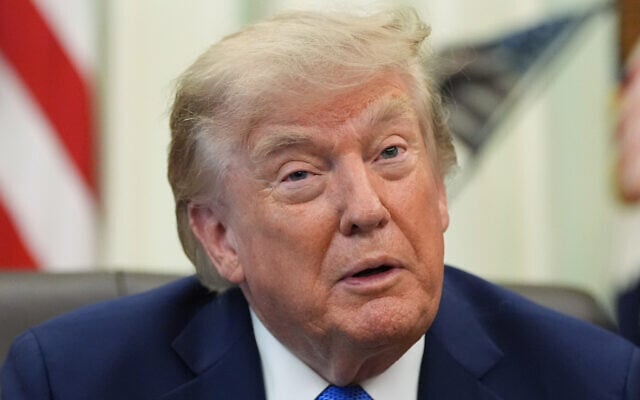


Abelardo de la Espriella was sworn in as Colombia's new conservative president on Friday in Cali, breaking tradition to signal a hard-line stance against illegal armed groups. De la Espriella, who financed his campaign as an outsider, pledged to tackle violence by abandoning his predecessor's negotiation policies and declared groups must surrender or become "military targets."
His rise to power will reinforce this rightward shift across much of Latin America and consolidate a regional bloc of conservative governments against a dwindling number of left-wing administrations,
said Glaeldys González, an analyst with the International Crisis Group. He also announced the restoration of diplomatic ties with Israel, severed by the previous administration, and the relocation of Colombia's embassy to Jerusalem, a decision praised by Israeli Foreign Minister Gideon Sa’ar, who stated, "You have laid a brick in the walls of Jerusalem." The new administration also agreed to renew coal shipments to Israel and withdraw from South Africa's ICJ case against Israel. De la Espriella faces robust opposition from former President Gustavo Petro, who has urged supporters to organize "people's militias" and prepare for a general strike, increasing the likelihood of confrontations.
© All rights to the original article belong to the source. Din Online shows a headline, an excerpt and a link only. The objectivity rating is computed automatically and is an estimate only.
Discussion
No comments yet — be the first to comment.