יום שני, יולי 20, 2026 עברית|English Log in Free sign-up
LIVE
Winning the war is not enough to permanently secure Israel's survival and security – editorialEmployee Union chairman says inspectors will not return to Bnei Brak without security – reportRodent infestation rises in Gaza border communities, hundreds of traps set outTwo Palestinians Killed During Clashes With Israeli Forces In West Bank VillageRescuers' plaque vandalized before Paris Holocaust ceremonyAfter World Cup heartbreak, Messi’s gift of hope lives on in IsraelThe Palestinian economy is struggling. In the West Bank, the problem is too much cashThe Myth of Israel’s IsolationPro-Israel GOP donors fueling Rep. Stevens' Dem primary in MichiganRehab center to be built in Tel Aviv for IDF vets suffering traumatic brain injuriesUS informs Israel of plans to intensify attacks on Iran in coming days: ReportWhy hating Israel comes natural to some peopleWinning the war is not enough to permanently secure Israel's survival and security – editorialEmployee Union chairman says inspectors will not return to Bnei Brak without security – reportRodent infestation rises in Gaza border communities, hundreds of traps set outTwo Palestinians Killed During Clashes With Israeli Forces In West Bank VillageRescuers' plaque vandalized before Paris Holocaust ceremonyAfter World Cup heartbreak, Messi’s gift of hope lives on in IsraelThe Palestinian economy is struggling. In the West Bank, the problem is too much cashThe Myth of Israel’s IsolationPro-Israel GOP donors fueling Rep. Stevens' Dem primary in MichiganRehab center to be built in Tel Aviv for IDF vets suffering traumatic brain injuriesUS informs Israel of plans to intensify attacks on Iran in coming days: ReportWhy hating Israel comes natural to some people
Security

On Lebanese border, a village still in Hezbollah crosshairs prepares for comeback
18h ago ·  Source: The Times of Israel 88Objectivity score88/100

On Lebanese border, a village still in Hezbollah crosshairs prepares for comeback

Reporter at The Times of Israel

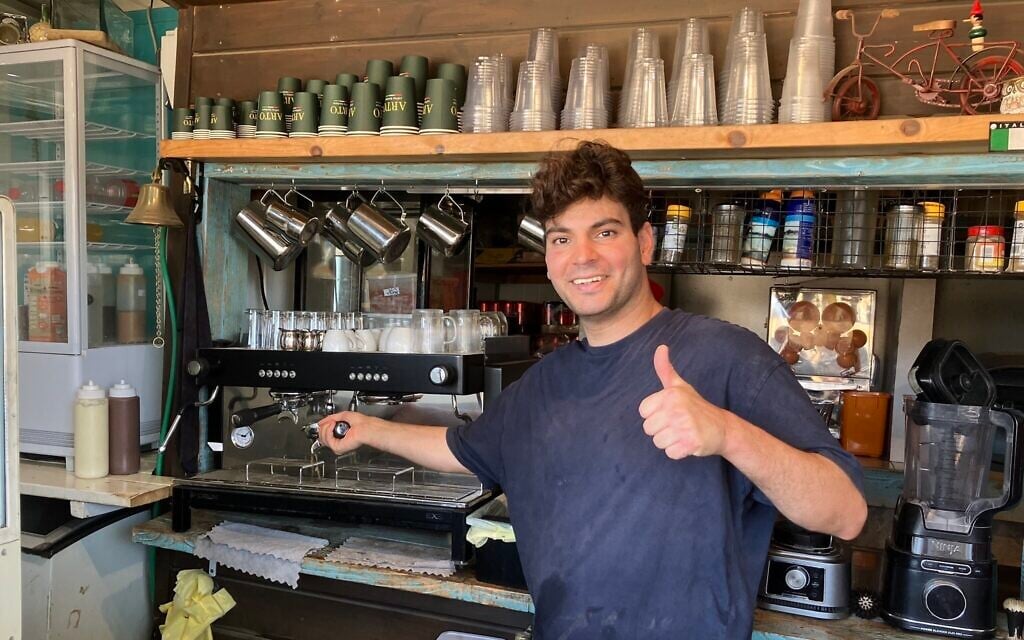
Ori Eliyahu at The Border Cafe in Shtula, on the border with Lebanon, on July 14, 2026. (Diana Bletter/Times of Israel)

SHTULA –  On a recent afternoon at On The Border Café, Ori Eliyahu made a cup of strong espresso for a customer and then gazed out at the cement barricade known as the Talking Walls. Eliyahu, the 28th of 51 grandchildren of Salah Eliyahu, one of the founders of this agricultural community, pointed out the colorful murals that are just inside the border with Lebanon.

“People are still hesitant to come here even though there’s a ceasefire,” Eliyahu, 30, said. “We hope the situation will get better so that people will come back.”

Despite the danger of missiles from the Hezbollah terror group in Lebanon, the government began a social media and television campaign on Sunday, advertising new homes being built in 28 frontline communities to encourage more people to live in Shtula and other places in northern Israel.

The campaign is part of an NIS 18 billion ($6 billion) allocation for communities up to nine kilometers (six miles) from the Lebanese border, including Shtula. The project, run by Tnufa LeTsafon (Northern Momentum, in Hebrew), aims to accelerate the construction of new neighborhoods and improve transportation, employment, and health services in the area that residents dub “the periphery of the periphery.”

In Shtula, 15 prefabricated houses, known in Hebrew as caravillas, with specially built rooms that protect against rocket and missile attacks, will be offered to families to rent on a trial basis. The rental price, set by the government, has not yet been announced.

“We have the resources, we’re working hard to help the residents, and our goal is to double or even triple the population in Shtula in the next few years,” David Cohen, the director general of Ma’ale Yosef Regional Council, told The Times of Israel. Shtula is one of 22 communities in the council’s jurisdiction in the Upper and Western Galilee. “That’s the answer to terrorists.”

תמונת סיקור

Sharon Hen, the village’s community manager, spoke to The Times of Israel in her newly renovated office. The building, in the center of the village under tall trees, had been struck by Hezbollah rocket fire during the war.

“We have a big task ahead of us to rebuild Shtula… In Shtula now, there are exactly 197 people,” Hen said. “I make sure to count everyone.”

Some residents have still not returned to Shtula, Hen said. However, 12 new families have recently moved in.

“They will face challenges living in a small community where the closest supermarket is about 15 miles (24 kilometers) away,” Hen said. “And the security situation is still uncertain.”

תמונת סיקור

“We know there are still Hezbollah tunnels near here,” Hen said. “But we’re still here.” She paused and asked rhetorically, “Where else can we go?”

The remote community, whose roots trace back to rugged farmers who came mostly from Kurdistan and Iraq, is surrounded by natural beauty. There are chicken coops, apple, pear and nectarine orchards, several restaurants, and a goat cheese farm.

However, on October 7, 2023 — when thousands of Gazans poured into Israel, invading communities, music festivals, army posts, and other locations, and massacring some 1,200 people and abducting 251 hostages in the deadliest attack on Jews since the Holocaust — residents fled Shtula.

The following day, Hezbollah began firing almost daily rockets and drones at northern Israel. The government then ordered the evacuation of Shtula’s residents along with some 60,000 people from 32 northern communities.

Recently, cross-border violence has been reduced following a fragile ceasefire between Israel and Iranian-backed terror group Hezbollah that was mediated by the Trump administration and implemented on June 19. However, Shtula has seen only about 60% of its 300 residents return to their homes; residents began coming back in early 2025 after the government authorized a phased return following the previous northern ceasefire, in November 2024.

More than two and a half years of Hezbollah bombardment destroyed about 64% of Shtula’s buildings, of which 80% have since been repaired in the past year.

תמונת סיקור

“Living here has always been like the way the Amish live,” Eliyahu, 30, reflected. “It’s a very simple life, far away from the city.”

After more than two years of closure, the On The Border Café recently reopened. The café offers homemade desserts and new picnic tables in an alcove of shady trees, but there are few visitors. Before the war, the picturesque border town drew thousands of tourists.

This current conflict is hardly its first foray into war. A 10-minute drive from On The Border Cafe brings visitors to a sharp bend in a road — the exact spot where Hezbollah terrorists killed and seized the bodies of Israeli reservists Ehud Goldwasser and Eldad Regev on July 12, 2006. Three other soldiers were killed in the attack, and five more IDF troops were killed shortly thereafter in a failed Israeli rescue attempt, triggering the Second Lebanon War.

Twenty years later, Israel’s military is holding what it describes as a “security zone” 10 kilometers (six miles) into Lebanon along the entire length of the Israeli border. Israeli officials say the zone is necessary to protect northern Israeli communities from attacks launched by Hezbollah.

Iran has reportedly told its regional allies, including Hezbollah, to prepare for the possibility of a broader conflict amid military escalations with the United States, raising the prospect of Israel becoming directly involved in the fighting.

תמונת סיקור

On a recent sunny afternoon, Avigail Baron, 23, was playing with her two children in part of the rebuilt playground in the village center. She and her husband moved to Shtula from a community near Hebron in May, renting a house from a family that had fled on October 7, 2023, and decided not to return.

“Living here gives us an important role,” Baron said. “It’s meaningful. It’s not just our home, it’s our country’s home.”

תמונת סיקור

In September 2026, the community gan, or kindergarten, will open with only eight children. In December 2026, when the 15 new families move into the caravillas, there will be more children. Right now, she said, parents jokingly call it a “boutique kindergarten.”

Over the years, the community has attracted a mixture of religious, traditional, and secular people. When religious people ask about moving to Shtula, Hen said she tells them that the roads in Shtula will “never be closed” on the Sabbath, and there will only be one synagogue, the one that all the residents have used since the village’s founding.

She then escorted The Times of Israel to look at the new border fence in the distance.

תמונת סיקור

“Before that fence, Hezbollah operatives would come up close to the edge of Shtula, wave Hezbollah flags, and threaten people, making a sign with their hand as if slashing their throat, saying, ‘We’re going to come for you.’”

Hen said the village is repairing the damaged basketball court and playing fields.

“We’re rebuilding the playground,” she said. “We’re trying to increase the number of people here, making sure to build up the community to be even stronger than it was before the war, so that people stay. That’s our victory.”

תמונת סיקור

The war with Iran has been draining for all of us in Israel. But when I heard about a high casualty incident – ballistic missile impacts in Arad and Dimona that left nearly 200 people wounded – I drank a cup of coffee, packed a bag, and headed south.

There, I spoke with Shilgit, the head of an after-school program for underprivileged youth. Standing outside her destroyed center, Shilgit said it was a miracle that no children were hurt and spoke about the community coming together in the hours since.

As a Times of Israel reporter, I’m committed to telling stories of resilience like Shilgit’s. But my colleagues and I can't do this alone. If you value work like this, please consider joining our reader support group, The Times of Israel Community. Your financial support is essential to keep real human reporting like this going.

— Stav Levaton, military reporter

תמונת סיקור

We’re really pleased that you’ve read X Times of Israel articles in the past month.

That’s why we started the Times of Israel – to provide discerning readers like you with must-read coverage of Israel and the Jewish world.

So now we have a request. Unlike other news outlets, we haven’t put up a paywall. But as the journalism we do is costly, we invite readers for whom The Times of Israel has become important to help support our work by joining The Times of Israel Community.

For as little as $6 a month you can help support our quality journalism while enjoying The Times of Israel AD-FREE, as well as accessing exclusive content available only to Times of Israel Community members.

Thank you, David Horovitz, Founding Editor of The Times of Israel

This combination of file photos created on July 16, 2026, shows Spain’s forward #19 Lamine Yamal in Arlington on July 14, 2026 (L); and Argentina’s forward #10 Lionel Messi in Atlanta on July 15, 2026. (Charly Triballeau and Roberto Schmidt/AFP)
Ofir Drori poses in Cameroon with elephant tusks seized from an African-Asian crime syndicate. (Courtesy, EAGLE)
New York City Mayor Zohran Mamdani speaks about the unstable building at 235 East 42nd Street and the surrounding buildings that were evacuated, July 7, 2026, in New York. (AP/Angelina Katsanis)
Hezbollah supporters wave Hezbollah and Iranian flags during a gathering in Beirut’s southern suburbs, Lebanon, July 8, 2026. (AP/Mustafa Jamalddine)
US Senate candidate Jordan Wood takes part in a debate at the WCSH-6 television studio, July 16, 2026, in Portland, Maine. (AP/Robert F. Bukaty)
US House Committee on Armed Services Ranking Member Rep. Adam Smith, a Washington Democrat, speaks during a meeting on Capitol Hill in Washington, DC, May 19, 2026. (AP Photo/Rod Lamkey, Jr.)
Demonstrators wave Iranian and religious flags, including one depicting the late Supreme Leader Ali Khamenei, during a pro-government gathering in Tehran, July 17, 2026. (AP/Vahid Salemi)
People cross the Islamic Revolution Street under a mural depicting a portrait of the Islamic Republic founder Ruhollah Khomeini in downtown Tehran, Iran, July 18, 2026. (AP/Vahid Salemi)
X
google
apple
facebook
timesofisrael
google
apple
facebook
timesofisrael
timesofisrael
google
apple
facebook
timesofisrael
check your email
X
X
Confirm Mail
💬 רוצים להגיב ולהצטרף לדיון? הצטרפו — חינם, ומקבלים גם את הדיג׳סט השבועי.
This story is based on reporting by The Times of Israel.
Read the full article at the source →

© All rights to the original article belong to the source. Din Online shows a headline, an excerpt and a link only. The objectivity rating is computed automatically and is an estimate only.

Related

Discussion

No comments yet — be the first to comment.

Add a comment