She thought the Holocaust erased her family. Then a DNA test found 50 relatives
Zev Stub is the Times of Israel's Diaspora Affairs correspondent.
Growing up in New Zealand, Adriana Turk always thought she was the last surviving member of a family wiped out during the Holocaust. But now, she is in Israel meeting long-lost relatives for the first time, after a MyHeritage DNA test led to a surprising revelation last year.

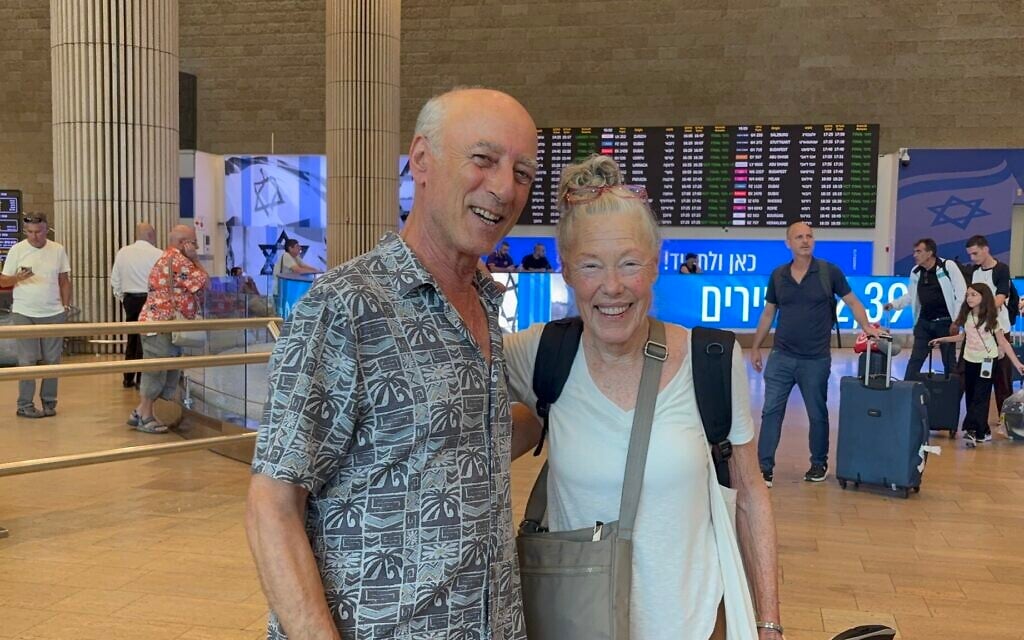
Discovering that she has over 50 living relatives across Germany, Israel, and Brazil was “absolutely astonishing,” the 74-year-old Turk told The Times of Israel in a call from the Tel Aviv home of her newly found third cousin, Raanan Gidron. “This has been such a revelation for me.”
Turk’s father John (Hans) Turk, a German Jew who escaped Nazi Germany for New Zealand in 1937, rarely spoke about his past. After the war, he learned that his mother was murdered in the Warsaw Ghetto in 1942, while his sister, her husband, and their two young children were killed at Auschwitz in 1944.
Upon arriving in New Zealand, the elder Turk worked hard to blend into his new country and kept almost no trace of the world he had fled. He changed his name from Hans to John, married a non-Jewish New Zealander, and rarely associated with Jewish institutions.
“He never spoke of it, and I never asked,” Turk said. “I just knew that his whole family — his mum, sister, brother-in-law, their children — were all murdered.”
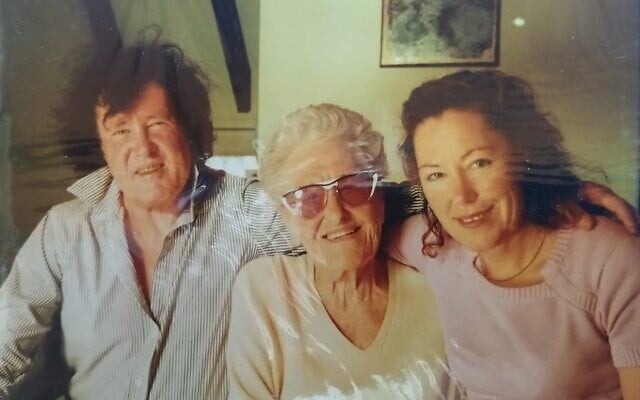
But after her only sibling, Julian, died in Auckland in late 2024, Turk was overcome with sorrow at the realization that she was the last surviving member of her immediate family.
“I felt this hole inside me,” she said. “It was a deep sadness.”
In the months that followed, Turk decided to take a MyHeritage DNA test, hoping to better understand her European roots.
“What have I got to lose?” she recalled thinking. The results upended her world.
The test showed that Turk had dozens of matches scattered across Germany, Israel, Brazil, and beyond. She started to reach out and was eventually linked to a third cousin in Germany who knew the family history that she had never heard.
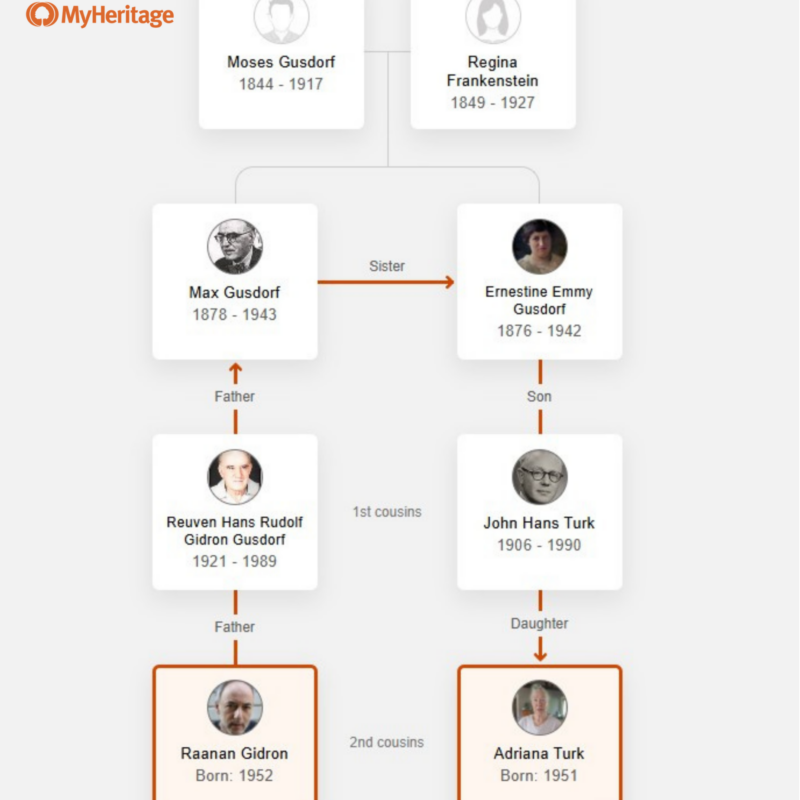
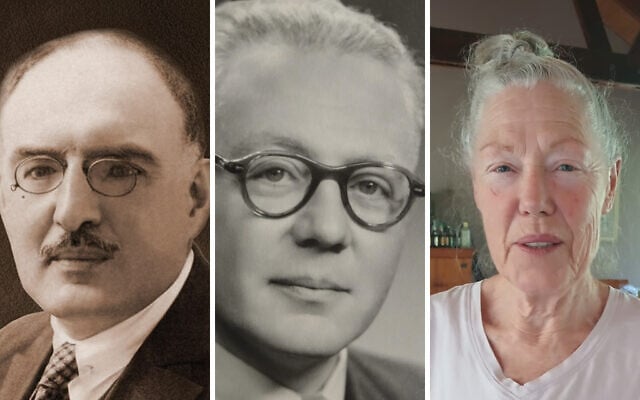
Turk learned that her great-uncle, Max Gusdorf, who was murdered in Sobibor in 1943, had three children who survived the war. One stayed in Germany. Another escaped to Brazil. The third, Hans Reuven Rudolph, later known as Reuven Gidron, made his way to what would become Israel and fought with the Palmach during Israel’s War of Independence. He also assisted Holocaust survivors and helped uncover Nazi war criminals in the postwar period.
“I didn’t know any of this,” Turk said. “My father didn’t want any part of this story.”
MyHeritage, an Israeli online genealogy and DNA testing company, later connected Turk to Reuven’s son, Raanan. They met for the first time during a video call on live TV in Australia and stayed in touch through follow-up calls.
Now, Turk has flown out to meet her relatives in person. Her first stop was in Germany, where she spent two weeks meeting with relatives and asking questions about her family’s past.
From there, she flew to Israel, where Raanan Gidron met her at the airport. Gidron said he had grown up hearing that his father had a cousin in New Zealand — Turk’s father — but that communication with him was sparse.
Turk had already seen photos and video of Gidron countless times by the time she landed at Ben-Gurion Airport, but the moment still felt surreal, she said.
Since Turk arrived in Tel Aviv on Saturday, the two cousins have been inundated with family introductions and media interviews. Their itinerary includes meetings with additional cousins around the country, a visit to the Yad Vashem Holocaust Museum and Memorial, and time to enjoy tourist sites.
“We are running day to day, with all kinds of spontaneous requests from the press and family obligations,” Gidron said.
Turk said her meetings with her cousins have all been “very warm,” and that meeting so many long-lost relatives has been nothing short of transformative.
“I feel like I’ve been born again through this experience,” she said. “Before I did the DNA test, I was overcome by sadness. Now, being surrounded by all these wonderful cousins has been such a revelation.”

As a multimedia journalist, my job is to take the quality, fact-based journalism produced by The Times of Israel newsroom and make it accessible across every platform — from Instagram posts to podcasts to short-form videos.
This is how many, especially young people, consume news these days. But misinformation is rampant on social media. Our team at ToI produces accurate, responsible short-form reporting on Israel and the Jewish world.
If you believe in the importance of factual social media journalism, please consider joining our reader support group, The Times of Israel Community. Your financial support is essential to sustain responsible multimedia reporting.
— Gabriella Jacobs, multimedia journalist

We’re really pleased that you’ve read X Times of Israel articles in the past month.
That’s why we started the Times of Israel – to provide discerning readers like you with must-read coverage of Israel and the Jewish world.
So now we have a request. Unlike other news outlets, we haven’t put up a paywall. But as the journalism we do is costly, we invite readers for whom The Times of Israel has become important to help support our work by joining The Times of Israel Community.
For as little as $6 a month you can help support our quality journalism while enjoying The Times of Israel AD-FREE, as well as accessing exclusive content available only to Times of Israel Community members.
Thank you, David Horovitz, Founding Editor of The Times of Israel








Adriana Turk, 74, from New Zealand, discovered over 50 living relatives across Germany, Israel, and Brazil through a MyHeritage DNA test, after believing her family was eradicated in the Holocaust. Her father, John (Hans) Turk, a German Jew who fled to New Zealand in 1937, rarely spoke of his past, leading Adriana to believe her immediate family were the sole survivors. The DNA test revealed that her great-uncle, Max Gusdorf, had three children who survived the war, one of whom, Reuven Gidron, settled in Israel. Turk is currently in Israel meeting her newly found third cousin, Raanan Gidron, and other relatives. She described the experience as "absolutely astonishing" and feels "born again through this experience."
© All rights to the original article belong to the source. Din Online shows a headline, an excerpt and a link only. The objectivity rating is computed automatically and is an estimate only.
Discussion
No comments yet — be the first to comment.