Sometimes, the path to peace runs through victory
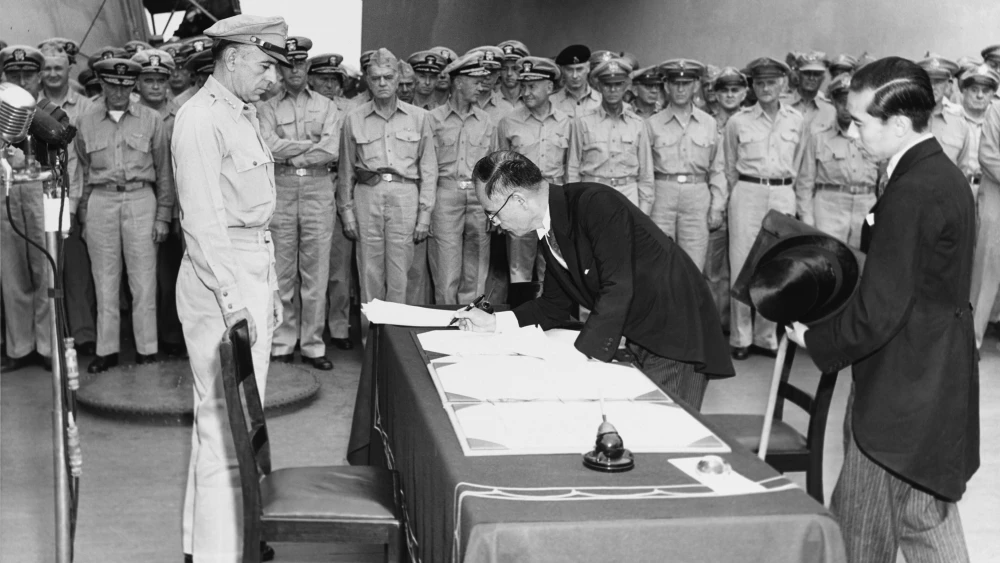

Today, 81 years ago, on Sept. 2, 1945, Japanese Foreign Minister Mamoru Shigemitsu boarded the American battleship Missouri, which was anchored in Tokyo Bay. Alongside him stood representatives of the Japanese military, and across from them stood Gen. Douglas MacArthur and representatives of the Allies.
The ceremony was brief. In less than half an hour, Japan’s instrument of surrender was signed, and World War II officially came to an end. In fact, that morning did not just end a war. Peace began.

And this is a distinction that is important to understand today of all days. Because looking back across eight decades, it is easy to look at Japan and see a democratic, prosperous, moderate country and one of America’s most important allies in Asia. It’s harder to remember what kind of Japan stood facing the United States just a few short years earlier.
This was a militaristic empire imbued with ideology, which for years waged cruel campaigns of conquest across Asia. It conquered vast territories, committed war crimes, attacked the United States at Pearl Harbor and was willing to send soldiers to die by the thousands in the name of the Emperor and the Empire.
In the battles of Iwo Jima and Okinawa, the intensity of that fanaticism was revealed to the Americans. Japanese soldiers continued to fight even when defeat was all but certain. Kamikaze pilots turned suicide itself into a weapon of war.
Washington did not respond to this fanaticism with hope alone. It responded with force. The Potsdam Declaration demanded unconditional surrender.
After Japan did not immediately accept the terms, atomic bombs were dropped on Hiroshima and Nagasaki. The Soviet Union declared war on Japan and invaded Manchuria. Faced with a reality where the continuation of the war threatened to bring further devastation to Japan, Emperor Hirohito intervened and ordered the acceptance of the Allied terms.
On Sept. 2, the surrender was signed. From this comes the first lesson of 1945: Sometimes, there is no way to reach peace before the side that initiated the war fully understands that it has lost it.
Not because war is better than peace. Quite the opposite.
Because sometimes, as long as a fanatic regime believes that violence pays off, an agreement does not end a war. It only postpones the next round.
The resolution that changed Japan
The truly important story begins after the signatures on the deck of the Missouri. America didn’t settle for a ceasefire, nor did it settle for a vague Japanese promise to behave better in the future. The Allies dismantled the military apparatus that enabled Japanese aggression. The army was disbanded. Officials from the militaristic establishment were removed from positions of influence. War criminals were brought to trial. Under MacArthur’s leadership, sweeping political, economic and social reforms were introduced.
The goal was defined in two words: demilitarization and deradicalization. The direction was sharp and clear: Japan would no longer be able to return to being the empire that ignited wars across Asia.
And then something amazing happened. The enemy that bombed Pearl Harbor became, within a generation, America’s most important strategic partner in Asia.
In 1960, the United States and Japan signed the Treaty of Mutual Cooperation and Security. For more than six decades, this alliance has been a pillar of the American strategic order in Asia and the Indo-Pacific region.
It’s perhaps one of the most surprising ironies of the 20th century. America did not achieve friendship with Japan by allowing Japanese militarism to survive. It achieved friendship with Japan after Japanese militarism was defeated.
It didn’t force the Japanese people to be an enemy forever. It liberated their future from the system that made them an enemy. And this is the crucial difference.
America was not in an eternal war with the Japanese people. It was in a war with a political and ideological order that turned Japan into a war machine. Once that order was defeated, the possibility for something else opened up.
Not every enemy must remain an enemy
In the West, a tendency has developed in recent decades to assume that the path to peace almost always begins with compromise. History teaches otherwise. Sometimes, peace begins precisely when doubt about who won comes to an end.
The Germany and Japan of 1945 are the most prominent examples. In both cases, no agreement was signed that allowed the old regimes to remain in place in the hope that they would gradually change their ways. The systems that gave birth to the war were broken, and only then did reconstruction begin. This lesson is especially important today in the Middle East.
It’s important in Gaza. And in Iran.
This doesn’t mean that the Gaza Strip is Japan or that Iran is Japan. Historical analogies are not mathematical formulas. Japan was a sovereign state that was defeated in total war and occupied. Hamas is a terrorist organization ruling part of Palestinian society; Iran is a nation of tens of millions of people, with an ancient history, culture and national identity. Yet the differences do not negate the principle.
When Hamas ideology turns war into a calling and when an Iranian leadership builds its legitimacy on relentless struggle against an external enemy, a ceasefire is not peace. It is oxygen.
This is why Israel cannot afford to end the campaign in Gaza while Hamas is still able to present Oct. 7 as a successful model. Israel can agree to arrangements, mediation and ceasefires. It can and should strive to minimize civilian suffering and build a different political horizon for the residents of Gaza. But one thing must not remain ambiguous: Hamas cannot remain the military and sovereign force that dictates the future of the Strip.
Israel’s stated goal remains the dismantling of Hamas’s military and governing capabilities, and the removal of the threat from the coastal enclave. Even amid current disagreements over a future arrangement, Israeli Prime Minister Benjamin Netanyahu insists that the disarmament of Hamas must precede a full Israeli withdrawal.
Some view this demand as an obstacle to peace. The history of 1945 allows us to view it the opposite way: The continued arming of Hamas is the obstacle to peace.
As long as a child in Gaza grows up within a system where the men of Oct. 7 are portrayed as role models, where weapons grant political status, where terror against Jews is described as a national achievement, and where the organization that brought immense destruction to the Strip can claim it survived and therefore won, the conditions for the next war are already being sown in the ground.
Demilitarization, therefore, is not revenge. Deradicalization is not humiliation.
Creating an education system that does not train another generation for holy war is not solely an Israeli interest. It is a Palestinian interest. The person liberated from a rule that teaches him his supreme goal is to die in the struggle against his neighbor is not defeated. Another possibility to live is opened before him. Japan is the most extreme proof that a nation is not forever bound to the ideology that ruled it at a certain moment in history.
And what is true for Gaza is true, on a different scale, for Iran as well. Here, the lesson becomes much more strategic for the United States. The problem that America and Israel have with Iran is not the Iranian people. In fact, far deeper ties exist between Iranian culture and the West than the rhetoric of the Islamic Republic allows the world to see.
The problem is the regime that took over Iran in 1979 and built its identity around revolution, anti-Americanism, the elimination of the State of Israel and the export of ideology by force. From the regime’s perspective, “Death to America” is not a rhetorical deviation. “The Zionist entity” is not a border dispute. The confrontation with the West is one of the sources of the revolution’s legitimacy.
Therefore, the biggest mistake Washington can make is to confuse Iran with the Islamic Republic. They are not the same thing. Just as Japan existed for thousands of years before the militarism of the 1930s and continued to exist long after it, ancient Iran is far older than the ayatollahs.
The Iranian people can have a future after the revolutionary regime. And perhaps entirely different relations with America and Israel.
U.S. President Donald Trump is waging sharp military and economic pressure against Iran. His administration announced on Aug. 24 the “Economic Outcast” operation, designed to cut the regime off from its financial sources. In recent days, military exchanges between the United States and Iran have also resumed.
One can debate various components of this strategy. One can and must examine its costs, the limits of power and the danger of being dragged into a war.
But Tehran must not be allowed to conclude that persistence pays, and that if it simply holds out long enough, the West will grow weary, retreat, and ultimately, learn to live with the Iranian threat. If, at the end of every confrontation, the regime retains the infrastructure that enables it to rebuild its power, threaten again and wait for the next opportunity to attack, then neither peace nor decisive victory has been achieved. What has been achieved is merely a pause until the next round. And the Middle East has already paid far too high a price for such pauses.
Victory is not the opposite of peace
On Sept. 2, 1945, American bombers flew over the Missouri as the ceremony ended. MacArthur declared that the guns had fallen silent and that a great tragedy had reached its end. Eighty-one years later, Japan and the United States are not preparing for the next war against each other. They are preparing together to face the challenges of the 21st century. This is a tremendous political achievement.
But it was not born from America learning to live with the kamikaze. It was born because the era that produced the kamikaze ended. This is perhaps the greatest lesson that Israel and the United States must remember today. The future of the Palestinians doesn’t have to be Hamas. The future of the Iranians does not have to be the Revolutionary Guards. Peoples can change. States can change. Enemies can become partners. But for the future to change, terror must first be defeated unequivocally.
Trump is right in his central principle regarding Tehran: A regime that repeatedly threatens its neighbors and America must understand that aggression is not a path to survival and concessions. And Netanyahu is right to insist that Hamas cannot emerge from the war as an armed force that continues to rule Gaza.
The challenge for both is to ensure a victory that enables a day after—not an arrangement based on the West learning to live with the threat, but an arrangement based on the threat ceasing to be an organizing principle of the state and society.
On the deck of the Missouri today, 81 years ago, one of the most terrible wars in human history came to an end. Yet at that very hour, the seed of one of the most impressive alliances created after it was also sown.


Get the latest updates in our WhatsApp group.






The article reflects on the 81st anniversary of Japan's surrender on September 2, 1945, marking the end of World War II, to illustrate that peace sometimes necessitates decisive victory and the dismantling of aggressive regimes. It highlights how Japan, once a militaristic empire, transformed into a democratic ally of the U.S. following its unconditional surrender, demilitarization, and deradicalization under Allied occupation. The author argues that this historical precedent offers lessons for contemporary conflicts, particularly regarding Hamas in Gaza and the Iranian regime. The article emphasizes that "sometimes, there is no way to reach peace before the side that initiated the war fully understands that it has lost it," and that agreements with fanatic regimes may only postpone future conflicts. It concludes that demilitarization and deradicalization are crucial for long-term peace, not revenge, and that a nation is not forever bound to the ideology that once ruled it.
© All rights to the original article belong to the source. Din Online shows a headline, an excerpt and a link only. The objectivity rating is computed automatically and is an estimate only.
Discussion
No comments yet — be the first to comment.