יום שלישי, אוגוסט 18, 2026 עברית|English Log in Free sign-up
LIVE
Williams sisters team up for first time in four years, lose in Cincinnati Open opening tennis matchMagnitude 6.1 earthquake strikes off Indonesia's Sumatra islandAs Iran-US negotiation window closes, countries race to reload, prepare for further war – analysisScientists use AI to create viruses not found in nature, simultaneously raising alarms, enthusiasmKatz's West Bank plan raises questions on pressure in Israeli society after Kusra events – analysisKKL-JNF inaugurates Tzippori River Trail, making nature accessible to allHaredi turnout high in Likud primary, amid fears they won’t vote for party in general electionIsrael Fears Saudi-Turkish-Pakistani Pact Could Reshape the Middle East – Jerusalem Center for Security and Foreign AffairsGlobal antisemitism transforms online Jewish dating for the good – Sponsored ContentState covers just 13% of food aid NGOs’ budgets, study finds‘There’s plenty of water in the river’: Israelis trickle north amid tourism droughtIs Somaliland America’s next Kosovo?Williams sisters team up for first time in four years, lose in Cincinnati Open opening tennis matchMagnitude 6.1 earthquake strikes off Indonesia's Sumatra islandAs Iran-US negotiation window closes, countries race to reload, prepare for further war – analysisScientists use AI to create viruses not found in nature, simultaneously raising alarms, enthusiasmKatz's West Bank plan raises questions on pressure in Israeli society after Kusra events – analysisKKL-JNF inaugurates Tzippori River Trail, making nature accessible to allHaredi turnout high in Likud primary, amid fears they won’t vote for party in general electionIsrael Fears Saudi-Turkish-Pakistani Pact Could Reshape the Middle East – Jerusalem Center for Security and Foreign AffairsGlobal antisemitism transforms online Jewish dating for the good – Sponsored ContentState covers just 13% of food aid NGOs’ budgets, study finds‘There’s plenty of water in the river’: Israelis trickle north amid tourism droughtIs Somaliland America’s next Kosovo?
Business

State covers just 13% of food aid NGOs’ budgets, study finds
5h ago ·  Source: The Times of Israel 93Objectivity score93/100

State covers just 13% of food aid NGOs’ budgets, study finds

Sue Surkes is The Times of Israel's environment reporter

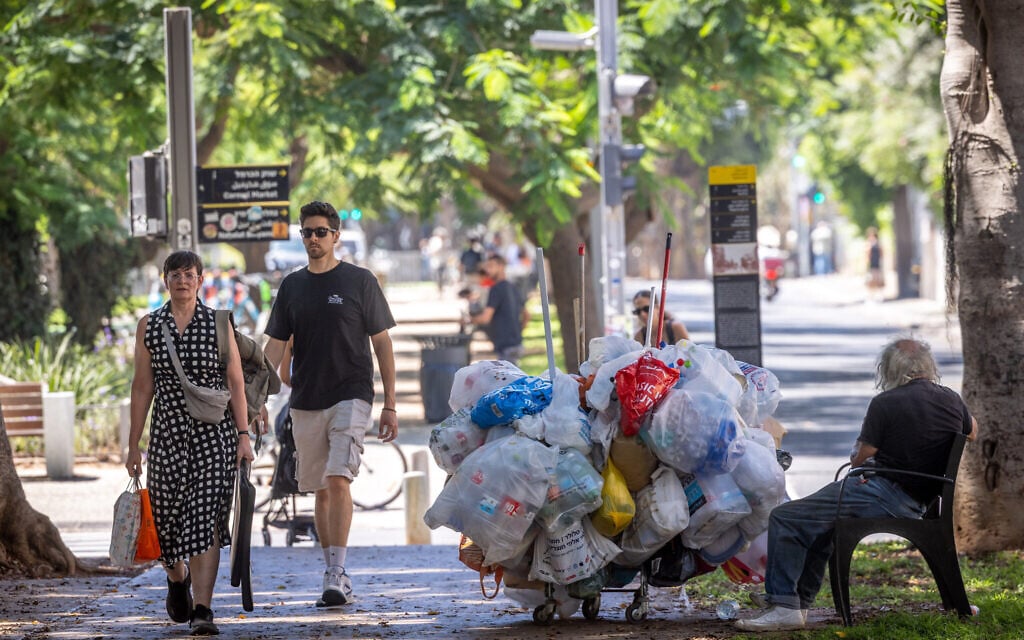
A homeless man sits on Rothschild Boulevard in Tel Aviv, July 28, 2026. (Miriam Alster/FLASH90)

The state contributes just 13 percent of the budgets of food aid organizations in Israel, according to the first comprehensive mapping of food aid charities led by the Hebrew University of Jerusalem and Sheba Medical Center in central Ramat Gan.

In September, the Latet charity reported that over a quarter of Israeli families, including every third child, were struggling to access sufficient food for proper development and health.

That meant around 2.8 million people, or 32.1 percent of Israelis, including 1.3 million children, were living with food insecurity, up from 24.9% in 2024.

The new study, published in this month’s issue of Food Policy,  reveals that there are 2,289 active food-aid groups in the country, with an annual total turnover of at least NIS 6.18 billion ($2.1 billion).

A third of the organizations that answered the question reported hiring a total of 28,623 employees, and half reported support from 173,771 volunteers.

About a third of reported turnover came from gifts made within Israel, 16% came from foreign donations, and 16% was in the form of in-kind donations.

תמונת סיקור

Most of the groups were affiliated with the Jewish religious sector, although turnover was higher for secular organizations.

While Arabs account for over a fifth of Israelis and 42.4% of Arab households are food insecure, according to 2023 research figures, only 4% of registered charities in Israel operate in Arab communities. (The study cautions that by focusing on data about registered aid groups, it might have overlooked food aid given by Arab religious institutions that do not formally register as charities.)

The Jerusalem district was served by 29% of the groups, compared to just 9% in the north, despite similar levels of need.

Most organizations operated locally and distributed food products rather than vouchers, the study found.

With relatively little standardized reporting, systematic data on food quality, basket composition and nutritional standards was scarce, raising questions about whether the entire system works as efficiently as it might.

תמונת סיקור

“Our findings show both the strength and the limits of philanthropy,” said Prof. Aron Troen of the Hebrew University, who co-led the study with Moran Accos, alongside Orly Tamir from Sheba Medical Center.

He continued, “Civil society does extraordinary work, but a modern state cannot rely on charity alone to ensure access to healthy food. The real question is whether aid is being delivered equitably, effectively, and transparently, and whether philanthropy is complementing public responsibility or being asked to replace it.”

Orly Tamir added, “From a health system perspective, food insecurity is not only a social issue but a clinical one. When access to adequate nutrition depends on fragmented charitable systems, the consequences are reflected in population health, disparities, and long-term system burden.”

“Helping families facing food insecurity is an immediate moral imperative,” said Moran Accos. “But the policy challenge is year-round. A country cannot treat food security only as a temporary or seasonal act of generosity. It must also ask whether the system is fair, whether it reaches those most in need, and whether public institutions are taking sufficient responsibility.”

The study authors call for stronger public leadership, including improved oversight, standardized reporting, nutritional standards, and better coordination between charitable organizations and government policy.

תמונת סיקור

While food insecurity rates are much lower in OECD countries — roughly 7.5% to 8% of the population — the authors note that comparable patterns of philanthropic expansion have been documented in other high-income countries (HIC), such as Canada, Germany, and the UK, where food banks increasingly serve as de facto welfare infrastructure.

The report says, “Across multiple high-income countries, philanthropic food-aid networks have expanded in response to rising food insecurity, austerity, and welfare retrenchment, and yet they struggle to meet the rising demand.”

Food insecurity can lead to malnutrition, but it is not the same thing. Indeed, it is a prime cause of obesity and is closely linked to disease and increased vulnerability to illnesses such as COVID-19.

תמונת סיקור

As a multimedia journalist, my job is to take the quality, fact-based journalism produced by The Times of Israel newsroom and make it accessible across every platform — from Instagram posts to podcasts to short-form videos.

This is how many, especially young people, consume news these days. But misinformation is rampant on social media. Our team at ToI produces accurate, responsible short-form reporting on Israel and the Jewish world. 

If you believe in the importance of factual social media journalism, please consider joining our reader support group, The Times of Israel Community. Your financial support is essential to sustain responsible multimedia reporting.

— Gabriella Jacobs, multimedia journalist

תמונת סיקור

We’re really pleased that you’ve read X Times of Israel articles in the past month.

That’s why we started the Times of Israel – to provide discerning readers like you with must-read coverage of Israel and the Jewish world.

So now we have a request. Unlike other news outlets, we haven’t put up a paywall. But as the journalism we do is costly, we invite readers for whom The Times of Israel has become important to help support our work by joining The Times of Israel Community.

For as little as $6 a month you can help support our quality journalism while enjoying The Times of Israel AD-FREE, as well as accessing exclusive content available only to Times of Israel Community members.

Thank you, David Horovitz, Founding Editor of The Times of Israel

This combo image shows then-director of US National Intelligence Tulsi Gabbard (L) in a White House briefing on July 23, 2025, and Islamic Revolutionary Guard Corps Gen. Ahmad Vahidi im Tehran, Iran, July 2, 2026. (AP Photo/Julia Demaree Nikhinson, Office of the Iranian Supreme Leader via AP)
US President Donald Trump returns a salute as he walks from Marine One to his limousine upon his arrival at the Ellipse just outside of the White House, August 16, 2026, in Washington. (AP/Jose Luis Magana)
Illustrative: A woman having shoulder and neck pain (kieferpix; iStock via Getty Images)
US envoy Jared Kushner (left) and Hamas chief Khalil al-Hayya (right) in a photo montage. (Fabrice COFFRINI / AFP; AP/Khalil Hamra)
National Security Minister Itamar Ben Gvir attends a hearing at the Supreme Court in Jerusalem on August 3, 2026. (Chaim Goldberg/Flash90)
Police and emergency forces at the scene where two children were stabbed in the city of Beit Shemesh, August 17, 2026. (Oren Ben Hakoon/Flash90)
A slice of pizza. Beta-casein, successfully engineered into a plant at Jerusalem's Hebrew University, is one of the milk proteins responsible for making cheese melts. (Proformabooks, iStock by Getty Images)
Left to right: White House adviser Jared Kushner, Board of Peace envoy Nickolay Mladenov, Prime Minister Benjamin Netanyahu. (Fabrice COFFRINI / AFP, Chaim Goldberg/ FLASH90)
X
google
apple
facebook
timesofisrael
google
apple
facebook
timesofisrael
timesofisrael
google
apple
facebook
timesofisrael
check your email
X
X
Confirm Mail
💬 רוצים להגיב ולהצטרף לדיון? הצטרפו — חינם, ומקבלים גם את הדיג׳סט השבועי.
🗞️ In-depth summary

A new study by the Hebrew University of Jerusalem and Sheba Medical Center reveals that the Israeli state covers only 13% of the budgets for food aid organizations. The study, published in Food Policy, identified 2,289 active food-aid NGOs with an annual turnover of at least NIS 6.18 billion ($2.1 billion). This comes as over a quarter of Israeli families, approximately 2.8 million people, experience food insecurity.

“Civil society does extraordinary work, but a modern state cannot rely on charity alone to ensure access to healthy food,”

said Prof. Aron Troen, co-leader of the study. The research highlights that most NGOs are religiously affiliated, with a disproportionately low number operating in Arab communities despite high food insecurity rates. The authors advocate for stronger public leadership, improved oversight, and standardized reporting to ensure equitable and effective food aid delivery.

Automatically generated summary based on the original article; quotes are from the source.
This story is based on reporting by The Times of Israel.
Read the full article at the source →

© All rights to the original article belong to the source. Din Online shows a headline, an excerpt and a link only. The objectivity rating is computed automatically and is an estimate only.

Related

Discussion

No comments yet — be the first to comment.

Add a comment