State reportedly not cutting funds to Haredi schools that fail to teach core subjects
Sam Sokol is the Times of Israel's political correspondent. He was previously a reporter for the Jerusalem Post, Jewish Telegraphic Agency and Haaretz. He is the author of "Putin’s Hybrid War and the Jews"

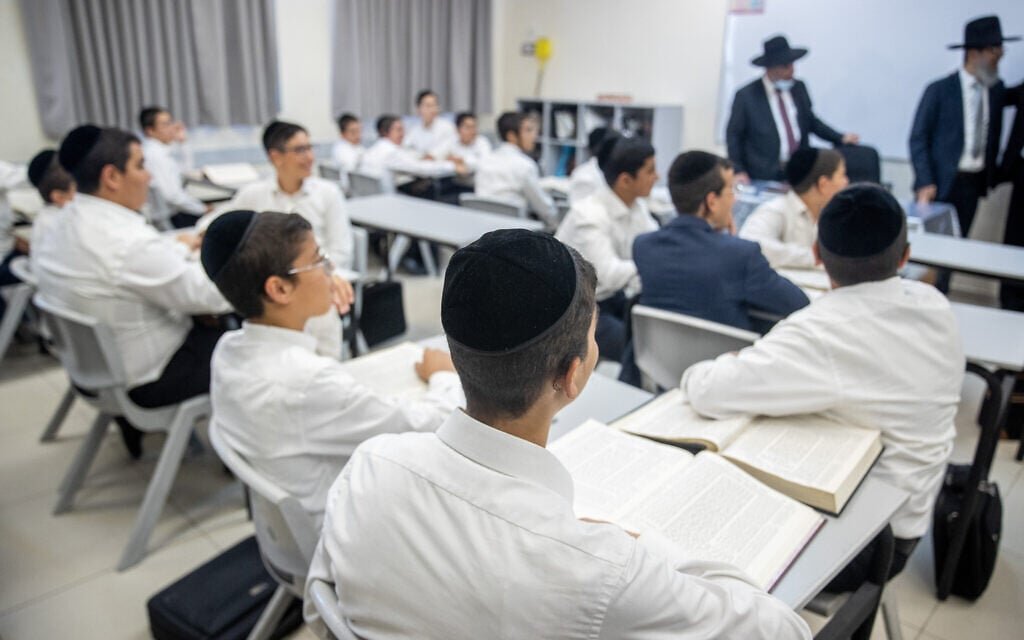
Despite claims to the contrary, over the past three years, the Education Ministry did not remove funding from schools failing to teach core subjects such as math and English, only deducting less than half a percent from funding for the United Torah Judaism party’s education network, according to a Sunday report.
The revelations by Channel 13 were in line with a 2025 research report by the Israel Democracy Institute, which found that only a small fraction of the ultra-Orthodox boys’ elementary schools that fail to teach core curriculum subjects as required by law face any sanctions.
Apparently disregarding the lack of core subjects in the ultra-Orthodox school system, the Knesset Finance Committee is slated to vote Tuesday on allocating an additional NIS 200 million ($65.5 million) for Haredi schools.
The vast majority of Haredi schoolchildren attend private schools that receive at least partial funding from the state. As of the 2024–2025 school year, only around seven percent of Haredi students were enrolled in public Haredi schools, known by their Hebrew acronym MaMaH.
These private schools fall into several categories.
“Exempt” institutions receive about 55% of the funding allocated to state schools, provided they teach 55% of the core curriculum.

A second category, “recognized but unofficial” institutions — known by the Hebrew acronym Mokshar — commit to teaching 75% of the curriculum and receive 75% of the funding.
Finally, “network” schools are affiliated with one of two major ultra-Orthodox political parties: Bnei Yosef, aligned with the Sephardic Shas party, and Chinuch Atzma’i, associated with the Ashkenazi United Torah Judaism party. These schools are fully funded by the government and are expected to teach the entire core curriculum.
According to a newly reported December 2025 brief to the High Court filed by Attorney General Gali Baharav-Miara, the Education Ministry last year warned dozens of ultra-Orthodox schools that they would lose their accreditation over their failure to teach core subjects.
Despite the long-running issues with the Haredi education system, Prime Minister Benjamin Netanyahu’s government has repeatedly boosted its funding, with the 2026 state budget increasing allocations to Haredi educational institutions by more than NIS 1 billion, from NIS 4.1 billion ($1.3 billion) to NIS 5.17 billion ($1.65 billion).

According to Channel 12, Baharav-Miara’s filing, which came in response to a petition against the transfer of some NIS 1 billion ($314 million) to ultra-Orthodox schools, stated that some 31 educational institutions affiliated with the Knesset’s Haredi parties received such warnings.
While the transfer was ultimately frozen by the court, most of the money had already been moved, and the Knesset Finance Committee later approved the transfer of an additional nearly NIS 100 million.
The filing further specified that the Education Ministry had offered all of the schools a chance to fix the issue and that only three schools refused to do so, losing their status as part of the party-affiliated networks.
Moreover, the filing stated that the Education Ministry considers schools that only teach some grades secular studies as meeting its criteria while the Finance Ministry believes that unless students through eighth grade participate in secular studies, the schools are not compliant.

According to the Finance Ministry’s criteria, 32% of Haredi institutions do not teach the required core subjects and 171 schools should be removed from their networks.
The Knesset Finance Committee is scheduled to convene again on Tuesday, despite the current legislative recess, to vote on transferring hundreds of millions of additional shekels from the 2026 state budget to the ultra-Orthodox and West Bank settlements.
Last Wednesday, opposition lawmakers blocked the transfer of an approximately NIS 392 million ($116 million) budget earmarked primarily for Haredi education and the Settlements Ministry, preventing a vote after an 11-hour Knesset Finance Committee marathon session ran past the allotted time allowed for parliamentary meetings during a recess.
Rossella Tercatin contributed to this report.

The war with Iran has been draining for all of us in Israel. But when I heard about a high casualty incident – ballistic missile impacts in Arad and Dimona that left nearly 200 people wounded – I drank a cup of coffee, packed a bag, and headed south.
There, I spoke with Shilgit, the head of an after-school program for underprivileged youth. Standing outside her destroyed center, Shilgit said it was a miracle that no children were hurt and spoke about the community coming together in the hours since.
As a Times of Israel reporter, I’m committed to telling stories of resilience like Shilgit’s. But my colleagues and I can't do this alone. If you value work like this, please consider joining our reader support group, The Times of Israel Community. Your financial support is essential to keep real human reporting like this going.
— Stav Levaton, military reporter

We’re really pleased that you’ve read X Times of Israel articles in the past month.
That’s why we started the Times of Israel – to provide discerning readers like you with must-read coverage of Israel and the Jewish world.
So now we have a request. Unlike other news outlets, we haven’t put up a paywall. But as the journalism we do is costly, we invite readers for whom The Times of Israel has become important to help support our work by joining The Times of Israel Community.
For as little as $6 a month you can help support our quality journalism while enjoying The Times of Israel AD-FREE, as well as accessing exclusive content available only to Times of Israel Community members.
Thank you, David Horovitz, Founding Editor of The Times of Israel


A recent report indicates that the Israeli Education Ministry has not significantly cut funding to Haredi schools that fail to teach core subjects like math and English, despite legal requirements. Over the past three years, less than half a percent was deducted from the United Torah Judaism party’s education network. This aligns with a 2025 Israel Democracy Institute report, which found that only a small fraction of ultra-Orthodox boys’ elementary schools face sanctions for not teaching core curriculum.
“Exempt” institutions receive about 55% of the funding allocated to state schools, provided they teach 55% of the core curriculum.
The Knesset Finance Committee is set to vote on an additional NIS 200 million ($65.5 million) for Haredi schools. While the Attorney General warned dozens of schools about losing accreditation, only three refused to comply and lost their network status. The Finance Ministry, however, believes 32% of Haredi institutions do not meet core subject requirements.
© All rights to the original article belong to the source. Din Online shows a headline, an excerpt and a link only. The objectivity rating is computed automatically and is an estimate only.
Discussion
No comments yet — be the first to comment.