The old-new ‘stab-in-the-back’ lie



Author and activist Susan Abulhawa recently accomplished something unusual: She drew millions of views to a social-media post about World War I. Attention, however, is not accuracy.
Responding to reports about Israel and the International Criminal Court, Abulhawa wrote that “zios” had “boasted and took credit for Germany’s defeat” in the war, leading to the Treaty of Versailles and “extreme anti-Jewish sentiment.” She ended ominously: “History will rhyme.”

Strip away the contemporary setting and the claim is familiar. It echoes the Dolchstoßlegende—the “stab-in-the-back” myth that Germany had not truly been defeated on the battlefield but had been betrayed from within, with Jews among the principal villains.
As a historian, I am less interested in online outrage than in chronology. And the chronology is fatal to Abulhawa’s claim. The campaign against German Jewish loyalty did not arise after Germany’s defeat. It preceded it.
On Oct. 11, 1916—more than two years before the Armistice and nearly three years before the Treaty of Versailles—Prussian War Minister Adolf Wild von Hohenborn ordered the notorious Judenzählung, or “Jewish Census.” Antisemitic organizations, politicians and military officers had been alleging that Jews were Drückeberger—shirkers—who evaded service or secured comfortable posts behind the lines while other Germans fought and died.
The War Ministry ordered units to count their Jewish soldiers and report where they were serving. The census was statistically crude: Instructions were inconsistent, names were not required and soldiers absent because of wounds, leave or transfers could be missed. Yet even this tendentious exercise failed to substantiate the accusation of collective Jewish evasion.
In January 1917, the new War Minister Hermann von Stein privately informed Reichstag deputy Oskar Cassel that the claims about Jewish military service were unfounded. Yet the government did not publish the findings. The public vindication never came. Silence allowed antisemites to suggest that the suppressed figures must have been devastating.
The true numbers come from more reliable postwar research. Statistician Jacob Segall’s 1921 study concluded that approximately 100,000 German Jews served in the Kaiser’s armed forces, nearly 80,000 of them at the front. Approximately 12,000 died, and tens of thousands received military decorations. A 1932 memorial volume published by the Reichsbund jüdischer Frontsoldaten preserved the names of the fallen as a final answer to those who denied their sacrifice.
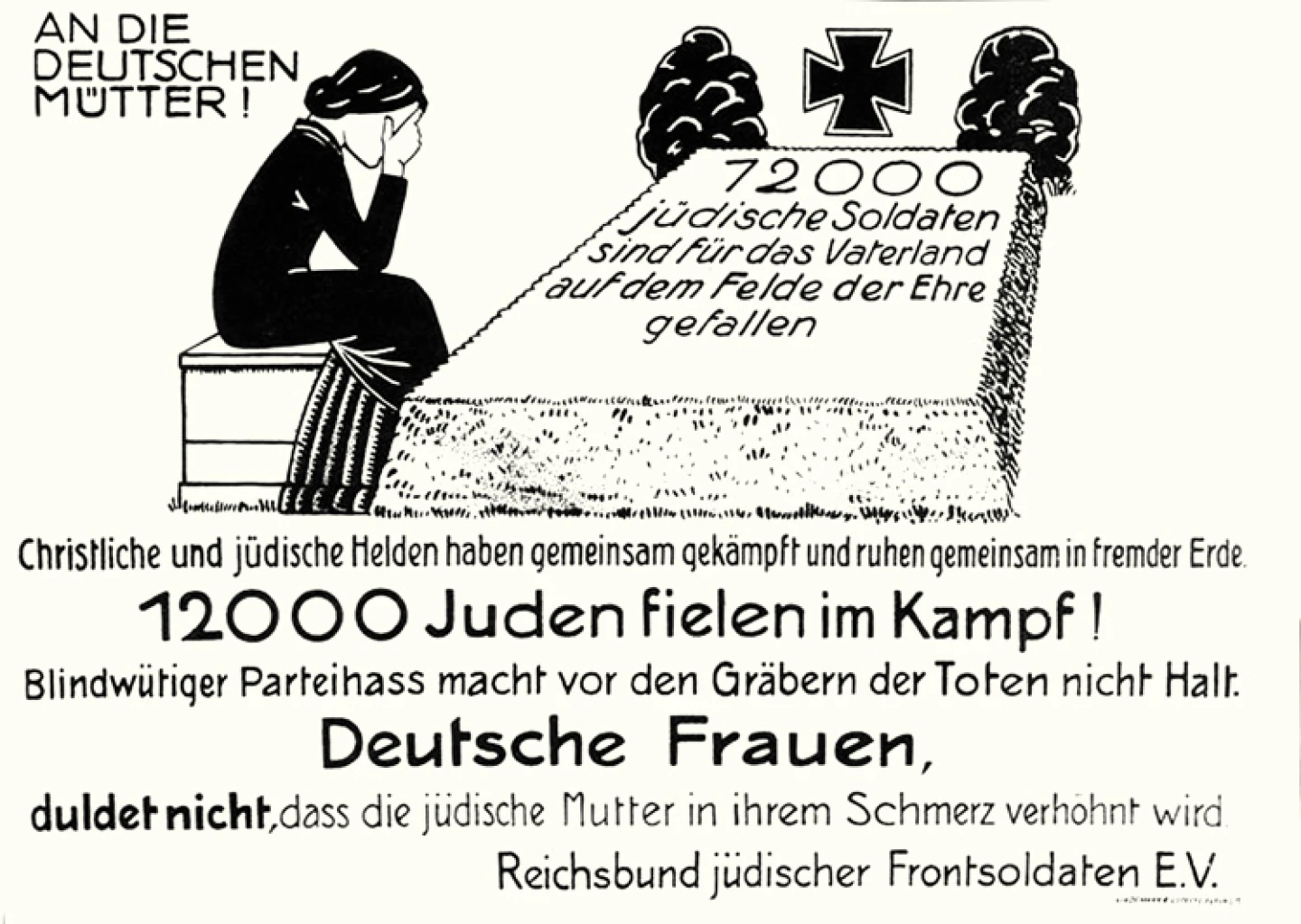
In other words, the stab-in-the-back legend hardened after 1918, but its essential premise—that Jews were powerful, disloyal and responsible for national misfortune—was already being cultivated while Jewish soldiers were fighting and dying in German uniform.
That is how conspiracy theories work. They don’t arise from evidence; they survive despite it. The Judenzählung should have discredited the accusation. Instead, the government’s decision to count Jews separately conferred official legitimacy on the suspicion while its refusal to publish the findings preserved the lie.
This history is not abstract to me. I am chief historian of “Operation Benjamin,” which identifies Jewish American servicemen mistakenly buried beneath Latin crosses and works to restore grave markers reflecting the faith they professed. We also partner with the German War Graves Commission—the Volksbund Deutsche Kriegsgräberfürsorge—and their Operation Levi program to identify and honor German Jewish soldiers of World War I whose graves do not accurately reflect their Jewish identity.
Standing before one of those graves is profoundly disorienting. The man buried there died for Kaiser and country, yet within a generation Germany declared that men like him had never truly belonged. His grave is more than a place of remembrance. It is evidence. Damning evidence.
Every corrected marker and recovered biography rebuts the mythology that consumed the country those soldiers defended. These are arguments written in stone: German Jews served, fought, sacrificed and died. No slogan can alter that history, but if we fail to preserve its evidence, the lie can take its place.
Abulhawa’s post matters not because it is original, but because it is not. Today the vocabulary may be “Zionist power,” “dual loyalty” or hidden influence. The underlying allegation remains familiar: Jews are uniquely powerful, insufficiently loyal and somehow responsible for the grievances of others.
This warning is neither Democratic nor Republican, neither left nor right. Antisemitic conspiracy theories have crossed every political boundary, and the obligation to confront them must do the same.
Historical truth alone cannot eliminate antisemitism. The history of the Judenzählung proves that much. But history supplies something indispensable: a record that resists propaganda.
The dead cannot answer a viral post. They already answered the lie with their lives. Our responsibility is to ensure that their answer is not forgotten.










Author and activist Susan Abulhawa recently propagated a historical falsehood on social media, claiming that "zios" boasted about Germany's defeat in World War I, leading to the Treaty of Versailles and antisemitism. This echoes the "stab-in-the-back" myth (Dolchstoßlegende) that blamed Jews for Germany's internal betrayal.
The chronology is fatal to Abulhawa’s claim.
The campaign against German Jewish loyalty predated Germany's defeat. In 1916, the Prussian War Ministry ordered the Judenzählung (Jewish Census) to investigate claims of Jewish shirking, but the census failed to substantiate these accusations. Despite findings in 1917 that the claims were unfounded, the government did not publish the results, allowing antisemitic narratives to persist. Postwar research by Jacob Segall in 1921 confirmed that approximately 100,000 German Jews served, with 80,000 at the front, and 12,000 died. The author, as chief historian of "Operation Benjamin," highlights efforts to correct grave markers of Jewish servicemen, emphasizing that these historical records rebut the mythology of Jewish disloyalty and sacrifice.
© All rights to the original article belong to the source. Din Online shows a headline, an excerpt and a link only. The objectivity rating is computed automatically and is an estimate only.
Discussion
No comments yet — be the first to comment.