The Palestinian Authority's massive army threatens millions of Israelis within just 22 kilometers
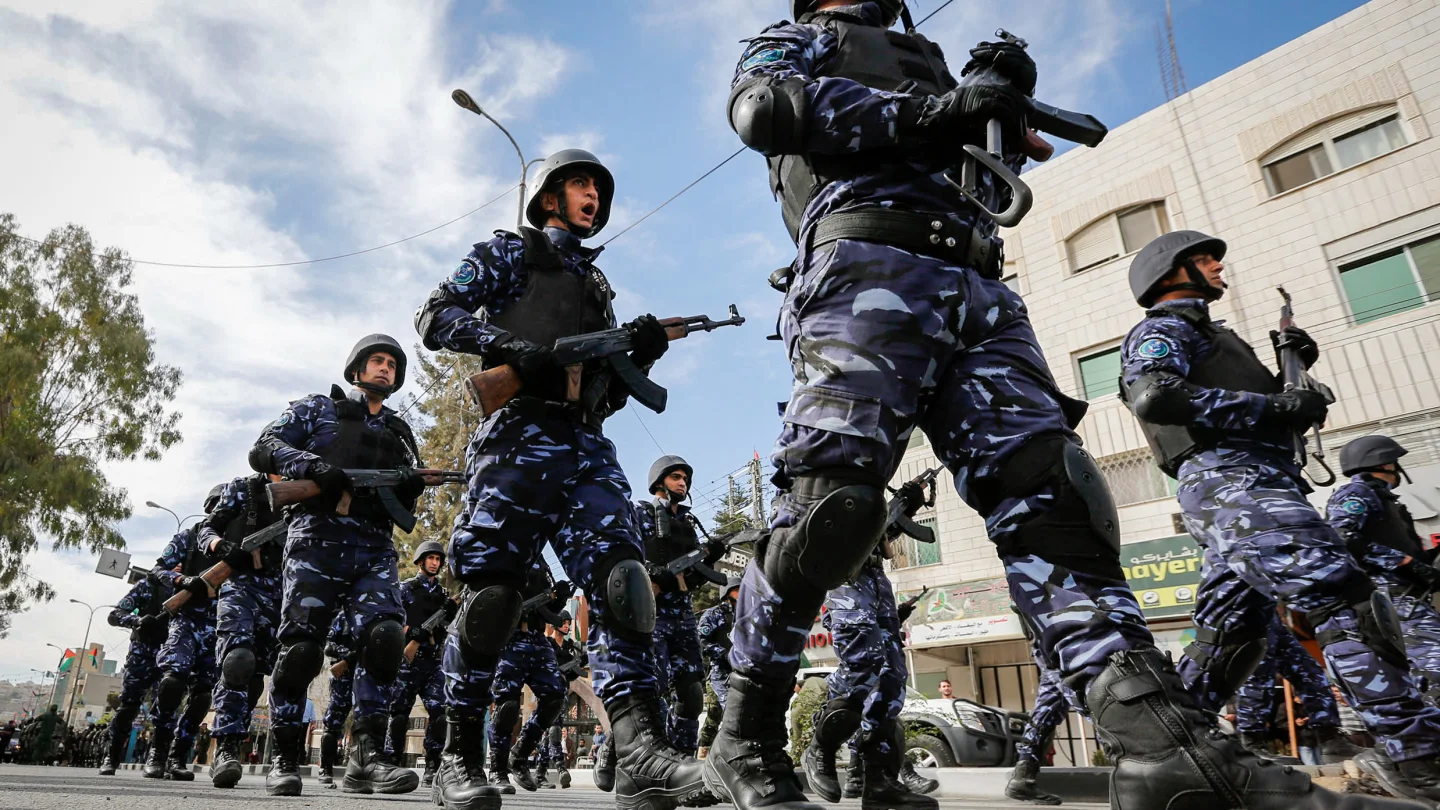
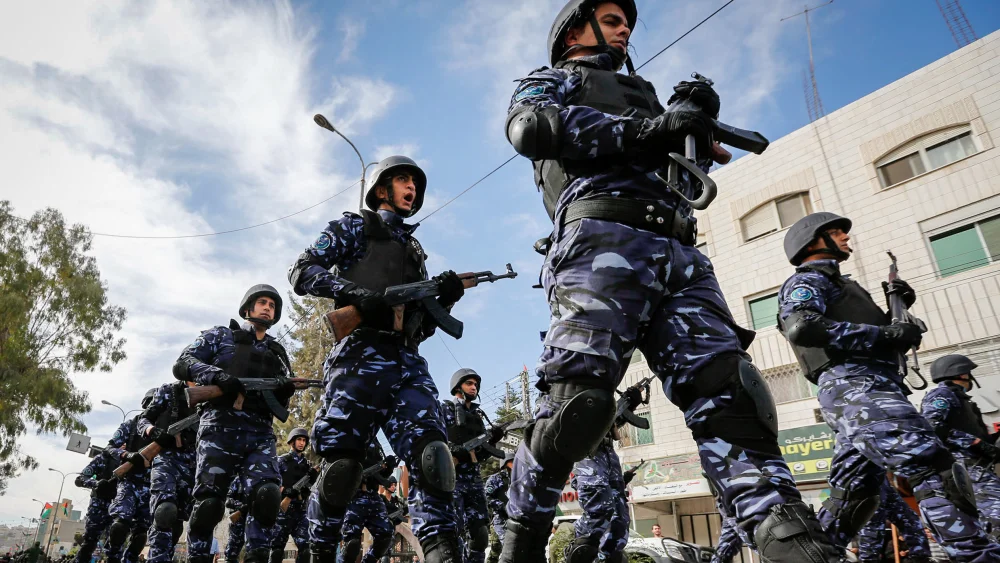

During the Hamas massacre on Oct. 7, 2023, more than 6,000 terrorists from Gaza invaded Israel. Half were trained and armed operatives belonging to terrorist organizations, including Hamas, Palestinian Islamic Jihad and the Al-Aqsa Martyrs Brigades.
The other half were additional terrorists from Gaza who were not necessarily members of those organizations. The terrorist squad that penetrated farthest reached the city of Ofakim, 22 kilometers, or 13.7 miles, from Gaza.
In breach of the Oslo Accords, Judea and Samaria (the West Bank) now host an armed force 10 times larger than the total number of terrorists who invaded Israel from Gaza. This force is awaiting orders to attack. It is a trained and prepared military body that possesses tens of thousands of weapons. Many of its members have already participated in terrorism against Israel and its citizens, and it trains exclusively for one scenario: war against the State of Israel. This force consists of the Palestinian Authority’s security apparatuses.
Unlike the area known as the Gaza envelope, which has a relatively limited population, the regions adjacent to Judea and Samaria contain Israel’s largest population centers. In the country’s narrow waist—once described by former Israeli Foreign Minister Abba Eban as the “Auschwitz borders”—the distance from Qalqilya in Samaria to the Mediterranean Sea is only 14 kilometers, or nine miles.
Kfar Saba, Ra’anana, Hod Hasharon, Herzliya and numerous other population and industrial centers lie within that narrow strip between the 1949 Armistice Line, or Green Line, and the sea. Within a 22-kilometer radius, comparable to the distance reached by Hamas terrorists on Oct. 7, millions of Israeli citizens live under direct threat.
During the terror war initiated by Yasser Arafat from September 2000 to 2005, hundreds of P.A. security personnel participated in attacks. Since then, as this study shows, the P.A. security forces in Judea and Samaria alone have grown by 400%. They have transformed from a small policing force with limited weapons into a trained army equipped with tens of thousands of firearms, assault weapons and other combat equipment.
In P.A. circles, Arafat’s terror war was called the “Al-Aqsa Intifada.” The name was intended to mobilize the Palestinian public around the false claim that Israel or Jews were harming the Temple Mount and its mosques, which therefore required defending.
Similarly, Hamas named the Oct. 7 massacre “Operation Al-Aqsa Flood.” The similarity is not coincidental. It reflects a deeper reality: There is no meaningful difference between the P.A., which is controlled by Fatah, and Hamas. Both organizations embrace terrorism, and both seek the destruction of the State of Israel.
Without urgent and significant action to neutralize the danger posed by the P.A. security forces, the “reversal of the rifles” scenario—in which P.A. security personnel turn their weapons against Israeli citizens, whether in an organized operation or through uncontrolled individual attacks—could once again end in horrific slaughter.
The Oslo Accords: What is the P.A. Police Force?
Under the agreements between the Israeli government and the Palestine Liberation Organization in the Oslo Accords, the Palestinian Authority Police Force was supposed to be a small policing body responsible for maintaining local public order.
It was to consist of police and intelligence components tasked with combating ordinary Palestinian crime on the one hand and terrorist organizations such as Hamas, the Popular Front for the Liberation of Palestine and Palestinian Islamic Jihad on the other. For this purpose, the parties agreed to arm the force with a limited quantity of weapons.
As was typical of the PLO and the P.A., what began with sincere intentions—at least on the Israeli side—quickly transformed from a modest police force into an army of terrorists.
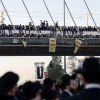
Originally, the P.A. police in Judea and Samaria, including all its components, was limited to 12,000 personnel equipped with 4,000 rifles, 4,000 pistols, 120 light and heavy machine guns, and 15 armored vehicles.
Over the years, the P.A. blatantly violated the Oslo Accords by transforming the small police force, whose members were called “policemen,” into large and sprawling bodies known collectively as the P.A. security apparatuses, whose members are called “soldiers.”
These apparatuses now number approximately 70,000 personnel. Instead of possessing a limited number of weapons, they possess tens of thousands of rifles and pistols. They undergo genuine military training and are equipped with dozens of armored vehicles. Some weapons were supplied with the approval of Israeli governments, while others were smuggled into Judea and Samaria or produced locally.
The ‘Palestine Liberation Army’
According to data from the Palestinian Central Bureau of Statistics, the reported crime rate in the Palestinian Authority—excluding Gaza and parts of eastern Jerusalem under Israeli control—stood at 1,335.6 criminal offenses per 100,000 residents in 2024.
This rate is relatively low by international standards and indicates that Palestinian society does not suffer from unusually high crime levels that would justify the establishment of such a large armed force for policing purposes.
Furthermore, a civilian police force does not require comprehensive military training that includes armored warfare, artillery, sniping, heavy machine guns and parachuting. As will be shown, the P.A. security apparatuses do not, in practice, act systematically against active terrorist organizations in the territory under their control.
These facts lead to an inescapable conclusion: What has been established is not a police force but a full-fledged military structure—the army of the Palestinian Authority—which in practice serves the goals of terrorism.
This resembles the mistaken conception that prevailed until Oct. 6, 2023, and led Israel to disaster. Ignoring this terror army, which constitutes a real and tangible danger, could lead to another foreseeable catastrophe.
Unless Israel acts to dismantle it, or at least significantly reduce it to the agreed-upon dimensions, millions of Israeli citizens will remain under threat and could once again fall victim to a massacre that may dwarf the horrors of Oct. 7.
The Palestinian police under the Oslo Accords: Force structure and armament
Article IV of Annex I of the Interim Agreement defined, delineated and restricted the P.A.’s ability to establish a “Palestinian Police.”
According to those provisions, the police’s roles were clearly civilian in nature:
a. Maintaining internal security and public order;
b. Protecting the public and all other persons present in the areas, as well as their property, and providing a sense of security, safety and stability;
c. Adopting all measures necessary to prevent crime in accordance with the law;
d. Protecting public installations, infrastructure and places of special importance;
e. Preventing acts of harassment and retribution;
f. Combating terrorism and violence and preventing incitement to violence; and
g. Performing other normal police functions.
The provisions also defined six branches of the police: the regular police, public security, preventive security, the force responsible for protecting the P.A. chairman, intelligence, and civil defense and rescue forces.
The total force was limited to 30,000 personnel, of whom 12,000 were to be deployed in Judea and Samaria and the remainder in the Gaza Strip. The P.A. was required to submit the names of all police candidates to Israel, which held veto power over recruitment.
“The Palestinian side will notify Israel of any candidate for recruitment to the Palestinian Police. Should Israel object to the recruitment of any such candidate, that person shall not be recruited.”
Regarding equipment and weapons, the agreement stipulated that the police forces in Judea and Samaria could be equipped with 4,000 assault rifles, 4,000 pistols, up to 120 machine guns and up to 15 vehicles for use in riots.
Regrettably, the agreement also allowed the quantity of weapons and equipment to be increased with mutual consent. A peculiar provision added that the term “weapons” included not only firearms and ammunition but also “explosives of all kinds,” even though the agreement made no reference to the possession of explosives and therefore imposed no limits on their quantity.
An additional section governing Hebron stipulated that following the withdrawal of IDF forces from Area H-1, the P.A. could establish police stations in the city staffed by up to 400 policemen and equipped with 20 vehicles and 200 pistols.
The Palestinian police began exceeding its authorized size immediately after implementation of the Gaza-Jericho Agreement in 1994. According to a November 1995 U.S. State Department report, even before the P.A. had been fully established, the force already numbered 18,000 personnel, although it was limited at that stage to only 9,000.
According to a 2021 report by the Palestinian Academic Society for the Study of International Affairs, the Oslo framework limited the police to 30,000 personnel overall: 12,000 in Judea and Samaria and 18,000 in Gaza.
Nevertheless, by 1997, after additional implementation stages of the Oslo II Accords and the transfer of major Arab cities in Judea and Samaria to P.A. jurisdiction, the police force had grown to approximately 32,000 personnel.
In 2001, the force was estimated at approximately 40,000 personnel. By 2003, it had reached approximately 52,000. In 2006, it stood at 61,051 personnel.
A reorganization took place in 2007, when the various forces were officially renamed the P.A. Security Apparatuses. These included the Civil Police, National Security Forces, Preventive Security, General Intelligence, Military Intelligence, Civil Defense and Customs Police.
By 2009, the force had grown to 62,096 personnel. In 2010, it reached 63,474, and in 2011 it stood at 63,515. By 2014, it had grown to 65,277. In 2016, the P.A. had 65,463 salary recipients in the security apparatuses, and in 2018 the number reached approximately 65,829.
All these figures refer solely to P.A. security forces in Judea and Samaria. Tens of thousands of additional Palestinian security personnel affiliated with and operating under Hamas’s guidance and control were active in Gaza.
By 2018, the security apparatuses were already five-and-a-half times larger than the 12,000-person force authorized for Judea and Samaria.
According to a report by the AMAN Coalition, another Palestinian research organization, the P.A. security forces grew even more than reported by PASSIA, increasing from 64,491 personnel in 2013 to 67,772 in 2017.
The Hamas takeover of Gaza: The salary test
In the summer of 2007, following Hamas’s victory in the 2006 elections and Mahmoud Abbas’s refusal to accept the results, Hamas forces violently seized control of the Gaza Strip.
Within approximately three days, Hamas terrorists threw P.A. security personnel and political opponents from rooftops and shot others in the knees. Some P.A. supporters fled toward the Israeli border fence, seeking refuge in Israel and relocation to Judea and Samaria.
Following the Hamas takeover, the size of the P.A. security forces in Gaza was frozen at 18,151 personnel. Those who remained continued to receive salaries without working. Consequently, all subsequent growth occurred in Judea and Samaria.
It has been claimed that some participants in the Oct. 7 massacre carried documentation showing an affiliation with P.A. security forces. However, it is unclear whether they belonged to the group of 18,151, and the issue requires further examination beyond the scope of this study.
A relatively recent report by the Geneva Centre for Security Sector Governance, based on information provided by the P.A. in April 2023, claimed that the P.A. security forces in Judea and Samaria numbered only approximately 34,000.
This figure, the lowest reported in 20 years, does not align with reality. Such a sharp decline—approximately 25%—would necessarily be reflected in a corresponding reduction in the P.A.’s salary expenditures for the forces.
According to official P.A. Ministry of Finance budget-performance reports, salary payments to the security apparatuses through the Interior Ministry amounted to 3.153 billion shekels in 2017 and 3.078 billion shekels in 2025. The DCAF figures should therefore be treated with considerable skepticism.
Who are the P.A. security personnel?
As explicitly stipulated in the Oslo Accords, Israel was supposed to hold veto power over the recruitment of every individual into the P.A. security forces. Even if this arrangement initially functioned, its boundaries were later completely blurred.
This blurring manifested itself in various ways. For example, one of the branches defined in the Oslo Accords was the Presidential Guard. However, due to the deep and systematic involvement of Arafat’s Presidential Guard in the terror war he initiated in late September 2000, Israel in December 2001 designated both the Presidential Guard, known as “Force 17,” and the Tanzim as terrorist organizations.
The term “Tanzim” means “the organization” and was intended to emphasize the group’s centrality within Fatah. Tanzim operatives led terror attacks even before Hamas, Palestinian Islamic Jihad, the Popular Front and other groups joined the fighting.
The Al-Aqsa Martyrs Brigades, which served openly as Fatah’s terror arm, emerged from the Tanzim, an organic and inseparable part of Fatah.
Systematic violation of agreements
When Yasser Arafat entered the Gaza Strip in July 1994, a fundamental violation of the security agreements occurred. Under the protection of his official motorcade’s immunity, senior wanted terrorists were smuggled into the territory while concealed in the convoy’s vehicles.
The most prominent terrorist smuggled in was Jihad Amarin, who rose through the ranks of the Tanzim. Amarin later founded and commanded the Al-Aqsa Martyrs Brigades in Gaza, using his official position in the security apparatuses to direct dozens of deadly shooting and bombing attacks until he was killed in a targeted Israeli operation in 2002.
The violation of security agreements deepened through the institutionalized integration of terror operatives into the P.A. security forces. Senior PLO and P.A. officials have even boasted about the high level of involvement of security personnel in terrorist attacks against Israelis and the large number of prisoners originating from the security apparatuses.
For example, senior PLO figure Jibril Rajoub once boasted that no fewer than 12% of the terrorists imprisoned in Israeli jails belonged to the P.A. security forces.
The Abbas era: Same lady, different dress
Arafat’s death in November 2004 and Mahmoud Abbas’s subsequent rise to power did not improve the situation. On the contrary, Abbas significantly expanded both the security apparatuses and their training. He also continued and deepened the policy of integrating terrorists into these forces.
Abbas presented and branded himself as a moderate whose path differed from Arafat’s. He had the good fortune of being in the right place at the right time, as Arafat’s terror war had largely exhausted itself.
What began with Operation Defensive Shield in March 2002 continued with the IDF’s recapture of major cities in Judea and Samaria and the dismantling of P.A. and Hamas terror infrastructure through extensive IDF and Shin Bet operations.
Amid the more positive atmosphere that followed, and in his role as a supposed reformer, Abbas pushed, under heavy pressure from the United States and the Quartet, for general P.A. elections in early 2006 that would include all “Palestinian factions”—a Palestinian euphemism for Hamas and other terrorist organizations.
Abbas promised the U.S. administration a guaranteed victory for his Fatah party. Despite receiving millions of dollars from the United States for that purpose, Abbas failed, and Hamas took control of the P.A. through the ballot box.
The outcome pleased no one. The United States, Europe and other donors halted their funding to the P.A. After an extended period, Abbas dismissed the elected Hamas government. This created a clear split in the Palestinian camp between Abbas-Fatah forces controlling P.A. areas in Judea and Samaria and Ismail Haniyeh-Hamas forces controlling Gaza.
The split was not ideological. Both Fatah and Hamas continued to adhere to the vision of destroying the State of Israel. Their dispute concerned only the preferred method, the intensity with which terrorism should be used to achieve that vision and which faction would control the billions of shekels handled annually by the P.A., whether through international donations or tax revenues collected and transferred by Israel.
Thus, by mid-2007, Israel and Abbas found themselves facing a common enemy: Hamas. To concentrate forces against that shared foe, then-Israeli Prime Minister Ehud Olmert agreed to what became known as the “Wanted Terrorists Agreement.”
As noted, hundreds of Fatah operatives participated in the Palestinian terror war from September 2000 to 2005. Olmert’s government, which sought to advance negotiations and arrangements with Abbas and the P.A., decided that it was preferable to stop pursuing those terrorists and instead cooperate with them against Hamas.
Under the July 2007 agreement, Israel undertook not to arrest those terrorists as long as they refrained from further terrorist activity.
Abbas exploited the opportunity not only to promote the major concession he had extracted from Olmert but also to integrate some of the terrorists into the security apparatuses. In one stroke, terrorists who had fought against Israel became central figures in the P.A. security forces.
This was not an isolated case but part of a consistent policy of integrating terrorists into the P.A. security apparatuses. A prominent example occurred in 2020, when, as part of an effort to conceal payments to terrorists amid international pressure and Israel’s “Pay for Slay” deduction law, Abbas approved the direct placement of released terrorists into the security forces.
The move converted “terrorist salaries” into official security wages, creating the absurd situation in which the operational mission of thwarting terrorism and arresting Hamas operatives was entrusted to Fatah activists with extensive terrorist backgrounds.
In effect, Abbas appointed the cat to guard the cream, granting released terrorists enforcement powers and weapons under legal cover.
American training of P.A. security forces
After Abbas’s election as P.A. chairman in January 2005, he complained to Israel and the United States that the security apparatuses he had inherited from Arafat were insufficiently skilled and equipped to fight terrorist organizations.
At the time, Abbas still managed to portray himself as a leader who differed from Arafat and did not support terrorism.
To address Abbas’s complaints, and after various parties accepted his claims, the United States Security Coordinator mechanism for Israel and the P.A. was established.
Following Hamas’s electoral victory in 2006 and the resulting crisis, the United States began funding and training P.A. security forces in Judea and Samaria. The stated rationale was that Hamas, Israel’s enemy, had also become an enemy of the Fatah-controlled P.A. This created the false impression that building a stronger P.A. force would enable it to fight their common enemy.
According to a report by the U.S. Government Accountability Office, the United States contributed $392 million to the P.A. for security purposes between 2007 and May 2010.
Of that sum, $160 million was allocated to training, $89 million to the procurement of nonlethal equipment, $99 million to the renovation and construction of camps, and $22 million to capacity building in the P.A. Interior Ministry.
The report noted that although the various participants claimed that security-coordination capabilities had improved, the USSC had established no quantifiable metrics. It was therefore unclear to what degree the initiative had achieved its goals.
U.S. security assistance to the P.A. continues today, including under an exception to the Taylor Force Act.
The Taylor Force Act, enacted in March 2018, conditions most direct U.S. economic aid to the P.A. on the complete cessation of its policy of paying terrorists and their families. Security assistance to the P.A., however, was exempted.
Of the approximately $1.319 billion that the United States committed over the years to support the P.A. security apparatuses, slightly less than $1 billion was disbursed.
The continued provision of this assistance means that the United States continues to maintain P.A. security forces despite the P.A.’s persistent refusal to end its direct funding of terrorists and their families.
Training of Palestinian security forces by others
As part of the broader effort to professionalize the P.A. security forces, the apparatuses have undergone training through various frameworks over the past 20 years, particularly since 2005.
One major framework is the European Union Coordinating Office for Palestinian Police Support, or EUPOL COPPS.
Officially, the program seeks to support the reform and development of the “civilian police” and strengthen law enforcement. Despite investments of tens of millions of euros over the years, the Palestinian public does not perceive significant improvement, according to periodic surveys by the Palestinian Center for Policy and Survey Research.
Beyond public sentiment, discussions of the P.A.’s endless reform programs invariably focus heavily on the law-enforcement system.
Transformation of P.A. security apparatuses into a military force
The P.A. does not conceal the fact that it has effectively established a military force. On television and in other publications, the P.A. openly takes pride in and displays the activities of the “Palestine Army.”
In one video, a senior official was interviewed in front of a sign reading “General Military Training Institution.”
The final exercise of a recent officers’ course included long marches and a scenario involving the stopping of a vehicle and the forcible removal of its occupants by P.A. soldiers—images reminiscent of the abduction of Israelis on Oct. 7.
In addition to military training conducted at P.A. facilities, some P.A. security personnel undergo training provided by other, hostile countries.
In May 2024, for example, the Hakol Hayehudi website revealed that numerous P.A. security officers had undergone comprehensive military training at Pakistan’s military academy. The training included armored warfare, artillery, shoulder-fired missiles, heavy machine guns, sniping and parachuting.
In January 2025, no fewer than 49 cadets from the P.A. security forces were participating in such training.
One participant said that the course had transformed him from a civilian into a soldier. Another said that after completing the training and returning to Judea and Samaria, he would share the knowledge he had acquired with “the forces at home.” A third said he had received “motivation to return to his country, defend his people and serve the state.”
The Regavim organization later reported that one P.A. security officer who participated in the Pakistani training, Ahmed Alawna, had himself taken part in numerous terrorist attacks. According to reports, Alawna was killed by IDF forces during a counterterrorism operation in Jenin in September 2022.
Hamas forces have also reportedly undergone training by the Pakistani military, which even established a training camp in the Gaza Strip.
Arming the P.A. army with Israeli government approval
The P.A.’s fundamental lack of reliability has been demonstrated repeatedly through its consistent failure to fulfill its core obligation to fight terrorism.
The P.A. has chosen to act decisively only against elements that threatened its own political stability and Fatah’s rule, while showing deliberate leniency toward other terrorist infrastructure.
Nevertheless, successive Israeli governments continued approving the strengthening of the P.A. security apparatuses, including the provision of weapons and modern armored vehicles.
This slippery slope of security assistance is not new. It began years ago, and its trajectory can be seen in a series of Israeli decisions.
In July 2007, alongside the false portrayal of Abbas as a leader willing to fight Hamas and the implementation of the Wanted Terrorists Agreement, the Olmert government approved the transfer of 1,000 rifles from Jordan to the P.A.
In May 2008, alongside Olmert’s proposal to establish a Palestinian state on territory larger than the pre-1967 areas of Judea, Samaria and Gaza, Olmert approved the transfer of another 1,000 Kalashnikov rifles and tens of thousands of rounds of ammunition to the P.A.
In December 2016, Prime Minister Benjamin Netanyahu and Defense Minister Avigdor Lieberman approved the transfer of five additional armored vehicles to the P.A.
In May 2019, the Netanyahu government approved the transfer of another 10 armored vehicles.
In September 2023, only weeks before the Oct. 7 massacre, and while Israel remained deeply committed to the belief that Hamas was deterred and that cooperation with the P.A. was possible, it was reported that the P.A. had received 1,500 weapons and eight additional armored vehicles donated by the U.S. administration.
After the report’s publication, Netanyahu denied that new weapons had been transferred to the P.A. He said the armored vehicles had been transferred to fulfill a commitment undertaken by the previous Israeli government.
Obtaining precise information on the number of Israeli approvals for arming the P.A. and the quantities involved is difficult because Israeli security agencies are reluctant to disclose it.
For example, a freedom-of-information request submitted by the Lavi organization to the Defense Ministry, the IDF and other bodies regarding the number of approvals and weapons transferred received no substantive response.
The requests were passed from one agency to another without answers. The most charitable interpretation is that the information was not properly recorded. The less charitable interpretation is that it exists but would embarrass security officials if disclosed.
Notably, the agencies never claimed that the information was classified. Their silence was deafening.
Many parties, including at times Israeli security officials, emphasize the importance of security coordination between Israel and the P.A. This coordination is based on cooperation with the P.A. security apparatuses.
Praise is one thing; reality is another.
The record shows that the P.A. security apparatuses assist Israeli security agencies primarily when doing so serves the goal of eliminating the P.A.’s political rivals.
Fatah, led by Mahmoud Abbas and controlling the P.A. in Judea and Samaria, is willing to cooperate in the arrest of Hamas and Palestinian Islamic Jihad operatives. It refrains, however, from cooperating in action against terrorists affiliated with Fatah, the Popular Front and other PLO factions.
For Fatah and the P.A., “security coordination” enables them to create the appearance of sincerity in fighting terrorism, but only when Israel carries out the arrests.
In this manner, the P.A. evades its obligations, avoids friction with the Palestinian population and simultaneously vilifies Israel for arresting terrorists. The pretense also enables the P.A. to continue receiving funding from foreign donors.
The weakness—or, more accurately, the misrepresentation—of security coordination has been exposed repeatedly when the P.A. has decided to freeze it.
In May 2020, for example, Abbas froze security coordination in response to the advancement of President Donald Trump’s “Peace to Prosperity” plan. Although the freeze lasted for months, it did not result in an increase in terrorism.
By contrast, in 2022, when coordination had been renewed and was operating fully, 31 Israelis were murdered by Palestinian terrorists. That made 2022 the deadliest year since 2014-2015.
Even then, security coordination, supposedly operating at its best, did not prevent the wave of vehicle-ramming, stabbing and shooting attacks that killed dozens of Israelis.
Preparation for the ‘reversal of the rifles’ scenario
The nightmare scenario in which P.A. security forces—including the organization they call the “Palestine Army”—abandon the pretense of cooperation and turn their weapons against Israel is known within the Israeli security establishment as the “reversal of the rifles” scenario.
This is not merely a theoretical concern. It is based on painful historical precedent: Arafat’s terror war, commonly known as the Second Intifada, in which P.A. security personnel formed the spearhead of attacks that led to the murder of more than 1,000 Israelis.
The term “reversal of the rifles” itself reflects a fundamentally flawed perception of the P.A. security forces.
It assumes that those weapons are presently directed against Palestinian terrorists and serve as a shield for Israel, and that any change would require a deliberate reversal. The reality is entirely different.
Although the P.A. is obligated to fight Palestinian terrorist elements and has received the means to do so, it has almost never acted against them except in isolated cases.
From the P.A.’s perspective, the “Palestinian Police” established under the Oslo Accords was, from the beginning, nothing more than a “Trojan horse,” as senior Palestinian official Faisal Husseini acknowledged, through which the army of a future Palestinian state could be built.
Nevertheless, the “reversal of the rifles” scenario occasionally arises in meetings of the Knesset Foreign Affairs and Defense Committee.
One such discussion took place in December 2023, during the war that followed the Oct. 7 massacre.
It was reported that Netanyahu told the committee: “The Oslo Accords were the mother of all sins. The difference between Hamas and the Palestinian Authority is only that Hamas wants to destroy us here and now, while the Authority wants to do it in stages. We cooperate with them against Hamas when it serves their interests and ours, up to a certain limit. We decided a few months ago that we do not want them to collapse so that Hamas does not rise in Judea and Samaria as well.”
Netanyahu added that “the reversal of the rifles scenario is known to us and is on the table. We are discussing it.”
No operational steps were reported following the discussion.
Another discussion was held by the Foreign Affairs and Defense Committee in December 2024, after P.A. security personnel were documented carrying rocket-propelled grenade launchers. Again, no operational steps by the government or security agencies were reported.
The scope of the danger: 22 kilometers
As noted, the terrorist squad that advanced farthest during the Oct. 7 massacre reached Ofakim, 22 kilometers (13.7 miles), from the Gaza Strip.
While the population of the Gaza envelope was relatively small, millions of Israeli citizens live within a 22-kilometer radius to the north, west and south of Judea and Samaria.
A breakthrough northward from Jenin in northern Samaria, for example, would endanger residents of Afula, Yokne’am and other communities, placing approximately 340,000 people at risk.
A breakthrough westward from Tulkarm in central Samaria would enable attacks on both seam-line communities and major cities, endangering approximately 500,000 Israelis.
A breakthrough westward from Qalqilya, also in central Samaria, could paralyze Highway 6 and expose tens of thousands of motorists to attack during rush hour. Such a breakthrough could endanger more than 2.5 million Israelis.
A breakthrough from central or southern Judea and Samaria would endanger, among others, residents of Jerusalem, Modi’in, Beit Shemesh, Kiryat Gat, Beersheva and numerous other communities with a combined population of approximately 2 million.
The scenario presented in this report does not account for attacks directed inward within Judea and Samaria, which could endanger hundreds of thousands of additional people traveling on roads or living in Israeli communities.
The focus here is solely on breakthroughs beyond the Green Line as a possible and reasonable course of action.
Summary, conclusions and recommendations
The data presented in this study paints a clear picture of the collapse of Israeli security oversight over the P.A.
What was defined in the Oslo Accords as a limited police force of no more than 30,000 personnel has become a military behemoth numbering approximately 70,000 armed personnel—133% more than the original overall force structure.
More than 50,000 armed personnel are now stationed in Judea and Samaria alone, more than four times the 12,000 policemen authorized under the agreements.
The disparity is equally stark in the area of armament.
Instead of the 4,000 rifles permitted in Judea and Samaria, the apparatuses now possess tens of thousands of weapons, armored vehicles and heavy military equipment—including documented RPGs and shoulder-fired missiles—intended for urban warfare and combat against a regular army, not civilian policing.
As in the past, the terror army built by the P.A. is destined to turn its weapons against Israeli citizens.
Given the nature, size and capabilities of this force, a northward, westward or southward invasion would endanger millions. The scale of destruction and killing in communities inside the Green Line could be significantly greater than during the Oct. 7 massacre.
As Israel learned painfully from the events of Oct. 7, reassuring statements by security officials and optimistic intelligence assessments guarantee nothing.
A basic principle of both counterterrorism and warfare is that an enemy will place special emphasis on the element of surprise. No attack can be prevented with absolute certainty.
Operational conclusions: Failure of Israeli oversight
The inability—or unwillingness—of Israeli security agencies to provide data on the quantity of weapons approved for transfer to the P.A. indicates both a loss of control and a deliberate policy of looking the other way.
The misconception of security coordination
Israel remains captive to the belief that strengthening the P.A. security apparatuses serves Israeli interests by helping to fight Hamas.
In practice, the apparatuses serve as a hothouse for terrorists, as evidenced by the reported 12% of security prisoners who originated in their ranks. They also train for the “reversal of the rifles” scenario: a combined attack on central Israel and Israeli communities in Judea and Samaria.
The short distance between Israel’s major population centers and the bases of the P.A. terror army—between 14 and 22 kilometers, or nine to 13.7 miles—means that any potential outbreak of violence would pose an immediate strategic threat to millions of Israelis, on a scale and with a potential lethality greater than the Oct. 7 massacre.
Recommendations to decision-makers
Given the severity of the threat, the Israeli government must adopt a strategy of dismantlement and demilitarization instead of containment and armament.
Immediate neutralization of offensive weapons
Israel must halt all approvals for the transfer of weapons, ammunition and armored vehicles to the P.A.
It should demand the immediate surrender of any weapons exceeding the limits established in the Oslo Accords, including heavy machine guns, RPGs and explosive devices.
Israel should condition all economic and civilian assistance to the P.A. on reducing the size of the security apparatuses to the originally agreed-upon level of 12,000 personnel in Judea and Samaria.
Israel should establish an independent oversight mechanism, operating without reliance on the P.A., to conduct surprise inspections of weapons depots and training bases.
All historical data regarding Israeli approvals for weapons transfers to the P.A. should be disclosed to the Israeli public and the Knesset.
Closure of military-training bases
Israel should demand that the P.A. immediately close all facilities, training bases and institutions whose purpose is to provide military training.
Change in the defense concept in Judea and Samaria and along the seam line
The IDF should prepare operationally for the “reversal of the rifles” scenario not as a theoretical concern but as a central threat.
Physical barriers should be constructed and significant additional forces deployed along the seam line, based on the assumption that in a future conflict the P.A. security apparatuses could be the first enemy to open fire.
Israel should issue a firm diplomatic demand that the United States and the European Union condition all training they fund or conduct for the P.A. security forces on reducing those forces to the levels agreed upon in the Oslo Accords.
At the same time, Israel should pursue legal action and the strongest available penalties against P.A. security personnel who undergo military training abroad, including in Pakistan.
Continuing to ignore the growth of the P.A. terror army is a dangerous gamble with the lives of millions of Israelis.
The writing is on the wall, less than 22 kilometers from the heart of the country. The danger is real and highly probable.
To prevent a disaster potentially far greater than the Oct. 7 massacre, Israel must act before it is once again left to count the victims.
This article was originally published on the Jerusalem Center for Security and Foreign Affairs website.


Get the latest updates in our WhatsApp group.





The Palestinian Authority (PA) maintains a 70,000-strong armed force in Judea and Samaria, which the article argues poses a significant threat to Israel, potentially exceeding the severity of the October 7, 2023, Hamas attack. This force, described as a trained military body, is ten times larger than the total number of terrorists who invaded Israel from Gaza. The article highlights that this PA force has grown by 400% since the Second Intifada and is equipped with tens of thousands of weapons, despite the Oslo Accords limiting the PA police to 12,000 personnel with specific weaponry for civilian policing. The proximity of major Israeli population centers to Judea and Samaria means millions of Israelis live within a 22-kilometer radius, similar to the farthest reach of Hamas terrorists on October 7. The article concludes that this is not a police force but a full-fledged military structure serving terrorist goals, and urgent action is needed to dismantle or significantly reduce it to prevent a future catastrophe.
© All rights to the original article belong to the source. Din Online shows a headline, an excerpt and a link only. The objectivity rating is computed automatically and is an estimate only.
Discussion
No comments yet — be the first to comment.