יום שלישי, אוגוסט 4, 2026 עברית|English Log in Free sign-up
LIVE
High Court asks Levin whether he will advance PID appointments before electionIreland gov't's new €53m. jet can't land in fog, lacks Elbit-manufactured system needed- reportEisenkot demands police launch probe into politically motivated assault of Yashar! party activistEU migration chief claims Ceuta border crisis caused by criminal smuggling networks, disinformationIsrael did not engineer migrant crisis at Ceuta, Spain-Morocco border, Huckabee tells Piers MorganIsraeli film about October 7 selected for Toronto International Film Festival despite boycottProtesters swarm haredi soldier, shout: "Traitor"Exhibition of ultra-Orthodox military draft cartoons vandalized ahead of Animix FestivalMass funeral held in Gaza for victims of 2023 Israeli strikeIndian-flagged ship sinks in Red Sea after explosives attackOne San Diego Congressional Rep Voted Against Funding Israeli WarUS sees progress in Hormuz Strait talks, hopes for deal very shortly, Rubio saysHigh Court asks Levin whether he will advance PID appointments before electionIreland gov't's new €53m. jet can't land in fog, lacks Elbit-manufactured system needed- reportEisenkot demands police launch probe into politically motivated assault of Yashar! party activistEU migration chief claims Ceuta border crisis caused by criminal smuggling networks, disinformationIsrael did not engineer migrant crisis at Ceuta, Spain-Morocco border, Huckabee tells Piers MorganIsraeli film about October 7 selected for Toronto International Film Festival despite boycottProtesters swarm haredi soldier, shout: "Traitor"Exhibition of ultra-Orthodox military draft cartoons vandalized ahead of Animix FestivalMass funeral held in Gaza for victims of 2023 Israeli strikeIndian-flagged ship sinks in Red Sea after explosives attackOne San Diego Congressional Rep Voted Against Funding Israeli WarUS sees progress in Hormuz Strait talks, hopes for deal very shortly, Rubio says
Security

Trump’s Iran strategy validates Netanyahu’s war management
4h ago ·  Source: JNS 86Objectivity score86/100

Trump’s Iran strategy validates Netanyahu’s war management

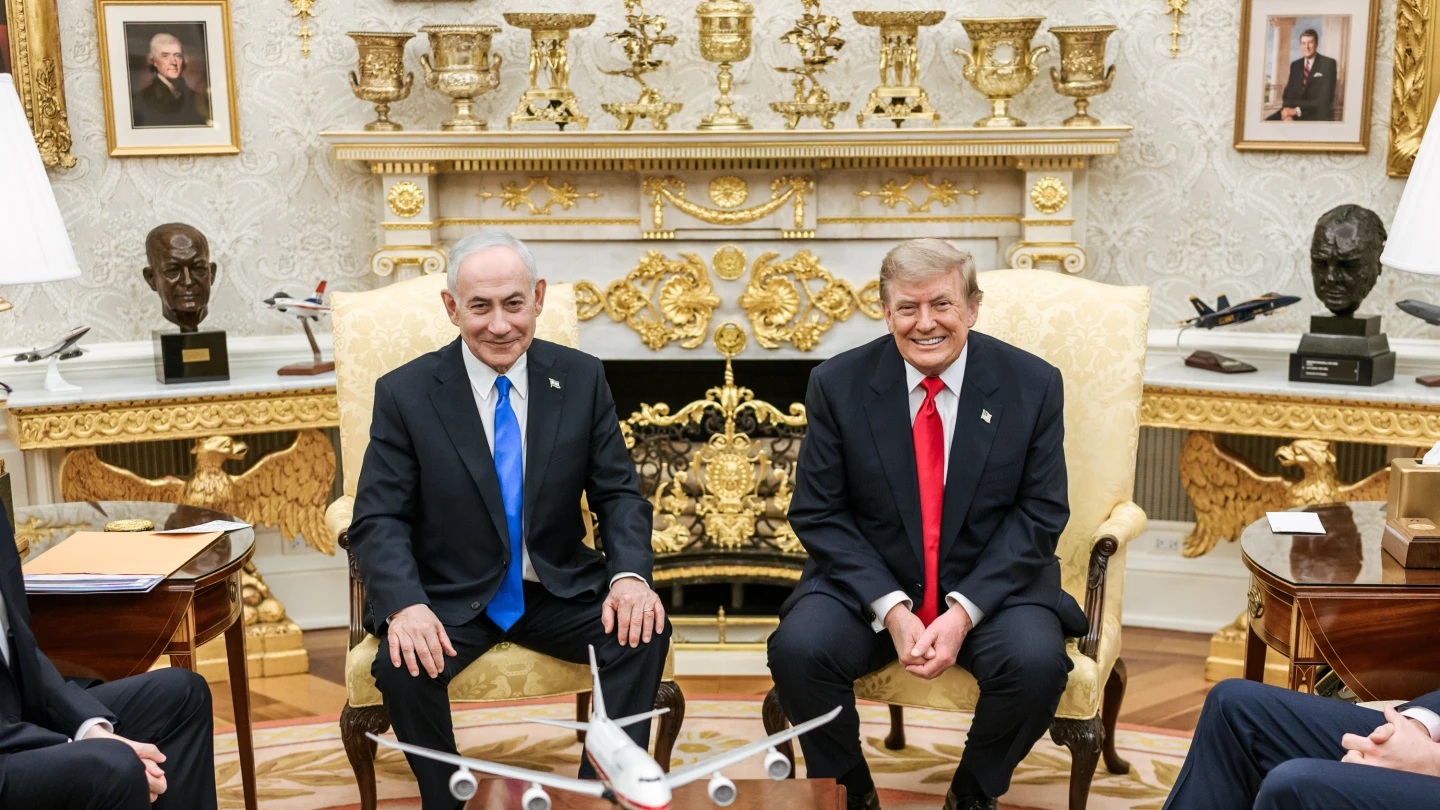
Trump Netanyahu
Alex Traiman
Alex Traiman

For nearly three years, Israeli Prime Minister Benjamin Netanyahu has been relentlessly criticized for “managing” Israel’s multifront war instead of pursuing immediate, all-out victories on every battlefield.

Why, critics ask, did Israel repeatedly adjust the intensity of its campaign in Gaza? Why did it wait before launching a decisive offensive against Hezbollah? Why has Israel alternated between attacking Iran and allowing diplomacy and economic pressure to run their course?

U.S. President Donald Trump’s evolving strategy toward Iran provides the answer—and an unmistakable validation of Netanyahu’s war management.

That does not necessarily mean conflict management is the best strategy. It certainly does not mean that an inconclusive cycle of threats, attacks and negotiations should continue indefinitely. Israel would prefer the Iranian threat to be eliminated decisively rather than managed and passed down to another generation.

But Trump is now confronting the same realities Netanyahu has faced since Oct. 7, 2023. The fact that the American president has adopted a similar approach demonstrates that Netanyahu’s decisions were not simply the product of weakness or indecision. They reflected the genuine constraints confronting any responsible leader managing a complicated, multifront war.

Trump clearly wants Iran’s nuclear and ballistic-missile programs dismantled, its attacks on international shipping stopped and its terrorist proxies neutralized. He has demonstrated a willingness to employ considerable military force. Yet he has also repeatedly paused escalation to give negotiations another chance.

Trump prefers a negotiated settlement. At the same time, he understands that the only possibility of achieving one is by demonstrating that the United States is prepared to attack.

Netanyahu has attempted to strike the same balance under considerably more dangerous circumstances.

The realities of fighting entrenched enemies

The difficulty is that terrorist organizations—and the regimes that sponsor them—rarely collapse as quickly as military planners hope.

Hamas is not a conventional army that raises a white flag after losing territory and commanders. It embeds its fighters, weapons, command centers and tunnels within a civilian population. As long as a handful of operatives can emerge from underground and wave the organization’s flag, Hamas can claim that it survives.

Hezbollah constructed a similarly entrenched terrorist infrastructure throughout civilian communities in southern Lebanon. Homes, villages and protected areas were converted into weapons depots, firing positions and tunnel complexes. Eliminating that infrastructure requires painstaking military operations that are far more complicated than defeating uniformed forces on an isolated battlefield.

The Iranian regime is entrenched on a much larger scale. The Islamic Revolutionary Guard Corps is embedded throughout Iran’s political institutions, economy and security apparatus. Its operatives exercise control over a population that may deeply resent the regime but cannot easily organize against a heavily armed system of repression.

This is why even an intensive military campaign may not immediately bring down the Islamic Republic. Economic pressure, sanctions and blockades are also essential. As long as Tehran can finance the IRGC and its regional proxies, those forces can continue intimidating civilians and preserving the regime’s grip on power.

Israel has been forced to operate simultaneously against Hamas in Gaza, Hezbollah in Lebanon, the Houthis in Yemen, Palestinian terrorist cells in Judea and Samaria, Iranian-backed militias across the region and the Iranian regime itself.

Netanyahu constantly had to assess whether Israel possessed enough troops to fight intensively on multiple fronts at once, as well as sufficient aircraft, interceptors, precision-guided munitions and other offensive and defensive weapons. Forces had to be shifted as threats changed, while weapons supplies, operational readiness and Israel’s capacity to withstand enemy retaliation all had to be preserved for the battles still to come.

When the northern front escalated, Israel reduced the intensity of operations in Gaza and redirected troops and resources toward Hezbollah. When circumstances permitted, it renewed pressure elsewhere.

Israel also had to manage its dependence on American weapons deliveries. The Biden administration frequently delayed or restricted the deliveries of critical munitions, forcing Israeli decision-makers to calculate not only what targets needed to be struck, but whether Israel would possess sufficient offensive and defensive capabilities for the next round of fighting.

Netanyahu could not discuss Israel’s weapons inventories publicly. Nevertheless, every decision had to account for them.

Now Trump is managing the confrontation with Iran in much the same fashion. He must consider the security of international shipping, the stability of energy markets and the readiness of American weapons stockpiles. He must also coordinate with Israel and regional partners while assessing their ability to absorb and defend against Iranian ballistic-missile attacks—and determining how much pressure is sufficient to force Iranian concessions without triggering a wider war.

Trump must also balance his military objectives against domestic political concerns. With the midterm elections approaching, the president may be reluctant to launch the United States into a decisive and potentially costly phase of the war. Even a successful operation could expose regional allies to Iranian retaliation, disrupt energy markets and create political uncertainty at home.

Trump may therefore be calculating that the next major strike should wait until after the midterms. If Republicans maintain control of the House and Senate, he would emerge with renewed political strength and fewer immediate electoral constraints. He could then conclude that the period for limited escalation and repetitive negotiations has ended.

Such a calculation would not mean Trump has abandoned his military objectives. It would mean he is choosing the timing he believes gives those objectives the greatest chance of success.

Netanyahu’s critics often pretend that political considerations should play no role in wartime decision-making. Yet every democratically elected leader must maintain the public support necessary to sustain a prolonged campaign.

The Trump administration’s cycle of military threats, limited strikes, renewed negotiations and additional pressure strongly resembles Netanyahu’s methodical approach to Gaza, Lebanon and Iran.

The limits of conflict management

There is, however, a danger in repeating this cycle indefinitely. The Iranian leadership has studied Trump’s negotiating behavior and understands his preference for an agreement. Tehran may conclude that it can offer talks whenever American pressure becomes intolerable, secure a pause and then return to its previous violations.

Each time Washington threatens overwhelming force and then accepts another round of negotiations, Iran becomes more confident that it can manipulate the process. Conflict management may be temporarily necessary, but it cannot become an objective in itself.

Eventually, Trump may lose patience. A return to large-scale military operations may be inevitable. The remaining question is whether it occurs before or after the American electorate goes to the polls.

Israel wants more than temporary restraints on uranium enrichment or another unenforceable nuclear agreement. It wants an end to the regime’s nuclear ambitions, ballistic-missile production and financing of terrorist proxies. Ultimately, Israel would like to see the Iranian people freed from the Islamic Republic that has oppressed them since 1979 and diverted their nation’s resources toward regional war.

Nevertheless, Israel understands why Trump is giving negotiations another opportunity. Netanyahu has faced the same tension between the desire for decisive victory and the need to proceed at a sustainable pace.

The two leaders may differ on whether negotiations can succeed, but that disagreement does not amount to the strategic rupture repeatedly imagined by the media.

After their latest meeting, Netanyahu described the U.S.-Israel alliance as a “wall of granite” and said the two countries share a common objective: preventing Tehran’s “fanatic regime” from acquiring nuclear weapons.

“We have a common goal, and it’s going to be achieved, either through diplomatic means or other means,” Netanyahu said. “We’re both committed to that.”

That formulation captures the alignment between Jerusalem and Washington. Trump may still hope diplomacy can achieve the objective. Netanyahu remains deeply skeptical. But both understand that diplomacy has meaning only when backed by credible military force.

Israel’s conduct has already transformed the region’s strategic balance. It has severely degraded Hamas and Hezbollah, demonstrated its ability to strike targets anywhere in Iran and established a level of deterrence that did not exist before Oct. 7.

Those results were not produced by passivity. They were produced by controlled escalation, careful prioritization and a willingness to ignore international red lights when Israel’s survival required it.

Trump is now discovering the same reality. Even the commander-in-chief of the world’s most powerful military must weigh timing, diplomacy, logistics, alliances and elections against the urgency of his military objectives.

This does not prove that managing the conflict is the best available strategy. It proves that managing the conflict is sometimes unavoidable—even for an American president with vastly greater military and economic resources at his disposal.

Netanyahu has been making those calculations from the first day of Israel’s longest and most complicated war. Trump is now making many of the same calculations himself.

That alone validates Netanyahu’s management of Israel’s multifront campaign. The ultimate test, for both leaders, will be whether careful management eventually creates the conditions for decisive victory—or merely postpones the next war

Rubio political terrorism terror
Matam Vilnai, an Israeli politician and former major general in the Israel Defense Forces, speaks at a conference in Tel Aviv titled “Opportunities for Israel Under Trump,” Jan. 28, 2025. Photo by Tomer Neuberg/Flash90.
Sbarro Pizzeria Bombing 2001

Get the latest updates in our WhatsApp group.

Trump Board of Peace
Fauci
Spanish actor Javier Bardem arrives for the 77th Primetime Emmy Awards at the Peacock Theatre at LA Live in Los Angeles on Sept. 14, 2025. Photo by Patrick T. Fallon / AFP via Getty Images.
Mamdani Tisch NYPD
Pro-Palestinian, Pro-Hamas, Anti-Israel Protesters, May 2021
Menachem Glik. Credit: Courtesy.
Benjamin Kerstein. Credit: Courtesy.
💬 רוצים להגיב ולהצטרף לדיון? הצטרפו — חינם, ומקבלים גם את הדיג׳סט השבועי.
🗞️ In-depth summary

U.S. President Donald Trump's evolving strategy toward Iran validates Israeli Prime Minister Benjamin Netanyahu's approach to managing Israel's multifront war since October 7, 2023. Both leaders face similar strategic constraints, balancing military pressure with diplomacy against entrenched enemies like Hamas, Hezbollah, and the Iranian regime. Netanyahu has been criticized for not pursuing immediate, all-out victories, but Trump is now confronting the same realities, demonstrating that such decisions reflect genuine constraints rather than weakness. Both leaders aim to dismantle Iran's nuclear and ballistic missile programs and neutralize its proxies, while also considering the complexities of fighting non-state actors embedded in civilian populations and managing international and domestic political concerns. Netanyahu stated that the U.S.-Israel alliance is a "wall of granite" and that they share a common objective: preventing Tehran's "fanatic regime" from acquiring nuclear weapons, adding, "We have a common goal, and it's going to be achieved, either through diplomatic means or other means."

Automatically generated summary based on the original article; quotes are from the source.
This story is based on reporting by JNS.
Read the full article at the source →

© All rights to the original article belong to the source. Din Online shows a headline, an excerpt and a link only. The objectivity rating is computed automatically and is an estimate only.

Related

Security Full Article4h ago

Iran’s Hidden Nuclear Threat: What Happened to the Missing Uranium?

אנחנו משתמשים בקובצי Cookie ובנתונים, כולל כתובות IP, כדי:אם בוחרים באפשרות "אישור הכול", נשתמש בקובצי Cookie ובנתונים, כולל כתובות IP, גם כדי:אם בוחרים באפשרות "דחיית הכול",…

Source: Google News75

Discussion

No comments yet — be the first to comment.

Add a comment