Twenty years after Michael Levin fell in Lebanon, his legacy is still growing


Twenty years after American-born Israeli lone soldier Michael Levin was killed defending Israel during the Second Lebanon War, family members, friends, supporters and U.S. Ambassador to Israel Mike Huckabee gathered on July 30 at his grave on Jerusalem’s Mount Herzl to honor his memory and celebrate the enduring legacy that has transformed the lives of thousands of lone soldiers.
The ceremony marked two decades since Levin, who grew up in Philadelphia and made aliyah to enlist in the Israel Defense Forces, was killed by Hezbollah sniper fire at the age of 22. It was followed by a memorial barbecue hosted by the Lone Soldier Center in Memory of Michael Levin.


Huckabee said the biblical belief in the sanctity of every individual underpins both American democracy and Israel’s struggle for survival.
“Whether one fights in the uniform of the IDF or the United States military, those values are the same,” he said.
Huckabee paid tribute to Michael Levin’s parents, Mark and Harriet Levin, who flew in from the United States, saying they had transformed unimaginable personal grief into an organization that has helped thousands of young men and women serving far from home.
“They took their love for Michael and their grief, and they did something that has now benefited thousands upon thousands of lone soldiers who have served and received support that Michael never had,” Huckabee said. “I cannot help but think that nothing could have been done more powerfully for Michael’s memory than what his parents have done through their own sacrifice, honoring their son by honoring every lone soldier who serves the State of Israel.”
Mark Levin said that while serving in the IDF, his son recognized that lone soldiers faced challenges unknown to native-born Israelis and envisioned creating a national support organization.
“Michael had an epiphany,” Levin said. “He said, ‘When I finish my service, you and I are going to start a lone soldier organization in this country.’”
At the time, he said, individuals across Israel were helping lone soldiers on an informal basis, but there was no central organization providing comprehensive support.
“There was no brick-and-mortar place where lone soldiers could go for help, for Shabbat meals, for camaraderie or for the many programs that could support them,” he said. “This was Michael’s idea. This was Michael’s dream.”
Two decades later, Levin said, that dream has become a thriving reality.
“Today there are more than 7,000 lone soldiers serving in the IDF, and the organizations we helped create support well over half of them,” he said.
He credited the staff and volunteers for the success.
“The lion’s share of the credit belongs to the people at the Lone Soldier Center in Memory of Michael Levin—its staff, its hundreds and hundreds of volunteers, community members and employees—people with the passion to do everything they can to make Michael’s dream come true,” he said. “There is a new awareness, a new understanding and, most importantly, a new appreciation for lone soldiers that simply did not exist 20 or 25 years ago.”

‘He didn’t want us crying’
Harriet Levin reflected on the friendships forged after her son fell, recalling that Michael never wanted those who loved him to dwell in grief.
“I stand here 20 years later, and I see so many of those same friends,” she said. “They still come together to commemorate Michael because, as he always said, he didn’t want us crying.”
She described the bond she has developed with Israel over the past two decades. “There really are no words to describe it,” she said. “I have an adopted family here now. They truly are my family, and I can’t wait to come back every single year.”
Founded in 2009, the Lone Soldier Center in Memory of Michael Levin has grown into Israel’s largest organization supporting lone soldiers. The center assists immigrant soldiers and Israeli service members without family support through housing assistance, social workers, Shabbat and holiday programming, financial guidance and ongoing support before enlistment, throughout military service and for years after discharge.
Speaking to JNS after the memorial ceremony, Mark Levin said he was encouraged not only by the turnout but by the continued commitment to his son’s vision.
“I was inspired by the turnout today,” he said. “There were close to 100 people—friends of Michael’s who served with him, dignitaries and representatives of the army. It was an inspiring service.”
He added, “Ambassador Huckabee praised Harriet and me for all the great things we’ve done. When somebody says something like that, I always respond in two ways. First, I say, ‘Thank you very much.’ Second, I say the lion’s share of the credit belongs to the people here in Israel doing the work day in and day out to help lone soldiers.”
Levin noted that, in addition to the original Lone Soldier Center in Memory of Michael Levin, he and his wife support lone-soldier initiatives across Israel and co-hosted the memorial event.
“We support the center we helped create here in Israel, and we also support 15 other lone-soldier organizations,” he said. “Many of them focus on helping soldiers cope with post-traumatic stress disorder, and unfortunately there are a lot of soldiers dealing with PTSD.”
Asked what message he hoped people would take away from Michael’s story, Levin reflected on the values that motivated his son to leave the United States and enlist in the IDF.
“Michael was a typical American kid who loved sports and loved America,” he said. “But he was also a passionate Zionist. He was proud of being Jewish. He was proud of Israel. He wanted to spend his life here, and he could think of no better way to do that than by joining the IDF, becoming a career officer and doing everything he could to protect the people and the State of Israel.”
‘I knew I had to build something in Michael’s memory’
Among those honoring Michael Levin was Tziki Aud, one of his closest friends in Israel and a co-founder of the Lone Soldier Center in his memory.

Aud first met Levin while working for the Jewish Agency, where he encouraged young participants in Israel programs to extend their stays. Levin stood out immediately.
“He kept asking questions,” Aud recalled with a smile. “I thought, ‘Here’s another American who will talk endlessly and then go back home.’ But instead, he came to my office in Jerusalem, and we became very close friends.”
When the Second Lebanon War broke out in 2006, Aud urged Levin to delay his return to Israel, believing the fighting would soon end.
“I remember thinking that if there was one person I couldn’t convince not to come, it was Michael,” he said. “Within 24 hours he was back in Israel.”
After Levin was killed in action just days later, Aud said he felt compelled to ensure that Michael’s legacy endured.
“I knew I had to build something in Michael’s memory,” he said. “Together with friends, we founded the Lone Soldier Center in Memory of Michael Levin. Today it’s an empire. Thousands of lone soldiers receive help from the center, and I’m very happy about that.”
Aud also recalled Levin’s love of bringing people together over late-night barbecues, a tradition that continues after the annual memorial ceremony.
“He used to tell everyone, ‘If anything ever happens to me, don’t mourn me—have a barbecue,’” Aud said. “That’s what we do every year. We celebrate Michael the way he would have wanted.”
‘We look each soldier in the eye’
Liora Rubinstein, CEO of the Lone Soldier Center, told JNS the organization has grown into Israel’s largest support network for lone soldiers, accompanying them from before their enlistment through military service and for five years after their discharge.
“We support more than 5,000 lone soldiers at any given time through two programs—one for immigrant lone soldiers and one for Israeli lone soldiers without family support,” Rubinstein said.
The center operates seven residential homes—four in Jerusalem and one each in Tel Aviv, Herzliya and Petach Tikvah—providing approximately 200 lone combat soldiers with housing, meals, counseling and a supportive environment.
“When a soldier comes home, we want them to feel they have a safe place, a home, support and a hug,” she said.
In addition, the organization runs four regional support centers in Beersheva, Tel Aviv, Jerusalem and Haifa, where lone soldiers can share Shabbat meals, receive hot food prepared by volunteers, meet staff members and access ongoing assistance.
Rubinstein said the center’s defining feature is its personalized approach, with social workers and coordinators meeting individually with every soldier to develop tailored support plans based on their needs during military service and after their release.
“We look each soldier in the eye,” she said. “We ask what they need, where they need help and how we can best support them at every stage of their journey.”
In June, the organization received Israel’s 2026 Presidential Award for Volunteering in recognition of its contribution to Israeli society. Since its founding, it has supported more than 15,000 lone soldiers, fulfilling the vision Michael Levin first shared while serving in uniform.
For Rubinstein, the 20th yahrzeit ceremony was a powerful reminder of how one heroic warrior’s dream grew into an organization that now supports thousands of lone soldiers across Israel.
“It’s incredibly moving to see what one young man created,” she said. “Twenty years later, his dream continues to ensure that no lone soldier is ever left alone.”
‘Miracles happen here every day’
Drorit Nitzani, who is president of the entire organization and founder of its program for Israeli lone soldiers without family support, said the initiative grew out of a chance encounter with a wounded soldier following “Operation Protective Edge” in 2014.

Nitzani said her family had “adopted” a lone soldier recovering from wounds sustained during the war, assuming he had immigrated to Israel. Instead, she discovered he had been born in Jerusalem, left an ultra-Orthodox home as a young teenager, lived on the streets and eventually enlisted in the IDF’s elite Maglan unit.
“When he came to us, I realized he couldn’t read or write because he had never attended school,” she said.
Unable to find any organization assisting Israeli lone soldiers without family support, Nitzani approached the Michael Levin Lone Soldier Center and worked with its leadership to establish a dedicated program. Over the past 12 years, she said, public awareness has grown dramatically, with many Israelis now recognizing that roughly half of the country’s lone soldiers are Israelis lacking family support rather than new immigrants.
Today, she said, half of the 5,000 lone soldiers the center assists are native Israelis, providing them with financial assistance, social workers and practical support to help them build independent lives.
Nitzani pointed to the wounded soldier as one of the program’s greatest success stories. With intensive tutoring from volunteers, he completed high school, graduated with honors, earned a business degree from Reichman University, married and recently celebrated his son’s first birthday.
“Miracles happen here every day,” she said. “Young people who might never have been able to integrate into Israeli society go on to study medicine, computer science and other professions. That’s why we do this work.”
Journalist Yigal Grayeff, a friend of Michael Levin and an adviser to the Lone Soldier Center, said the organization fulfilled a vision Levin told him about long before he fell in Lebanon.

Grayeff, who met Levin through the Jewish Agency before the Second Lebanon War, now volunteers by advising prospective and serving lone soldiers on everything from military service to housing and personal challenges.
“I see my role as helping them find answers or directing them to people who can,” he told JNS. “Sometimes they just need someone who understands what they’re going through.”
Grayeff said Levin made a lasting impression on virtually everyone he met.
“He touched everybody,” he said. “He left a mark on every person.”
Levin’s legacy extends far beyond the center that bears his name, Grayeff added.
“His vision was to create an organization that would support lone soldiers,” he said. “Today that vision has helped thousands of soldiers and inspired many others to make aliyah and serve in the IDF. His legacy is tremendous.”

Get the latest updates in our WhatsApp group.



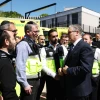

On July 30, family, friends, and U.S. Ambassador to Israel Mike Huckabee gathered at Mount Herzl to commemorate the 20th anniversary of American-born Israeli lone soldier Michael Levin's death during the Second Lebanon War. Levin, who made aliyah from Philadelphia to enlist in the IDF, was killed by Hezbollah sniper fire at age 22. The memorial honored his legacy, particularly the Lone Soldier Center in Memory of Michael Levin, which has significantly impacted thousands of lone soldiers.
“They took their love for Michael and their grief, and they did something that has now benefited thousands upon thousands of lone soldiers who have served and received support that Michael never had,”
Ambassador Huckabee stated, acknowledging Michael's parents, Mark and Harriet Levin, for transforming their personal grief into an organization that supports young men and women serving far from home. Mark Levin recounted his son's vision for a national support organization for lone soldiers, a dream that has materialized into a thriving reality, with the center now supporting over half of the 7,000 lone soldiers in the IDF. The Lone Soldier Center, founded in 2009, is Israel's largest organization assisting lone soldiers with housing, social workers, Shabbat meals, financial guidance, and ongoing support before, during, and after military service.
© All rights to the original article belong to the source. Din Online shows a headline, an excerpt and a link only. The objectivity rating is computed automatically and is an estimate only.
Discussion
No comments yet — be the first to comment.