Two brothers separated by war in Ukraine reunite at summer camp in Poland

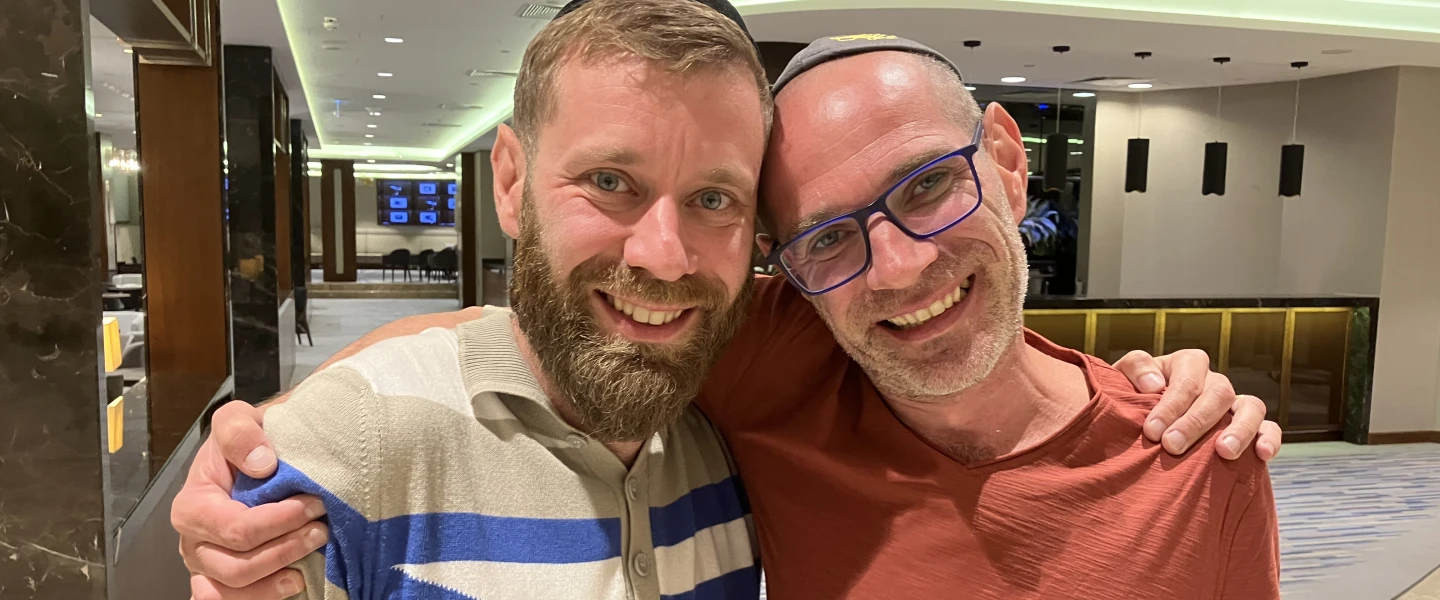
WARSAW, Poland—It was a surprise reunion.
For the last nine years, Moshe Galinkin had been unable to see his younger brother Daniel, first because of travel restrictions imposed during the COVID-19 pandemic and then because of the ongoing war in Ukraine.
A summer camp organized by the Chabad-Lubavitch movement for a group of war-weary Ukrainians last month brought the two siblings together for the first time in nearly a decade.
“It was something I didn’t even dream of,” Moshe Galinkin, 45, of the central Israeli city of Beit Shemesh, told JNS, his eyes welling with tears of joy.
Galinkin moved to Israel from Ukraine a quarter-century ago, but his family stayed behind.
He would periodically visit them, most recently in 2017, but then the pandemic broke out, followed by the wars in Ukraine and Israel, upending travel.
When he heard earlier this summer that Chabad was planning its third annual summer retreat for some 200 Ukrainians, he thought he would get a chance to see his elderly mother again, whom he had last seen at the organization’s camp last year.
Meanwhile, in Ukraine, Daniel Galinkin, 40, and his 70-year-old mother, Yenta, were praying that he would be allowed to join the Ukrainians registered for the event. As a man of draft age, it is extremely difficult for him to leave the country.
Yenta Galinkin recounted that in addition to praying, she had fasted on Tisha B’Av, the traditional Jewish day of mourning for the destruction of the ancient Temples in Jerusalem, hoping that her younger son would be able to make the two-week trip.
“Until the very end, it was only a 50-50 chance it would work,” Daniel Galinkin recounted, explaining that this was part of the reason he and his mother had kept the hoped-for reunion a secret.
When Galinkin arrived at the Ukrainian border, he was allowed to cross within seven minutes, an uncertain process that could have taken hours or even a day.
“It was only then that I knew I made it,” he said. “I felt it was a miracle.”
After a 24-hour journey by train and bus, Daniel and his mother arrived in Warsaw.

Moshe Galinkin had flown in from Israel for the summer retreat and walked into the upscale Warsaw hotel where the camp was being held, convinced that he was only going to meet his mother.
After the two embraced, his brother, who had hidden himself behind a column in the lobby, suddenly appeared.
After a moment of shock, the two brothers embraced and broke into song and dance as their mother looked on, overwhelmed with joy.
“It is hard to express in words how I felt,” Yenta Galinkin recounted, sitting between her two sons and her grandchildren.
“The camp is an island of comfort and paradise, offering a period of relaxation from the tension and bombing of the war,” said Rabbi Levi Stambler, the Chabad-Lubavitch emissary and chief rabbi of the Ukrainian city of Kamianske, who organized the event.
The two-week event is sponsored by private donors who cover its $500,000 budget. It takes place in conjunction with Chabad of Warsaw, headed by Stambler’s brother, Rabbi Shalom Stambler, which provided the food.
“Even though this is in essence a charity event, our job is to make sure that they are happy just like normal hotel guests,” Stambler said as he ran the camp’s operations with his wife, Dina, and their teenage daughters. “Seeing them happy makes everything worth it.”
While about 100 Jewish families from Kamianske have moved to Israel and 50 families have relocated to Europe since the Russian invasion of Ukraine four years ago, hundreds of additional families, mainly pensioners, remain behind.
As for the Galinkins, they know their time together is short-lived, as Daniel and his mother are set to return to Ukraine this week.
“It is very hard to return to the terrible winter and the unknown after being here in this paradise together,” Daniel said. “But for now this is our life.”




Get the latest updates in our WhatsApp group.
Test yourself on one question pulled from JNS reporting. New puzzles daily.







© All rights to the original article belong to the source. Din Online shows a headline, an excerpt and a link only. The objectivity rating is computed automatically and is an estimate only.
Discussion
No comments yet — be the first to comment.