Vest that US-Israeli startup helped make can cut astronauts’ exposure in solar storms, study suggests
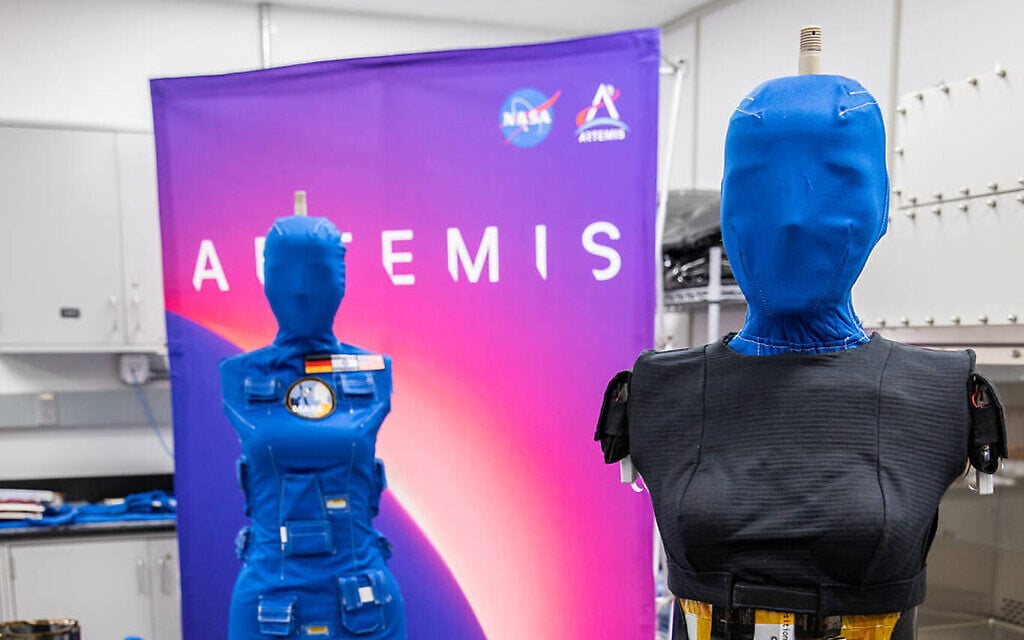

CAPE CANAVERAL, Florida (AP) — A new study suggests a protective vest tested on a manikin during NASA’s first Artemis moonshot could drastically cut the radiation exposure of lunar astronauts during severe solar storms.
Scientists reported Wednesday on the radiation-shielding vest worn around the moon by a female test dummy in 2022. No one was aboard that Artemis I debut flight, which paved the way for humanity’s long-awaited return to the moon in April by a flyby crew of four.
Radiation remains one of the biggest threats to astronauts as NASA works toward a moon base. Shielding garments could keep lunar crews safe when solar storms strike and even allow them to venture beyond their shelters if necessary, the US, German and Israeli team reported in the journal Science Advances.
A version of the vest was previously tested on the International Space Station. It didn’t travel with the Artemis II astronauts since it was a short 10-day mission with limited room, but may wind up a carry-on for future moon crews.
Meant to be worn only during high-radiation and potentially cancer-causing solar events, the vest covers the most vulnerable human organs and tissue: lungs, stomach, bone marrow, breasts and ovaries. Women are believed to be especially susceptible to radiation-induced cancer.
Artemis I carried two female manikins that spent nearly a month flying to the moon and back. Dubbed Zohar and Helga, the manikins — each a life-size 3 feet from head to lower torso — were strapped into the passenger seats of NASA’s Orion capsule.
Zohar wore the 57-pound (26-kilogram) AstroRad vest, developed by the US-Israeli startup StemRad and Lockheed Martin. The companies had already tested a prototype on the space station for comfort and function, modeling it after gear worn by nuclear disaster teams.
Helga flew vest-less, but like its companion contained thousands of radiation sensors.
The study’s lead author, StemRad’s Jordan Houri, called it “the largest experiment ever conducted to determine astronaut radiation exposure beyond low-Earth orbit.” NASA, the German Aerospace Center and the Israel Space Agency provided the funding. Radiation exposure is much less for space travelers closer to home, thanks to Earth’s protective atmosphere and magnetic field.

Artemis I encountered no major solar outbursts. But based on measurements gathered as NASA’s Orion capsule zipped through the inner Van Allen radiation belt, Houri and his team simulated how much protection the vest would provide during extreme solar particle events like those in 1972 and 1989 that detonated magnetic sea mines and collapsed a power grid.
Lucky for NASA, the 1972 solar outburst occurred in between that year’s two moon landings, keeping the crews of Apollo 16 and 17 safe from potentially lethal radiation exposure.
The latest findings showed the vest could reduce an astronaut’s radiation dose by about 60% in a solar storm as fierce as the one in 1972 and by nearly 40% in a calamity mirroring 1989. That’s equivalent to 193 days and 131 days, respectively, of unnecessary deep space radiation exposure, the scientists noted.
While none of the Apollo moonshots exceeded two weeks, the moon-base stays envisioned by NASA will likely last weeks, if not months, driving up the risk of enduring a dangerous solar storm. Mars expeditions will last even longer — months, years and possibly entire lifetimes if SpaceX CEO Elon Musk achieves his goal of building a city on the red planet.
The scientists are using their observations to trim more weight from the vest without sacrificing protection. They’re also investigating how to make radiation shielding from items already aboard a spacecraft — recycling that could save the lives of crews.
Houri doesn’t anticipate a need for further deep-space testing anytime soon, since Zohar and Helga “provided us with an exceptionally large, high-fidelity dataset.”
Zohar and her vest are now on display at Florida’s Kennedy Space Center, where their journey to the moon began.

As a multimedia journalist, my job is to take the quality, fact-based journalism produced by The Times of Israel newsroom and make it accessible across every platform — from Instagram posts to podcasts to short-form videos.
This is how many, especially young people, consume news these days. But misinformation is rampant on social media. Our team at ToI produces accurate, responsible short-form reporting on Israel and the Jewish world.
If you believe in the importance of factual social media journalism, please consider joining our reader support group, The Times of Israel Community. Your financial support is essential to sustain responsible multimedia reporting.
— Gabriella Jacobs, multimedia journalist

We’re really pleased that you’ve read X Times of Israel articles in the past month.
That’s why we started the Times of Israel – to provide discerning readers like you with must-read coverage of Israel and the Jewish world.
So now we have a request. Unlike other news outlets, we haven’t put up a paywall. But as the journalism we do is costly, we invite readers for whom The Times of Israel has become important to help support our work by joining The Times of Israel Community.
For as little as $6 a month you can help support our quality journalism while enjoying The Times of Israel AD-FREE, as well as accessing exclusive content available only to Times of Israel Community members.
Thank you, David Horovitz, Founding Editor of The Times of Israel


A new study indicates that a protective vest, developed by US-Israeli startup StemRad and Lockheed Martin, could significantly reduce astronaut radiation exposure during severe solar storms. The AstroRad vest was tested on a manikin named Zohar during NASA's uncrewed Artemis I lunar mission in 2022, while a vest-less manikin, Helga, served as a control. Scientists simulated the vest's effectiveness against extreme solar particle events, finding it could reduce radiation doses by approximately 60% in a 1972-level storm and nearly 40% in a 1989-level event. According to lead author Jordan Houri, this was "the largest experiment ever conducted to determine astronaut radiation exposure beyond low-Earth orbit." The vest, designed to cover vulnerable organs, is crucial for future long-duration lunar and Mars missions, where astronauts face higher radiation risks than in low-Earth orbit.
© All rights to the original article belong to the source. Din Online shows a headline, an excerpt and a link only. The objectivity rating is computed automatically and is an estimate only.
Discussion
No comments yet — be the first to comment.