West Bank fuel shortage strands Palestinians at pump with economy running on empty
Nurit Yohanan is The Times of Israel's Palestinian and Arab world correspondent

On most days, Sael Jabareen drives from his home in Ramallah to work at the office of the Israeli-Palestinian peace organization Combatants for Peace in Beit Jala, near Bethlehem, some 30 kilometers (19 miles) away.
But for the past two weeks, he has been unable to make the trip. He simply has no gas.
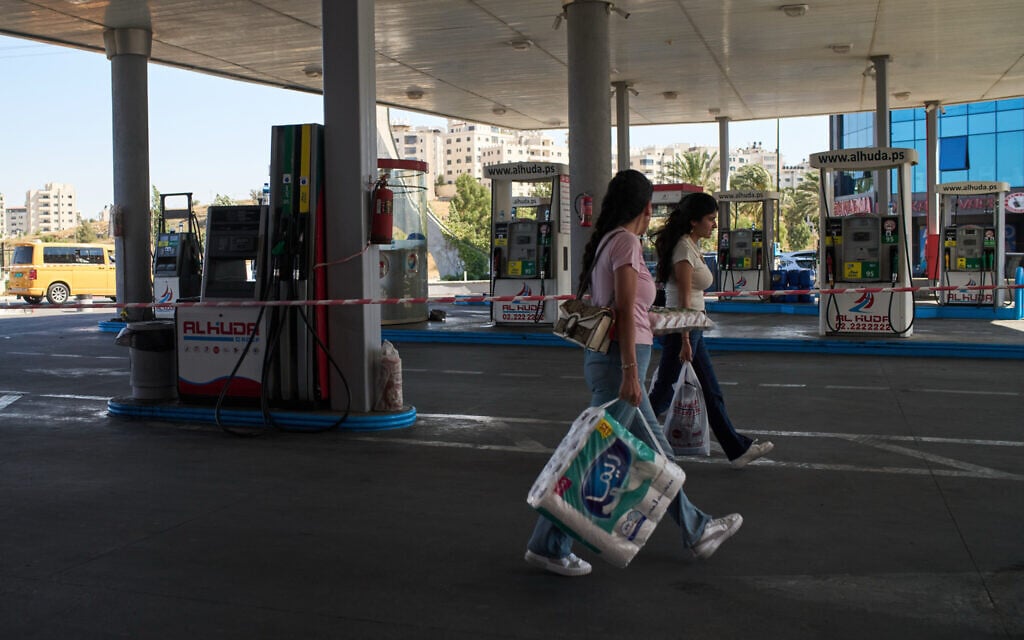
Across the West Bank, fuel gauges on Palestinian cars have recently been stubbornly stuck on empty as the territory grapples with an acute shortage of gasoline.
“The West Bank is completely paralyzed because of this,” said Sameh al-Atout, an economist at An-Najah National University in Nablus.
Driving the shortage is a cash crunch that has left fuel-sellers short of the money needed to purchase imported gasoline, possibly compounded by higher energy prices worldwide and panic buying by skittish consumers.
Experts say deeper structural issues are also at play, including the Palestinian economy’s reliance on Israeli currency and its restricted access to banking services, as well as the Palestinian Authority’s monopoly on fuel imports, leading to calls for far-reaching reforms.
Palestinian media outlets began reporting on severe shortages at gas stations across the West Bank on July 16. Since then, long lines have become a common sight, with residents describing fraying tempers and major disruptions to daily life.
“You drive past the stations and they’re all packed with lines. From morning until night, all you see are lines. Twice already my wife and I waited in line at a gas station, and after an hour to an hour and a half, the station ran out of fuel before we could fill up. And there’s no answer as to why this is happening,” Jabareen told The Times of Israel.

Among those hit hardest are operators of taxis and shared-taxi vans, who provide the only form of public transportation in the West Bank.
A taxi driver from the Nablus area, who requested The Times of Israel not use his name, said he had stopped operating altogether since the shortages began.
Alaa Mayas, head of the General Union of Transport Workers in Palestine, warned on July 26 that the prolonged shortage was threatening the entire transportation sector.
The PA only addressed the issues behind the problem for the first time on Wednesday, with Palestinian Finance Minister Estephan Salameh attributing the shortage to several economic crises, chief among them the ongoing cash liquidity crisis involving Israeli banks.
Almost all of the 3 million liters of fuel consumed in the West Bank daily is bought by the Palestinian General Petroleum Authority from Israeli fuel companies before being distributed to licensed Palestinian gas stations.
Under Palestinian law, the Petroleum Authority holds a monopoly over fuel imports into the West Bank, making it the sole entity authorized to purchase and import fuel.
The shortages come amid broader turbulence in global energy markets. In recent months, disruptions to oil shipments through the Strait of Hormuz, sparked by the war in Iran, have pushed global oil prices higher.
However, Israel has not experienced fuel shortages in recent weeks, suggesting that the crisis in the West Bank is rooted primarily in local economic constraints rather than global supply disruptions.

For over a year, the Palestinian economy has been hampered by a cash crisis rooted in the economic arrangements established under the 1994 Paris Protocol, the economic annex to the Oslo Accords.
Under those arrangements, the Palestinians do not have a national currency and instead use the Israeli shekel. Palestinian banks, therefore, rely on the Israeli banking system to clear and exchange shekels into foreign currencies.
Although the Palestinian economy has grown significantly over the past three decades, the quarterly ceiling on the amount of shekels that Palestinian banks can transfer to Israel for conversion has remained unchanged. As Palestinian officials describe it, banks now reach that ceiling much more quickly than in the past.
As a result, the transfer of shekels for conversion has slowed considerably in recent years to remain within the quarterly limit of NIS 4.5 billion ($1.47 billion). The backlog has left Palestinian banks holding large amounts of cash, leading many to refuse or significantly delay cash deposits by customers.
In recent weeks, the Israeli banks that provide correspondent banking services to Palestinian banks announced that they will cease doing so entirely in October, potentially worsening the crisis.

Al-Atout explained to The Times of Israel that the cash liquidity crisis with Israeli banks has left Palestinian businesses unable to deposit the cash they receive into the banking system. As a result, they cannot convert cash income into bank balances that can be used to purchase fuel from the Palestinian General Petroleum Authority, which in turn buys its fuel from Israel.
At a press conference on Wednesday, Salameh called for the PA to gradually phase out the use of the Israeli shekel and urged those buying fuel to use electronic payments.
“The issue has gone from being an economic matter to one of life and death,” Salameh said.
Cash, however, remains the dominant means of payment across much of the West Bank, including at gas stations.
Speaking to the Palestinian news outlet Ma’an on July 26, Samer Abu Hadid, head of the West Bank Gas Station Owners Association, said station owners were spending long hours at banks waiting to deposit the cash they receive from customers because of the ongoing cash liquidity crisis. He also urged the public to use electronic payment methods whenever possible.
The owner of a gas station in the West Bank told the Qatari newspaper Al-Araby Al-Jadeed that difficulties depositing cash had forced some station owners to shut their businesses altogether.
Al-Atout said Israel’s continued withholding of Palestinian tax revenues had also made it difficult for the Petroleum Authority to pay suppliers.
Under the Oslo Accords, Israel collects customs duties and other tax revenues on behalf of the Palestinian Authority — amounting to hundreds of millions of shekels each month — and is meant to transfer them to the PA.

Israel has withheld the funds for more than a year, with Finance Minister Bezalel Smotrich refusing to transfer the money due to what he described as PA support for terrorism.
According to Salameh, as of June, the PA was owed approximately $5.7 billion.
The tax revenues account for roughly 60% of the Palestinian Authority’s income, and the prolonged freeze has contributed to a broader fiscal crisis, including an ongoing doctors’ strike.
Khaled al-Sarahna, secretary of the West Bank Gas Station Owners Association, told Al-Araby Al-Jadeed on July 22 that the non-transfer of the funds had left the Petroleum Authority some NIS 3 billion (about $1 billion) in debt to Israeli suppliers.
Palestinian officials, however, dispute his claim that fuel imports had fallen off as a result.
On July 27, Majdi Hassan, head of the Petroleum Authority, told the official Voice of Palestine radio station that the volume of fuel supplied by the authority to Palestinian distributors had remained unchanged in recent months.

He argued that part of the shortage stemmed from panic buying, with Palestinians rushing to fill their tanks amid fears that regional instability and the possibility of another confrontation with Iran could lead to emergency conditions and fuel scarcity.
Salameh also said there had been stockpiling.
Israel’s oil company Paz, which supplies roughly half of all fuel sold to the Palestinian market, did not respond to a request for comment from The Times of Israel on whether fuel sales to the Palestinian Authority had declined over the past two weeks because of reduced purchasing power on the Palestinian side.
Jabareen said the shortages have brought entire neighborhoods in Ramallah to a standstill.
“When people post on social media that fuel has arrived at a station — in western Ramallah, for example — everyone rushes there. The whole area gets jammed. The lines are so long they block the roads,” he said.
On July 26, tensions at a gas station in Ramallah escalated into a fistfight. Footage circulated on social media showed dozens of Palestinians pushing and punching one another, some wielding the jerrycans they had brought to fill with fuel.
Jabareen said such scenes have become commonplace.
“Every day there’s chaos at gas stations. There are fights. People are angry and on edge all the time,” he said.
In theory, Palestinians in the West Bank can drive to Israeli-operated gas stations located in Area C, where fuel supplies have remained uninterrupted.
The settler-affiliated news outlet Hakol Hayehudi reported on July 23 that the number of Palestinians refueling at Israeli gas stations in the West Bank had increased in recent weeks.

However, reaching Israeli gas stations is not always possible for Palestinians because of the large number of checkpoints separating Palestinian cities and villages, the number of which has increased in recent years.
Jabareen also said he fears being attacked by settlers while refueling.
He needed to attend an important event at his office on July 24 and carefully planned how he would obtain fuel.
“I woke up at 5:30 in the morning and drove to an Israeli gas station near Mishor Adumim before the settlers woke up. I thought, ‘We’ll fill up in two minutes and leave.’ It worked. You have no idea how happy I was. After a whole week without being able to get fuel, it was an incredible feeling,” he said.
The shortages have fueled a thriving black market, Palestinian officials say.
Majdi Hassan, head of the Palestinian General Petroleum Authority, told the Voice of Palestine radio station on July 27 that some people were filling jerrycans at gas stations and then reselling the fuel privately at inflated prices.
The taxi driver from the Nablus area told The Times of Israel that some black market sellers were diluting fuel with water to increase their profits.
As part of efforts to curb black-market activity, the Palestinian Customs Police, together with inspectors from the Palestinian General Petroleum Authority, carried out inspections at gas stations across the West Bank on July 26 to ensure that customers were not filling jerrycans or stockpiling fuel.
Beyond those enforcement measures, the PA has yet to announce concrete steps to resolve the crisis.
Following a July 25 meeting chaired by Salameh, the Petroleum Authority said it was working to increase fuel supplies to the West Bank while addressing the effects of the shekel cash liquidity crisis, but it provided few details.
Salameh said Wednesday that the PA could keep regulation with the Petroleum Authority, but create a new public company in charge of purchasing and transportation
“What is being proposed is a government-owned company that is fully owned by the state,” he told reporters in Ramallah.
The idea is not new. As early as 2018, the Palestinian government announced plans to establish a state-owned fuel company that would maintain fuel stocks and help prevent shortages. The plan was never implemented, despite the passage of the Palestinian Petroleum Authority Law in 2023, whose Article 9 addresses the establishment of such a company.

On July 22, in the wake of the current crisis, the Palestinian government said it had already been discussing the proposal before the shortages began, describing it as “a long-term project that requires further discussions with the relevant parties.”
Palestinian businessman Samir Hullileh said he did not believe a public petrol company would solve the current fuel crisis or possible future ones.
“The private sector rejected the idea, but there was no public discussion,” he said.
He and others accuse the PA of being derelict in tackling the problem with real solutions.
“Our government is neglecting us,” the Nablus taxi driver said. “They’re not providing us with what we need. They always say, ‘The occupation, the occupation.’ Not everything is because of the occupation. There is negligence.”
Al-Atout argued that because the fuel crisis stems from the broader economic relationship between Israel and the PA, it ultimately requires a political rather than merely an economic solution.
“The other side (Israel) needs to understand that the Palestinian economic situation is only getting worse,” he said. “We need a solution to the broader economic disputes between Israel and the Palestinian Authority. The public tension we’re seeing now because of the fuel crisis is very high, and its long-term consequences will benefit neither side.”

The war with Iran has been draining for all of us in Israel. But when I heard about a high casualty incident – ballistic missile impacts in Arad and Dimona that left nearly 200 people wounded – I drank a cup of coffee, packed a bag, and headed south.
There, I spoke with Shilgit, the head of an after-school program for underprivileged youth. Standing outside her destroyed center, Shilgit said it was a miracle that no children were hurt and spoke about the community coming together in the hours since.
As a Times of Israel reporter, I’m committed to telling stories of resilience like Shilgit’s. But my colleagues and I can't do this alone. If you value work like this, please consider joining our reader support group, The Times of Israel Community. Your financial support is essential to keep real human reporting like this going.
— Stav Levaton, military reporter

We’re really pleased that you’ve read X Times of Israel articles in the past month.
That’s why we started the Times of Israel – to provide discerning readers like you with must-read coverage of Israel and the Jewish world.
So now we have a request. Unlike other news outlets, we haven’t put up a paywall. But as the journalism we do is costly, we invite readers for whom The Times of Israel has become important to help support our work by joining The Times of Israel Community.
For as little as $6 a month you can help support our quality journalism while enjoying The Times of Israel AD-FREE, as well as accessing exclusive content available only to Times of Israel Community members.
Thank you, David Horovitz, Founding Editor of The Times of Israel


The West Bank is experiencing a severe fuel shortage, paralyzing daily life and public transportation. This crisis, ongoing since mid-July, is primarily driven by a cash crunch preventing fuel sellers from purchasing imported gasoline, compounded by global energy prices and panic buying. Economist Sameh al-Atout stated, "The West Bank is completely paralyzed because of this."
- The Palestinian economy's reliance on the Israeli shekel and restricted access to banking services, along with the Palestinian Authority's (PA) monopoly on fuel imports, are identified as deeper structural issues.
- Palestinian Finance Minister Estephan Salameh attributed the shortage to multiple economic crises, particularly a cash liquidity crisis with Israeli banks, and called for phasing out the Israeli shekel and promoting electronic payments.
- Israel's withholding of Palestinian tax revenues, amounting to hundreds of millions of shekels monthly, has also contributed to the PA's fiscal crisis, impacting its ability to pay fuel suppliers.
- Despite claims of consistent fuel supply by the Petroleum Authority, residents report long lines, fraying tempers, and even physical altercations at gas stations, with many unable to refuel.
© All rights to the original article belong to the source. Din Online shows a headline, an excerpt and a link only. The objectivity rating is computed automatically and is an estimate only.
Discussion
No comments yet — be the first to comment.