AIPAC gets lots of attention in Michigan Senate primary, but voters say it’s not their top issue


OAK PARK, Michigan (JTA) – Working as a morning producer for Detroit’s Local 4 television station, Noelle Gray has had a front-row seat to the flood of political advertising in Michigan’s Democratic Senate primary.
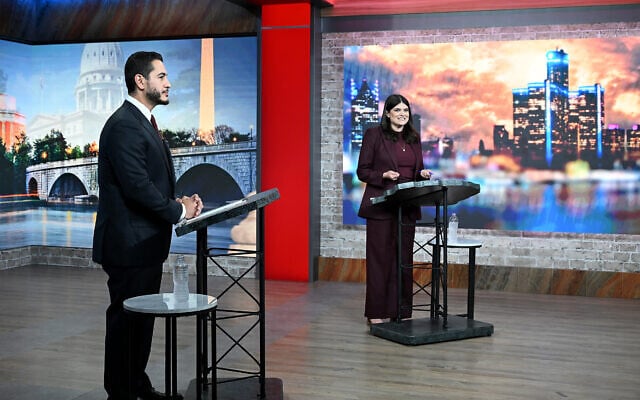
Amid the barrage, one thing stood out to her: how much money the pro-Israel lobby AIPAC was pouring into the race between US Rep. Haley Stevens, a pro-Israel moderate, and former county health official Abdul El-Sayed, a progressive and harsh Israel critic.
“It concerns me a little bit because it makes me a little leery of foreign interests being infiltrated into the state of Michigan,” said Gray, 27, who on Sunday stopped by her polling place in the Detroit suburb of Oak Park to vote early. “I want to support somebody who is for the state of Michigan. I love Michigan. Born and raised here my entire life, and it worries me on corporate and international interests. Are you really focused on Michiganders?”
Ultimately, Gray said, spending by the American Israel Public Affairs Committee’s affiliated super PAC did not drive her vote. She voted for El-Sayed because of her concerns about data centers and ICE, the immigration enforcement agency that has been at the front of a nationwide crackdown.
“I would hope putting someone in the position of our Senate will represent our interests, keep us safe, but also protect the people who are here,” Gray said of her decision.
But the lobby has become nearly impossible to miss in the race. AIPAC’s super PAC has spent over $30 million to support Stevens’ campaign, toppling its previous record in a bid to prevent one of its most vocal Democratic critics, El-Sayed, from reaching the Senate.
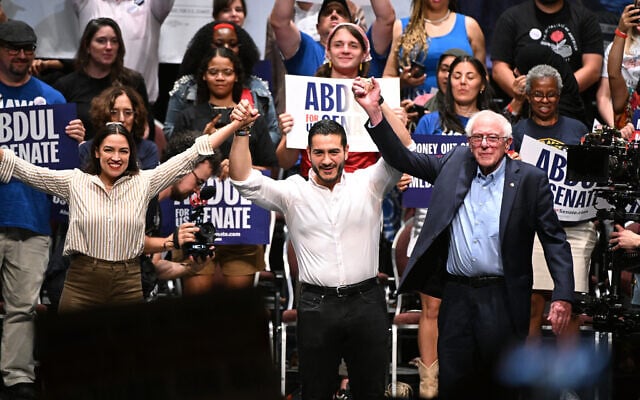
El-Sayed, who is currently leading Stevens by as much as 16 points in recent polling, has made opposition to the group, and to Israel, a defining feature of his campaign, inveighing against AIPAC in the debates ahead of Tuesday’s primary and in his attack ads against Stevens. “AIPAC is perfectly fine with either Congresswoman Stevens or Mike Rogers,” El-Sayed wrote in a post on X earlier this month, referring to the Republican Senate nominee. “If either of them win, Israel wins.”
Polling in Michigan suggests widespread opposition to AIPAC among Democratic voters. A survey conducted earlier this month of 500 likely Michigan Democratic primary voters on behalf of Detroit News/WDIV-TV found that 49% have an unfavorable opinion of AIPAC, while 12% view AIPAC favorably, and 39% were neutral. An April poll conducted by Data for Progress for Zeteo and Drop Site News, two outlets that prominently feature criticism of Israel, found that 64% of likely Democratic primary voters said they are less likely to support a Senate candidate who receives AIPAC donations.
But Josh Pasek, a professor of communication and media and political science at the University of Michigan, said that he did not think the “bulk of voters” in the state were voting primarily based on issues concerning Israel and AIPAC.
“I think most people care a whole lot more about substantive issues,” Pasek said. He added, however, that the issue was particularly important for Jewish and Muslim voters, both of which have large communities in Michigan. The state is home to more than 240,000 Muslims and roughly 129,000 Jews out of some 10 million total residents.
For all the attention AIPAC has commanded in the race, a snapshot of voters participating in early voting Sunday suggested AIPAC’s spending wasn’t the foremost issue shaping their decisions. Even among voters who shared concerns about money in politics, AIPAC was often one of several sources of political spending they cited, alongside issues including affordability and immigration.
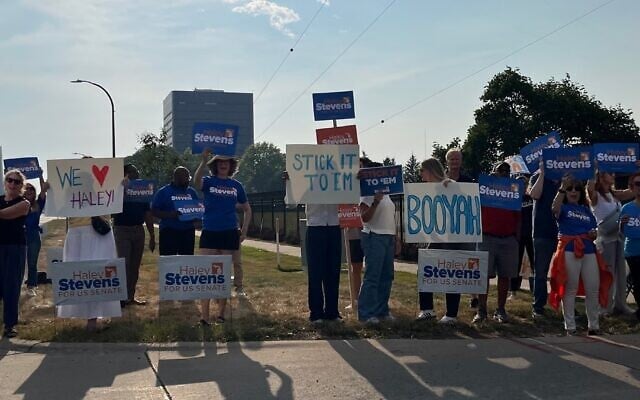
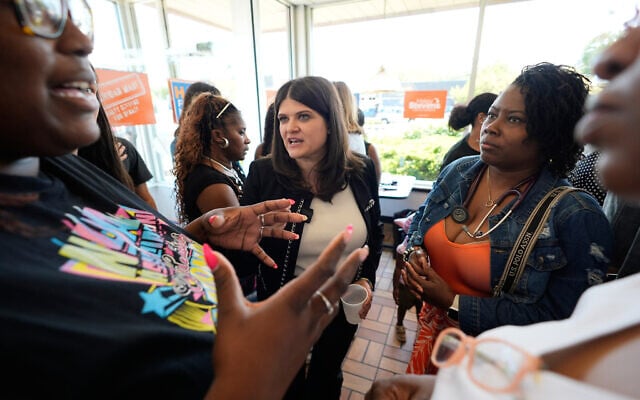
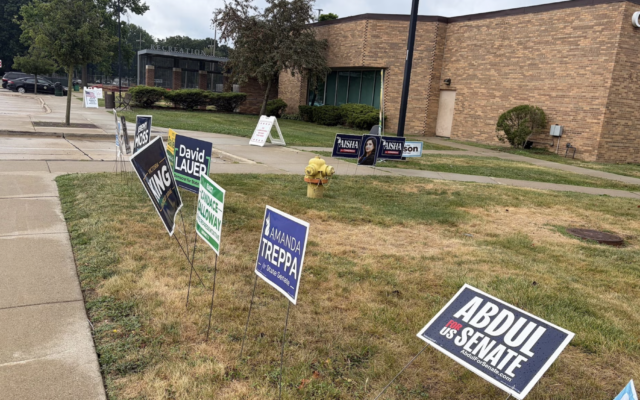
Gray was one of dozens of Michiganders who trickled into an early voting location in Oak Park, a diverse suburb with a sizable Orthodox Jewish population, on Sunday as campaign signs fluttered in the rain outside. For many of the non-Jewish voters who spoke with the Jewish Telegraphic Agency, other issues outweighed AIPAC when deciding how to vote.
Those included Nicole Haines, a 40-year-old resident of Berkeley, another Detroit suburb in Oakland County, and an El-Sayed voter. She said opposing super PAC spending ranked lower for her than priorities such as women’s rights, affordability and checking US President Donald Trump’s power.
Haines said she saw the heavy focus on Israel and AIPAC as a way for candidates to sidestep issues that might harm them in the general election.
“What I think every American cares about is: Can I figure out a way to pay my bills and pursue what makes me happy?,” Haines said. “And so I think [Israel and AIPAC] was an issue that allowed the candidates to keep some distance from talking about direct issues here and potentially, especially in that primary cycle, threatening their own success in the general by having an issue to hold up that almost acts as a foil.”
For Inez Thomas, an Oak Park resident, Israel and AIPAC barely registered as considerations at all. Thomas said she cast her ballot for Stevens because she “is really working on Michigan’s behalf.”
“I haven’t been following Israel,” Thomas said. “I know there’s a war and stuff going over there, but if they’re worried about [Stevens], they need to worry about the current president because he’s the one creating a lot of that. He’s the one that [has] our military people over there.”
The gap between AIPAC’s prominence in the campaign and its importance to some voters comes as El-Sayed has drawn criticism from some Jewish leaders for his focus on the group. He has also voiced opposition to Israel’s Jewish character and suggested that money is the only reason Democrats who “believe in human rights” support Israel.
“Those candidates who are solely talking about AIPAC are failing to see that American voters are voting on a range of issues in this election, most of them have to do with affordability, with the defense of our democracy, with our security, safety and well-being,” said Halie Soifer, the CEO of the Jewish Democratic Council of America.
Soifer also said that she believed the rhetoric carried a more serious risk.
“This is an issue that could potentially even endanger our security by again fanning the flames of antisemitism,” Soifer said. “I really think that at best they’re missing the boat on what voters want to hear about. At worst, they’re repeating what has become a dangerous antisemitic trope.”
Stevens has also criticized her opponent’s focus on AIPAC, writing in a recent post on X, “Everyone in America understands you want to blame all of your problems on Jewish Americans.”
Jessica “Decky” Alexander, the Michigan Jewish Democratic Caucus chair, said she shared some of Stevens’ concerns when it came to El Sayed’s focus on AIPAC.
“Is he blaming corporations or AIPAC for housing prices and what? Because of gas prices? Because there’s a war? Is everything now the Jews’ fault?” Alexander said. “I mean, I don’t think he thinks that, but I can see how that would be interpreted as such, and it makes me nervous.”
Jewish groups on the left have defended scrutiny of AIPAC, though some have cautioned candidates to be precise in how they criticize the group.
Jamie Beran, the CEO of Bend the Arc, a progressive Jewish group, said the scale of the group’s spending and its “anti-progressive political agenda” in Michigan warranted attention, but that it was important to use caution and avoid “antisemitic terms” when critiquing the group. Bend the Arc has held trainings with candidates, including El-Sayed, to help them stay away from problematic approaches.
“It’s important to be careful not to have a double standard for them,” Beran said. “But I also think that there’s a way that that accusation around it being a double standard or around it being antisemitic to call them out is just another way that they get protected from legitimate critique.”
Eli Williams-Szenes, Bend the Arc’s director of advocacy and political affairs, said the group had had a “productive conversation with the El-Sayed team about best language practices.”
In the trainings, the group tells participants, “Do not refer to the Israel lobby. Do not refer to Zionists. Don’t talk about the Jews. Be specific,’” Williams-Szenes said. “When people stray into the generalities is where it gets really dangerous.”
Some voters in Oak Park shared El-Sayed’s objections to outside spending.
Sean Lathrop, 36, of Oak Park, said that he had been driven to vote for El-Sayed because he felt it was essential to “get money out of politics.”
But he said that he was less concerned about AIPAC spending than he was about spending by DTE Energy, a Detroit-based energy company that has drawn outcry for raising energy prices.
“We want to see politicians be represented by the people, not represented by the corporations,” Lathrop said. “Honestly, DTE bothered me more than AIPAC because we know how big of a problem DTE is, and [Stevens] received $40,000 from DTE.” (DTE’s PAC has donated $35,000 to Stevens’ congressional campaign committee over four election cycles, according to Politifact.)
Seth Resler, 49, of Oak Park, said he voted for El-Sayed and shared his concerns about outside spending in the race.
But he also saw the focus on AIPAC as a product of a primary in which candidates needed to emphasize the issues that separated them.
“When you’re in a primary race, there’s not a lot of difference between the positions of the candidates, so you have to take the issues that are different and magnify them,” Resler said. “I think that’s what happened here.”
Times of Israel staff contributed to this report.

The war with Iran has been draining for all of us in Israel. But when I heard about a high casualty incident – ballistic missile impacts in Arad and Dimona that left nearly 200 people wounded – I drank a cup of coffee, packed a bag, and headed south.
There, I spoke with Shilgit, the head of an after-school program for underprivileged youth. Standing outside her destroyed center, Shilgit said it was a miracle that no children were hurt and spoke about the community coming together in the hours since.
As a Times of Israel reporter, I’m committed to telling stories of resilience like Shilgit’s. But my colleagues and I can't do this alone. If you value work like this, please consider joining our reader support group, The Times of Israel Community. Your financial support is essential to keep real human reporting like this going.
— Stav Levaton, military reporter

We’re really pleased that you’ve read X Times of Israel articles in the past month.
That’s why we started the Times of Israel – to provide discerning readers like you with must-read coverage of Israel and the Jewish world.
So now we have a request. Unlike other news outlets, we haven’t put up a paywall. But as the journalism we do is costly, we invite readers for whom The Times of Israel has become important to help support our work by joining The Times of Israel Community.
For as little as $6 a month you can help support our quality journalism while enjoying The Times of Israel AD-FREE, as well as accessing exclusive content available only to Times of Israel Community members.
Thank you, David Horovitz, Founding Editor of The Times of Israel










In Michigan's Democratic Senate primary, the pro-Israel lobby AIPAC has significantly invested in supporting US Rep. Haley Stevens against progressive Abdul El-Sayed, spending over $30 million. While El-Sayed has made opposition to AIPAC and Israel a central theme of his campaign, polling indicates widespread unfavorable views of AIPAC among Democratic voters, with 49% holding a negative opinion.
"I think most people care a whole lot more about substantive issues,"
said Josh Pasek, a University of Michigan professor, suggesting that for the majority of voters, issues like affordability, immigration, and women's rights outweigh concerns about AIPAC's spending. However, the issue holds particular importance for Michigan's Jewish and Muslim communities. Some Jewish leaders have criticized El-Sayed's focus on AIPAC, arguing it risks fanning antisemitism, while progressive Jewish groups advocate for careful, specific critiques of the organization.
© All rights to the original article belong to the source. Din Online shows a headline, an excerpt and a link only. The objectivity rating is computed automatically and is an estimate only.
Discussion
No comments yet — be the first to comment.