Bronx walking tour animates Fordham neighborhood’s forgotten Jewish sites
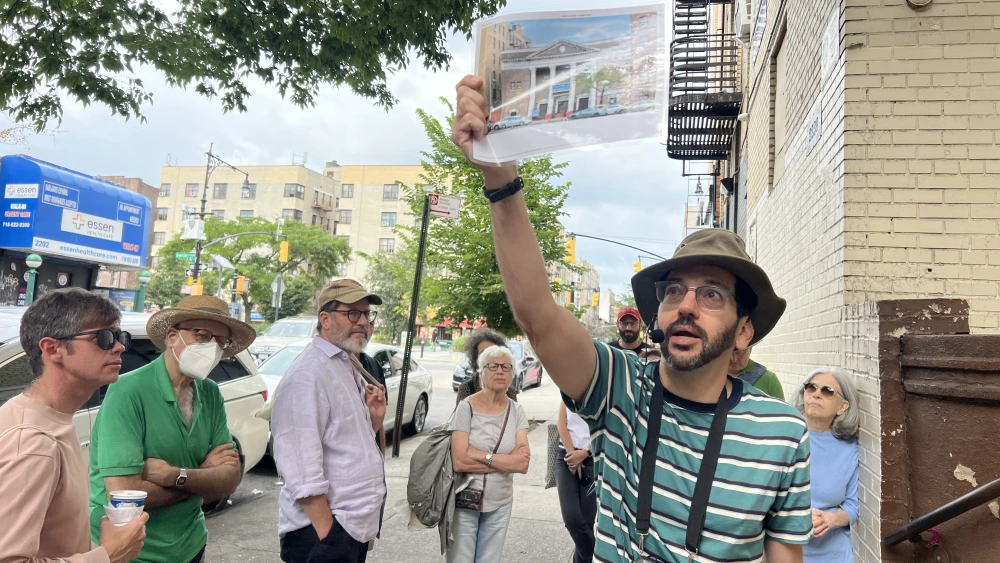
On a breezy Sunday morning in the Bronx, about 20 people gathered near the 182nd-183rd Street subway station to explore a side of the neighborhood near Fordham University that is easy to miss today—its Jewish past.“I find it fascinating that there are so many layers of history that people aren’t aware of,” David Herszenson, a physician and licensed city guide, told JNS at the end of the Aug. 30 “Jewish life” walking tour, which ran for two hours.Herszenson told attendees that the Bronx used to be called the “Jewish borough.”“It was almost half Jewish,” he told the group, on a tour organized by the Fordham Center for Jewish Studies as part of its Bronx Jewish History Project.“The south Bronx was majority Jewish for a while,” he said.Herszenson’s tour, which he has been leading since the pandemic, didn’t actually cover the campus of Fordham, a private Jesuit school, but it snaked…

On August 30, a walking tour organized by the Fordham Center for Jewish Studies explored the forgotten Jewish history of the Fordham neighborhood in the Bronx. Led by physician and licensed city guide David Herszenson, the two-hour tour highlighted sites that were once synagogues, businesses, and entertainment venues, revealing the area's past as a predominantly Jewish community. Herszenson noted that the Bronx was once called the “Jewish borough” and that “It was almost half Jewish.”
- The tour visited the former Concourse Center of Israel, now the Love Gospel Assembly church, where Jewish stars are still embedded in the facade.
- Participants learned about the former Reform synagogue Tremont Temple Gates of Mercy, which served German Jews and has since been demolished, with its ark doors preserved in Manhattan.
- Herszenson pointed out the Loew’s Paradise Theatre, a city landmark that inspired filmmaker Stanley Kubrick, and Krum’s ice cream parlor, which once had five soda fountains.
- The tour also entered a Fine Fare supermarket, where murals from the former Dollar Savings Bank depict scenes of the Bronx's early history.
Herszenson explained the Bronx's transformation from colonial settlements to a bustling commercial area, and its demographic shifts post-WWII, stating, “People say that the subways made the Bronx and the highways killed it.”
© All rights to the original article belong to the source. Din Online shows a headline, an excerpt and a link only. The objectivity rating is computed automatically and is an estimate only.
Discussion
No comments yet — be the first to comment.