In blow to Likud lawmakers, party court rules current MKs can’t run for district spots
Sam Sokol is the Times of Israel's political correspondent. He was previously a reporter for the Jerusalem Post, Jewish Telegraphic Agency and Haaretz. He is the author of "Putin’s Hybrid War and the Jews"
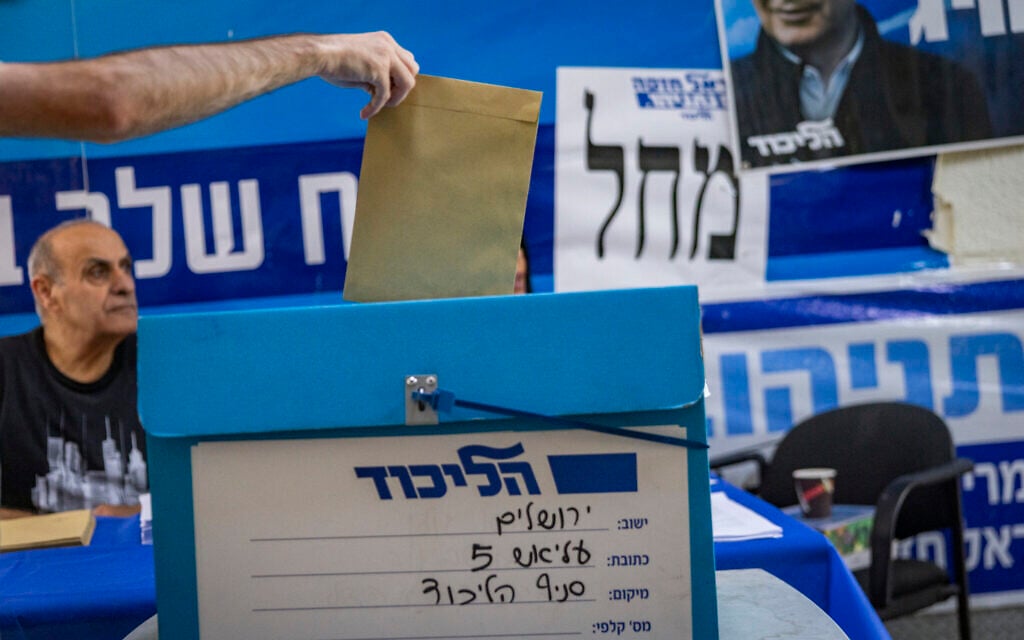
The ruling Likud party’s top court on Tuesday overturned a measure that allowed sitting and former Knesset members, ministers and deputy ministers to compete for slots reserved for regional districts in the upcoming August 17 primaries, dealing a blow to Prime Minister Benjamin Netanyahu’s attempt to satisfy his lawmakers by giving them a greater chance at political survival.
For decades, Likud’s reserved spots for districts have only been available for new MKs, acting as a diversifying tool that gives a chance for new figures to make it into the Knesset.
But amid opinion polls that consistently show Likud getting around 22-24 seats in the October 27 election, significantly down from its current 32, Netanyahu heavily campaigned for the Likud Central Committee to approve a change letting current and former lawmakers, ministers and deputy ministers to vie for those spots.
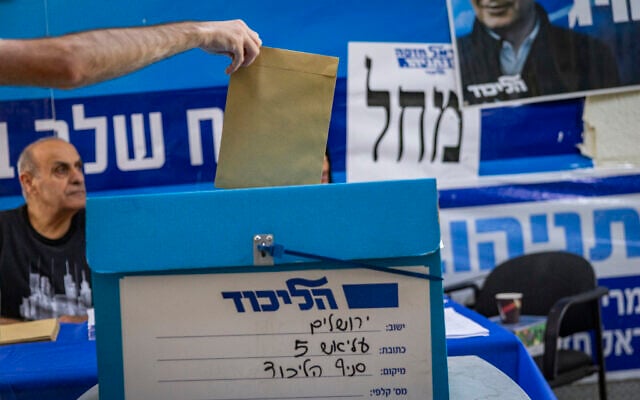
Last week, Likud’s roughly 4,500-member Central Committee approved the proposal by a majority of only five votes, immediately prompting petitions to the party’s internal tribunal, including by MKs Eliyahu Revivo and David Bitan.
Party members also voted last week in favor of a measure to significantly expand Netanyahu’s control over the party’s Knesset slate, granting him eight reserved slots in the top 29 places on the list ahead of the October 27 election.
That motion passed despite rare public dissent from within Likud, led by Bitan, who argued it would push incumbent lawmakers down the list in favor of Netanyahu’s handpicked candidates.
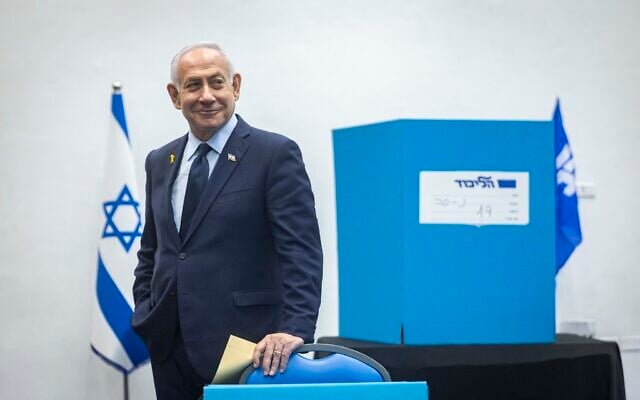
The premier’s push for reserved slots was based in part on concerns that primaries could elevate candidates who are highly popular among the Likud base — including MK Tally Gotliv and ministers Shlomo Karhi and May Golan — but who internal party polling suggests are less appealing to moderate right-wing and swing voters whose support could prove decisive in the upcoming national election.
On the matter of regional spots, court chief Michael Kleiner ruled overnight that the tiny victory margin failed to prove that the Central Committee indeed wished to change the decades-old practice of reserving districts for new candidates, given the number of disqualified ballots. He also noted that the outside firm that conducted the election had been contracted by a party organ supportive of the prime minister’s position. Moreover, he noted, opposition observers were not allowed at polling stations until late in the afternoon.
“MKs competing for the district [spots] contradicts the [Likud] constitution since it harms the value of equality,” Kleiner wrote in his ruling, adding that the district slots “have always been a protected space that has enabled new leadership to sprout in fair conditions… and that started the careers of most [current] Likud ministers.”
The decision means the current Likud MKs, ministers and deputy ministers have to compete for non-reserved spots, which means many of them will almost certainly fail to enter the next Knesset.

The district slots are the slate’s 27th spot, reserved for the Jerusalem, West Bank and Shfela districts; the 28th, reserved for the Tel Aviv and Dan districts; the 30th; reserved for the Galilee and valleys districts; and the 31st, reserved for the Negev district.
Those slots are realistic if Likud is part of the next government, given Israel’s so-called Norwegian Law, which allows ministers and deputy ministers to resign as MKs to allow others further down the slate into parliament, while guaranteeing they can return to the Knesset if they resign their cabinet post.
The court also ruled that sitting MKs who want to compete for slots reserved for women or ethnic or religious minorities must resign from the Knesset before the primaries and not use state money for their campaigns. It additionally found that the 35th spot on the list had been erroneously reserved for a female candidate due to a “clerical error,” with Kleiner stating that he was “fully confident that if, contrary to expectations, a shortage of women on the list arises” Netanyahu will utilize some of the reserved spots granted him “to rectify the defect.”
Also last week, Likud’s internal court struck down Netanyahu’s bid to allow the party to cancel its August 17 primary in the event of a “wartime situation” and instead select candidates through an appointed committee controlled by the premier.
In its ruling, the court said then that there was “no room to open even the slightest door to canceling the primary,” which is currently set for August 17, arguing that Likud “is not a one-man party and will lose its character if it becomes one.”

Recent Hebrew media reports said that some Likud lawmakers were concerned that Netanyahu was seeking to avoid holding primaries in order to give him absolute control over the entire slate, a move that could see some backbenchers pushed so far down they would not realistically return to the Knesset.
Likud uses a complex primary system to determine much, though not all, of its candidate list, and has long prided itself on its internal democratic processes. It is one of only a handful of Israeli parties that hold primaries to select both its leader and Knesset slate, alongside the left-wing The Democrats party and the Arab-majority Hadash.
Michael Bachner and Ariela Karmel contributed to this report.

The war with Iran has been draining for all of us in Israel. But when I heard about a high casualty incident – ballistic missile impacts in Arad and Dimona that left nearly 200 people wounded – I drank a cup of coffee, packed a bag, and headed south.
There, I spoke with Shilgit, the head of an after-school program for underprivileged youth. Standing outside her destroyed center, Shilgit said it was a miracle that no children were hurt and spoke about the community coming together in the hours since.
As a Times of Israel reporter, I’m committed to telling stories of resilience like Shilgit’s. But my colleagues and I can't do this alone. If you value work like this, please consider joining our reader support group, The Times of Israel Community. Your financial support is essential to keep real human reporting like this going.
— Stav Levaton, military reporter

We’re really pleased that you’ve read X Times of Israel articles in the past month.
That’s why we started the Times of Israel – to provide discerning readers like you with must-read coverage of Israel and the Jewish world.
So now we have a request. Unlike other news outlets, we haven’t put up a paywall. But as the journalism we do is costly, we invite readers for whom The Times of Israel has become important to help support our work by joining The Times of Israel Community.
For as little as $6 a month you can help support our quality journalism while enjoying The Times of Israel AD-FREE, as well as accessing exclusive content available only to Times of Israel Community members.
Thank you, David Horovitz, Founding Editor of The Times of Israel










© All rights to the original article belong to the source. Din Online shows a headline, an excerpt and a link only. The objectivity rating is computed automatically and is an estimate only.
Discussion
No comments yet — be the first to comment.