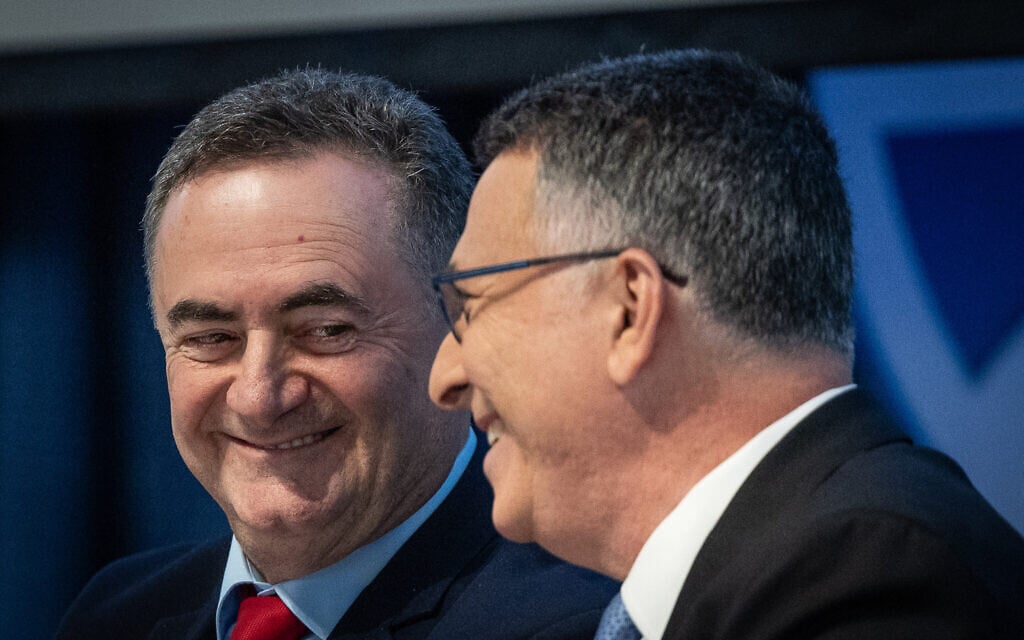
Likud grants reserved spots on party list to Sa’ar and Katz, expanding PM’s control over its makeup

Libya’s National Oil Corporation says that a drone fell near a main oil tank and pipeline network at the Zawiya Oil Refining Company’s oil blending plant, the third such attack in two days.
No casualties or damage were reported, NOC says, adding it could declare force majeure and completely halt refinery operations if the attacks continue.

Ultra-Orthodox activists are ramping up the recruitment of Haredim to join Prime Minister Benjamin Netanyahu’s Likud ahead of the party’s upcoming primaries, part of a years-long concerted effort to build political power within the ruling party and influence its policies, according to a Channel 12 report.
The report estimates that 7,000 of Likud’s roughly 140,000 members are Haredi, with nearly all of the major Hasidic groups now represented within the party.
Haredi public relations strategist and Likud operative Yossi Rosenbaum, who has been recruiting members to the party since 2004, tells Channel 12 that his bloc now numbers in the “thousands” and that he can bring several thousand voters to the polls.
The trend is driven partly by dissatisfaction with traditional Haredi political representatives, primarily United Torah Judaism but also Shas, and a belief that membership in the ruling party offers a more effective means of advancing their interests.
Even figures formally affiliated with the Haredi parties are participating in the effort, including an unnamed Bnei Brak city councilman representing Agudat Yisrael, a UTJ faction, who also runs an organized bloc of Likud voters.
Likud politicians, in turn, are increasingly courting the Haredi public, with Netanyahu, ministers including Israel Katz, Yariv Levin, Gideon Sa’ar, Shlomo Karhi and lawmakers David Bitan, Boaz Bismuth, Hanoch Milwidzky, Moshe Saada among others regularly attending Haredi events as they campaign for support ahead of next week’s primaries.
The upcoming race is expected to be unusually tight, with the party projected to drop to 23 seats and Netanyahu granted an unprecedented eight slots on the slate for handpicked candidates, significantly reducing the number of realistic spots available to primary contenders. As a result, a bloc of several thousand Haredi voters could prove decisive.
Prime Minister Benjamin Netanyahu’s Likud announces that the party’s secretariat will be asked to approve three additional reserved slots on the party’s electoral list, in addition to the eight reserved slots already granted to the prime minister for candidates of his choosing.
The three additional slots will be reserved for Foreign Minister Gideon Sa’ar, Defense Minister Israel Katz, and Likud Central Committee Chair Haim Katz, the announcement says.
Justifying the decision — which was announced just after 1 a.m. on Tuesday and will be brought to the secretariat for approval later in the day — the Likud announcement notes that Sa’ar had been guaranteed a reserved slot under the terms of the merger between his New Hope party and Likud.
The party says Israel Katz will receive a reserved spot on the list “to allow him to deal with security needs and not engage in politics at this time,” and that Haim Katz will receive a reserved spot due to his post as the chair of the Likud Central Committee.
It is unclear from the statement, though, why the three were not simply allocated three of the eight reserved spots already granted to Netanyahu.
The decision, if approved, would give Netanyahu control over 11 of the top 30 spots on the Likud list, ahead of the October 27 election.
The announcement comes hours after Netanyahu’s first pick for his eight reserved slots, entrepreneur Oren Dobronsky, caused an uproar after it was discovered that he had called US President Donald Trump a “morally corrupt piece of shit” less than two months ago.
Israel is reportedly holding on to the bodies of roughly 1,700 Palestinians, including some who were not involved in attacks against Israelis.
Citing two sources familiar with the matter, Haaretz says the bodies are being used as bargaining chips for future hostage negotiations, even though Hamas no longer holds any Israeli captives.
The vast majority of the bodies belong to Palestinians who carried out attacks against Israelis, Haaretz says, without specifying the breakdown of how many of the bodies were from Gaza compared to the West Bank.
The policy is backed by Shin Bet chief David Zini and the IDF but has faced pushback from the Shin Bet’s legal adviser, who has argued that Israel has no legal justification for holding onto the bodies of Palestinians not involved in attacks.
The IDF says that it won’t comment on internal deliberations, and the Shin Bet declines to comment on the matter.

As a multimedia journalist, my job is to take the quality, fact-based journalism produced by The Times of Israel newsroom and make it accessible across every platform — from Instagram posts to podcasts to short-form videos.
This is how many, especially young people, consume news these days. But misinformation is rampant on social media. Our team at ToI produces accurate, responsible short-form reporting on Israel and the Jewish world.
If you believe in the importance of factual social media journalism, please consider joining our reader support group, The Times of Israel Community. Your financial support is essential to sustain responsible multimedia reporting.
— Gabriella Jacobs, multimedia journalist

We’re really pleased that you’ve read X Times of Israel articles in the past month.
That’s why we started the Times of Israel – to provide discerning readers like you with must-read coverage of Israel and the Jewish world.
So now we have a request. Unlike other news outlets, we haven’t put up a paywall. But as the journalism we do is costly, we invite readers for whom The Times of Israel has become important to help support our work by joining The Times of Israel Community.
For as little as $6 a month you can help support our quality journalism while enjoying The Times of Israel AD-FREE, as well as accessing exclusive content available only to Times of Israel Community members.
Thank you, David Horovitz, Founding Editor of The Times of Israel
Israel is reportedly holding approximately 1,700 bodies of Palestinians, some of whom were not involved in attacks against Israelis, according to Haaretz. These bodies are allegedly being used as bargaining chips for future hostage negotiations, despite Hamas no longer holding Israeli captives. While most bodies belong to Palestinians who carried out attacks, the policy faces legal challenges from the Shin Bet's legal adviser, who argues there is “no legal justification” for holding the bodies of those not involved in attacks. The policy is supported by Shin Bet chief David Zini and the IDF, but both declined to comment on the matter.
© All rights to the original article belong to the source. Din Online shows a headline, an excerpt and a link only. The objectivity rating is computed automatically and is an estimate only.
Discussion
No comments yet — be the first to comment.