Long-lost Byzantine-era vines are again cultivated on ancient Negev terraces
Sue Surkes is The Times of Israel's environment reporter
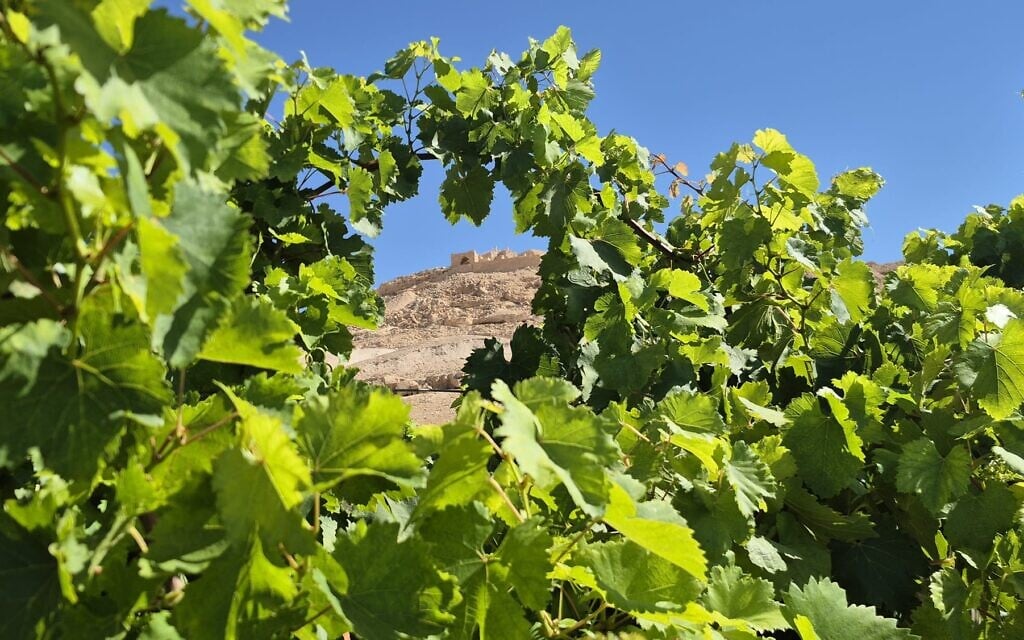
For the first time, oenophiles can now taste the closest thing to Byzantine-era wines grown in the parched Negev Highlands thanks to a project to cultivate ancient vine varieties at the Avdat National Park in southern Israel.

The project was sparked by the discovery of well-preserved carbonized grape seeds during an archeological excavation that ran from 2017 to 2019 at Avdat, located between Beersheba and Mitzpe Ramon.
The seeds, dated to the seventh century CE, were sent to Tel Aviv University for genetic analysis. One was found to be the ancestor of the Syriki variety, which has small black grapes and is still drunk in the monasteries of Lebanon and Greece. Another was identified as Ba’ar, which produces white wine.
Lior Schweimer, Southern District heritage director and archaeologist for the Israel Nature and Parks Authority, obtained cuttings of Syriki and Ba’ar from feral plants found in the Gaza border area, which was once part of the same massive wine-growing region that included Avdat.
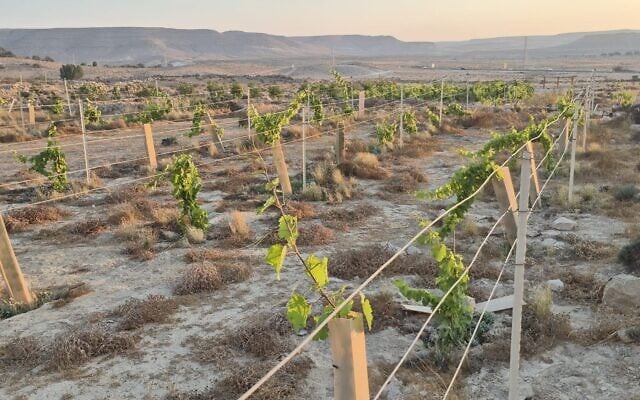
After having them verified as the same or very similar to the archaeological findings, he planted them in September 2023 on the Avdat site’s restored 1,500-year-old agricultural terraces. He added a row of Dabouki vines, the main heritage variety in southern Israel according to the historical record, on the assumption that they, too, would have been cultivated at Avdat.
Ancient techniques were taken from the Talmud and other rabbinic literature, but as Schweimer told The Times of Israel, there was not enough rain at present to rely on the kind of stormwater runoff typical of ancient desert terrace farming. Drip irrigation is being used instead.
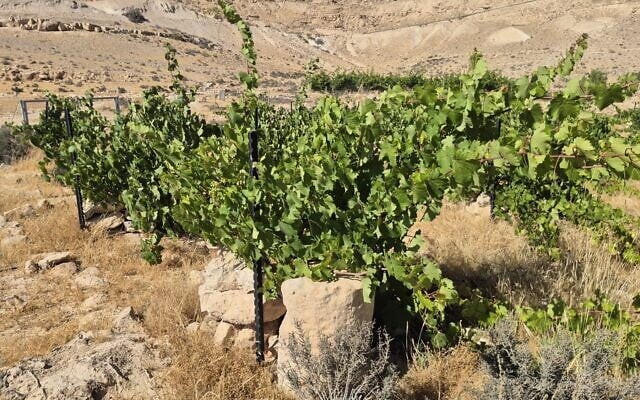
By September last year, there were over 200 grapevines planted with different kinds of support, from trellises to arbors and walls, across five dunams (1.25 acres).
“The [vines] grew like Jack and the beanstalk, without any disease, without any spraying, and twice as fast as the Chardonnay and Sauvignon vines grown in this area,” said Schweimer. “After two years, they yielded grapes.”
These were given to three local Negev winemakers to turn into wine. Tsur Shezaf and Boaz Dreyer took the Syriki and Ba’ar grapes, while Gidi Talmor was entrusted with the Dabouki.
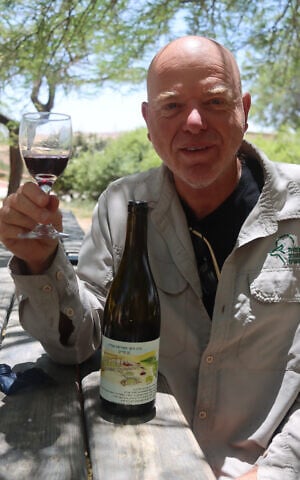
While all used modern equipment rather than feet to extract the juice, they were asked not to use any modern additives, such as industrial yeast, sulfites, or chemicals.
The three grape varieties yielded five varietals, or types of wine.
“The biggest surprise when we opened the bottles was to discover amazing wine,” said Schweimer, who added that seeing so much green in the desert was a delight.
As an archaeologist but not a wine expert, he took some of the 300 bottles to Tel Aviv to conduct blind tastings for 20 experts.
“They were impressed,” he said. “They couldn’t identify exactly what it was —nobody had drunk it for 1,300 years — but they said it was very balanced, with a bit too much alcohol. It’s not a drink you should drive after!”
While the Dabouki wine was unremarkable — the variety was historically used for table grapes and spirits — the Ba’ar and Syriki were “continuously improving as time goes on,” he added.
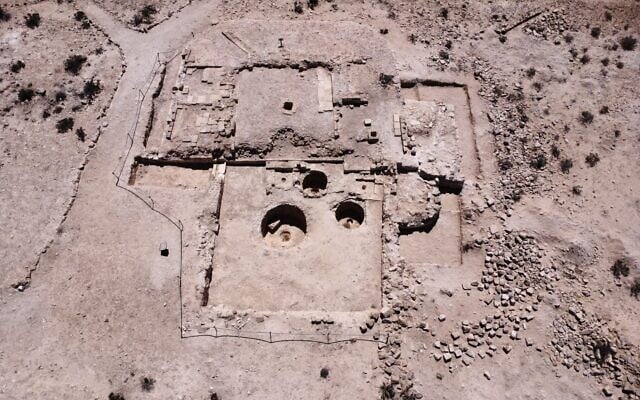
Over the past two years, Schweimer excavated a large wine press right next to the plots, along with Igal Radashkovsky, an archaeologist and excavator with the Israel Antiquities Authority.
“We’re now approaching the second harvest and constantly learning about the varieties, their response to different cultivation methods and irrigation regimes,” Schweimer said.
He is hoping that bottles will be available for sale to the public at the Avdat National Park store from next year, and commercially available within the next three to four years as local growers integrate these varieties into their fields.
The varieties are now being grown at the nearby Shivta National Park as well.
The Byzantine period in the Land of Israel, which lasted from the fourth to the early seventh centuries CE, was marked by political stability and economic growth. Towns and surrounding farms, served by a road network, filled the area between the Beersheba Valley and the Ramon Crater, Schweimer said.
By the third century CE, Roman-Byzantine viticulture overtook Nabatean frankincense and myrrh as the Negev’s main commercial export.
By the late fifth century CE, so-called Gaza wines were being transported into Europe and south to Arabia, where they earned a glowing reputation.
The industry peaked in the mid-sixth century, with some 100,000 terraces under cultivation, but then declined during the eighth to 10th centuries. Settlements in the area were abandoned, and large-scale wine growing ceased until the 1990s, when the current Negev wine revival began.
In May, the dry, sandy landscape stretching from Kiryat Gat to Eilat was officially recognized as the Negev appellation, an international wine region, placing Israel’s south and its distinctive desert terroir on the global wine map.
That agriculture could flourish in Byzantine times in an area with just 80 to 150 millimeters (3.15 to six inches) of annual rain was thanks to the cumulative knowledge of the Nabataeans, discharged Roman soldiers given land, and Christian monks.
Relying on surface runoff from rain and floods, careful engineering, and community organization, farmers planted in valley bottoms and up through a system of terraces that supported loess soil fertilized with pigeon manure.
Over the past few decades, archaeologists have discovered plentiful remains of third- to seventh-century vineyards in the Negev, with wine presses, stores, watchtowers, and columbaria.
The project of the Israel Nature and Parks Authority received initial help from the Merage Foundation, Haifa University, and the Ramat Negev Regional Council.
Schweimer said the project could help wine growers worldwide, whose vines are proving vulnerable to the higher temperatures and more extreme weather events associated with climate change.
“I think that finding varieties in their feral state, a moment before they disappear, and bringing them back to the place where they grew before can be copied elsewhere,” he said.
“Our varieties grow well in the desert, and they don’t need much,” he went on, adding that while modern agriculture favored growing large quantities of the same variety, the ancients grew as many varieties as possible, to ensure that at least some survived.

The war with Iran has been draining for all of us in Israel. But when I heard about a high casualty incident – ballistic missile impacts in Arad and Dimona that left nearly 200 people wounded – I drank a cup of coffee, packed a bag, and headed south.
There, I spoke with Shilgit, the head of an after-school program for underprivileged youth. Standing outside her destroyed center, Shilgit said it was a miracle that no children were hurt and spoke about the community coming together in the hours since.
As a Times of Israel reporter, I’m committed to telling stories of resilience like Shilgit’s. But my colleagues and I can't do this alone. If you value work like this, please consider joining our reader support group, The Times of Israel Community. Your financial support is essential to keep real human reporting like this going.
— Stav Levaton, military reporter

We’re really pleased that you’ve read X Times of Israel articles in the past month.
That’s why we started the Times of Israel – to provide discerning readers like you with must-read coverage of Israel and the Jewish world.
So now we have a request. Unlike other news outlets, we haven’t put up a paywall. But as the journalism we do is costly, we invite readers for whom The Times of Israel has become important to help support our work by joining The Times of Israel Community.
For as little as $6 a month you can help support our quality journalism while enjoying The Times of Israel AD-FREE, as well as accessing exclusive content available only to Times of Israel Community members.
Thank you, David Horovitz, Founding Editor of The Times of Israel










A project at Avdat National Park in Israel's Negev Highlands has successfully cultivated Byzantine-era vine varieties, allowing for the first tasting of wines similar to those produced 1,300 years ago. The initiative began after carbonized grape seeds, dated to the seventh century CE, were discovered during a 2017-2019 excavation. Genetic analysis identified these as ancestors of the Syriki and Ba’ar varieties, with cuttings obtained from feral plants near the Gaza border. Planted in September 2023 on restored ancient terraces, the vines thrived, yielding grapes that were given to local winemakers. Lior Schweimer, the project's archaeologist, noted, "The [vines] grew like Jack and the beanstalk, without any disease, without any spraying, and twice as fast as the Chardonnay and Sauvignon vines grown in this area." Blind tastings by experts praised the Ba’ar and Syriki wines, which are expected to be available for sale at Avdat National Park next year and commercially within three to four years. This project also offers insights for global viticulture facing climate change, demonstrating the resilience of ancient varieties in desert conditions.
© All rights to the original article belong to the source. Din Online shows a headline, an excerpt and a link only. The objectivity rating is computed automatically and is an estimate only.
Discussion
No comments yet — be the first to comment.