Milk from seeds: Israeli scientists produce key dairy protein from safflower plant

Sue Surkes is The Times of Israel's environment reporter

Hebrew University scientists have successfully engineered a plant to produce beta-casein, a milk protein that helps give cheese its melting properties, which they believe puts them on the way to beating international competition to produce plants that can literally be milked at an industrial scale.

“Milk is not produced sustainably,” said Prof. Oded Shoseyov of the Faculty of Agriculture, Food and Environment, who led the research.
“Some 15 percent of global warming gases are emitted as methane by livestock,” he said. “Today, with genetic modification, you can take the genes coded for milk proteins and transfer them to another organism that’s more efficient, saving a lot in terms of resource input and emissions.”
Shoseyov said the global dairy industry was worth more than $1 trillion last year and was expected to reach $1.6 trillion by 2035, thanks to population growth and rising awareness of the nutritional value of milk protein.
The researchers first engineered the laboratory plant Arabidopsis thaliana, and then a drought-tolerant, oil-producing species, safflower, to manufacture the beta-casein, which is important for bone building. It also has curdling and emulsifying properties.
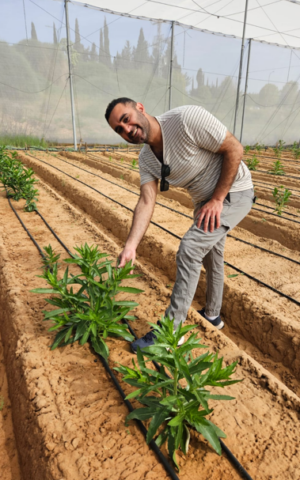
While engineering the seeds, the team was surprised to discover that instead of reaching the expected storage compartment, the milk protein formed structures resembling those that store natural casein in milk.
The best-performing plants produced beta casein at levels of around 1.26% of total soluble seed protein, which is much higher than many previous reports of casein production in plants.
Shoseyov said it was easy and relatively cheap to “milk the seeds” by putting them into a press and separating the resulting mixture into protein-rich cream and solids by centrifuge.
Almog Ozeri, Mai Shamir, Miron Abramson, Barak Cohen, and Amir Rudich participated in the research, with their results published in Frontiers.

As a multimedia journalist, my job is to take the quality, fact-based journalism produced by The Times of Israel newsroom and make it accessible across every platform — from Instagram posts to podcasts to short-form videos.
This is how many, especially young people, consume news these days. But misinformation is rampant on social media. Our team at ToI produces accurate, responsible short-form reporting on Israel and the Jewish world.
If you believe in the importance of factual social media journalism, please consider joining our reader support group, The Times of Israel Community. Your financial support is essential to sustain responsible multimedia reporting.
— Gabriella Jacobs, multimedia journalist

We’re really pleased that you’ve read X Times of Israel articles in the past month.
That’s why we started the Times of Israel – to provide discerning readers like you with must-read coverage of Israel and the Jewish world.
So now we have a request. Unlike other news outlets, we haven’t put up a paywall. But as the journalism we do is costly, we invite readers for whom The Times of Israel has become important to help support our work by joining The Times of Israel Community.
For as little as $6 a month you can help support our quality journalism while enjoying The Times of Israel AD-FREE, as well as accessing exclusive content available only to Times of Israel Community members.
Thank you, David Horovitz, Founding Editor of The Times of Israel










Hebrew University scientists, led by Prof. Oded Shoseyov, have successfully engineered safflower plants to produce beta-casein, a key milk protein essential for cheese properties and bone building. This breakthrough aims to offer a sustainable alternative to traditional dairy, addressing environmental concerns like methane emissions from livestock. The engineered plants produced beta-casein at levels of approximately 1.26% of total soluble seed protein, a significant improvement over previous attempts. The protein can be extracted from the seeds using a simple and cost-effective pressing and centrifuging process. Prof. Shoseyov stated, "Milk is not produced sustainably," highlighting the environmental benefits of this plant-based approach.
© All rights to the original article belong to the source. Din Online shows a headline, an excerpt and a link only. The objectivity rating is computed automatically and is an estimate only.
Discussion
No comments yet — be the first to comment.