יום שני, יולי 20, 2026 עברית|English Log in Free sign-up
LIVE
Spain beats Argentina 1-0 to capture second World Cup titleJewish chess trailblazer Judit Polgár tapped for Hungary's presidencyGulf State citizens concerned, angry at Iran for attacks on neighboring countries – reportOne US service member killed in Iraq, unidentified remains of soldier found in Jordan, CENTCOM saysUS Casualties Mount as Washington Sends More Refueling Aircraft to IsraelJudaism and Zionism on the frontlines of dangerous discourseTransportation Ministry to hold situational assessment amid fears of flight cancellations – reportUS announces another troop death as Israel warns Tehran's attacks are coming closeIsrael orders evictions, home demolitions to displace Palestinians near East JerusalemQatar working towards release of Jewish prisoners in Iran to improve US relations – reportMan seriously injured in violent incident in Kafr KannaIsrael Expands Stop‑Work and Demolition Measures in Jenin Area –Spain beats Argentina 1-0 to capture second World Cup titleJewish chess trailblazer Judit Polgár tapped for Hungary's presidencyGulf State citizens concerned, angry at Iran for attacks on neighboring countries – reportOne US service member killed in Iraq, unidentified remains of soldier found in Jordan, CENTCOM saysUS Casualties Mount as Washington Sends More Refueling Aircraft to IsraelJudaism and Zionism on the frontlines of dangerous discourseTransportation Ministry to hold situational assessment amid fears of flight cancellations – reportUS announces another troop death as Israel warns Tehran's attacks are coming closeIsrael orders evictions, home demolitions to displace Palestinians near East JerusalemQatar working towards release of Jewish prisoners in Iran to improve US relations – reportMan seriously injured in violent incident in Kafr KannaIsrael Expands Stop‑Work and Demolition Measures in Jenin Area –
Politics

Polls, blocs and mergers: Setting the stage for Israel Election 2026
15h ago ·  Source: JNS 90Objectivity score90/100

Polls, blocs and mergers: Setting the stage for Israel Election 2026

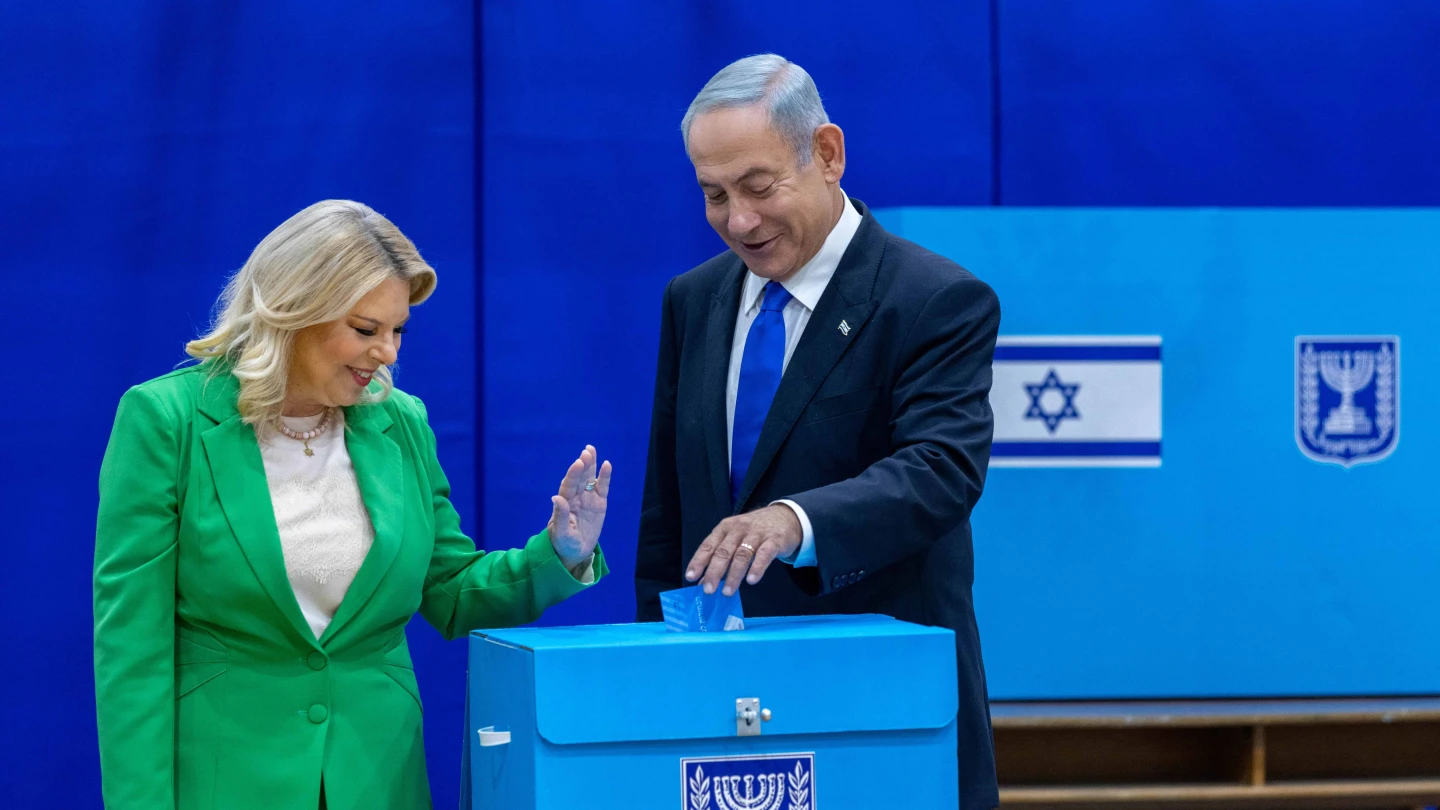
Likud Chairman Benjamin Netanyahu casts his ballot at a voting station in Jerusalem alongside his wife, Sara, on Nov. 1, 2022. Photo by Olivier FitoussiFlash90.
Shimon Sherman
Shimon Sherman

The 25th Knesset dissolved itself on Friday, formally opening a campaign that will end with national elections on Oct. 27. The outgoing parliament became the first since 1988 to complete a full term, a point coalition whip Ofir Katz underscored as lawmakers adjourned: “Ultimately, despite everything that was said, this Knesset is completing its full term.”

The election date is fixed; the political map is not. Gadi Eisenkot’s Yashar and Benjamin Netanyahu’s Likud are fighting for first place across much of the mainstream polling, but the size and sometimes even the direction of the gap depends heavily on the pollster.

A July 5 Kan survey put the two parties level at 23 Knesset seats each, while a Maariv poll published a week later gave Yashar a narrow 23-22 advantage. A polling average published by Statista on July 15, aggregating seven major Israeli media poll series, placed Likud ahead at 24.6 seats to Yashar’s 21.9. Channel 14’s Filber polls, meanwhile, have consistently produced a substantially stronger result for Netanyahu’s camp. One mid-July survey gave Likud 33 seats and Yashar 21.

Dr. Gayil Talshir from the Department of Political Science at the Hebrew University explained that although having the largest party does not guarantee a coalition, it is still an important factor that increases the chances of electoral victory. “Even though in Israeli politics, what is important is getting to the majority out of 120 seats, not the biggest party, the psychological effect is that people want to vote for the winner, which pushes them to the bigger party,” Talshir explained in a previous interview with JNS.

The differences are not confined to the contest for first place. Surveys generally place Netanyahu’s current coalition parties in the low-to-mid 50s, short of the 61 seats required for a majority, while the opposition often reaches the mid-to-high 50s. However, Channel 14’s polls have shown the coalition crossing the 60-seat threshold with as many as 65 seats. Most polls also show Arab parties together frequently accounting for roughly another 10 seats. At the same time, several smaller parties are hovering around Israel’s 3.25% electoral threshold, meaning shifts of a few tenths of a percentage point could determine whether roughly four lawmakers enter the Knesset or disappear from the seat allocation entirely.

The campaign is therefore developing along interconnected fronts. Netanyahu is trying to preserve a clearly defined governing bloc under growing internal strain, Eisenkot is seeking to consolidate a competitive but fragmented opposition, and a rapidly forming collection of smaller parties may ultimately determine which side can reach 61.

Netanyahu enters the campaign with the most clearly defined governing bloc, but the political arrangements required to preserve it are increasingly generating pressure within his own base. The clearest evidence has come from a series of departures centered largely on the Haredi conscription dispute. Veteran Likud lawmaker Yuli Edelstein announced on July 3 that he was leaving the party, declaring: “I don’t intend to run in the Likud primaries. I’ll set off on a new political path.” Likud MK Dan Illouz subsequently announced his own departure, while MK Sharren Haskel recently resigned as deputy foreign minister and then launched a new right-wing party.

At the same time, Likud is fighting an unusually public battle over control of its own electoral slate. Netanyahu initially sought as many as 10 reserved positions for candidates of his choosing before a compromise granted him eight, including six among the first 20 places. The arrangement gives the party chairman substantially more direct influence than in 2022. Opposition from senior party figures, including David Bitan, turned the procedural dispute into a broader struggle over internal power, while the Lod District Court intervened on July 16 to halt a planned Central Committee vote following petitions arguing that Likud’s wider membership had not been given a proper opportunity to participate.

The eventual slate will therefore provide an early indication of whether Likud remains primarily shaped through its activist and membership structures or moves further toward a ticket constructed by Netanyahu himself. The party’s primary has already been repeatedly postponed amid the dispute, adding another layer of uncertainty to a campaign in which several former or current right-wing figures are exploring political alternatives outside Likud.

The Haredi parties remain indispensable to Netanyahu’s political formula. Shas and United Torah Judaism constitute a central component of Netanyahu’s bloc, but their demands over conscription have become one of its principal sources of political strain. In the Knesset’s final legislative push, the coalition approved measures recognizing Torah study as a foundational state value and halting arrests and enforcement against qualifying Haredi draft dodgers. The High Court froze implementation of the latter almost immediately.

The legislation reflected pressure from within the Haredi parties themselves. United Torah Judaism’s Moshe Gafni, pressing for action on the Torah-study legislation, warned: “I want to know whether they are going all the way with the bill; I am tired of promises.” Yet concessions intended to secure the Haredi parties carry an electoral cost elsewhere. Edelstein’s, Illouz’s and Haskel’s breaks with the governing camp demonstrate that opposition to the current draft policy extends into the Zionist right.

Netanyahu’s other right-wing partners present a different challenge. Itamar Ben-Gvir’s Otzma Yehudit has remained comparatively stable in recent polling, making it a relatively secure component of the bloc. Bezalel Smotrich’s Religious Zionism is more vulnerable, moving between six mandates to below the electoral threshold across different surveys even as Smotrich continues to advance the government’s settlement agenda, including the July approval of funding for 34 new communities in Judea and Samaria.

The resulting dilemma is central to Netanyahu’s campaign. He begins with the election’s clearest coalition structure, but satisfying every component of that bloc may make it harder to recover the additional voters, and potentially the additional partner, needed to reach 61 seats.

The opposition enters the campaign in an unusual position: In much of the mainstream polling, its combined electorate is larger than Netanyahu’s governing bloc, but its path from electoral strength to a functioning coalition remains unclear. At the center of that puzzle is Gadi Eisenkot.

Recent polling has placed Yashar either ahead of, tied with or narrowly behind Netanyahu’s party, a significant shift from the beginning of the election cycle, when Naftali Bennett was generally regarded as Netanyahu’s leading rival. The trend is clear: Eisenkot has moved to the center of the contest over who will lead the alternative government.

His political advantage is that his appeal is not confined neatly to the traditional center-left. A former IDF chief of staff with a hawkish security reputation, Eisenkot can compete for centrist voters while also presenting himself as a plausible option for more center-right voters seeking an alternative to Netanyahu. His security credentials, personal wartime losses and undefined platform make him a strong neutral alternative for the politically homeless. Eisenkot has deliberately reinforced that broad positioning, declaring: “I will be the prime minister of all Israelis.”

His ascent has come at the expense of the political primacy once held by Bennett and Lapid’s Together alliance. Their April merger initially produced strong polling, with one early survey placing the new list ahead of Likud. Since then, however, Together has fallen into the mid-to-high teens.

The polling does not prove that the merger itself caused Bennett’s decline, but it has altered the political proposition he offers voters. Before joining with Lapid, Bennett occupied a relatively distinct position: a right-wing former prime minister seeking to replace Netanyahu without presenting himself as part of the traditional center-left opposition. The merger created a larger unified list, but it also undermined Bennett’s already shaky right-wing credentials. At the same time, Eisenkot’s rise has given voters seeking a broadly centrist, security-oriented alternative another option that currently polls substantially better.

Regardless of who holds the mantle in the final vote count, the eventual leader will face a difficult challenge of cobbling together a coalition from an incredibly broad ideological array. Avigdor Liberman’s Yisrael Beiteinu dominates the right flank of the current opposition and remains a substantial component of any anti-Netanyahu majority. Once identified primarily with immigrants from the former Soviet Union, Yisrael Beiteinu has broadened into a political home for secular, right-wing and security-hawkish voters, and polls at roughly nine to 10 seats in most recent surveys. Liberman’s refusal to countenance Netanyahu is firm, but so are his coalition restrictions. Liberman has said that “there is no place for non-Zionist forces in the next government, neither Arab parties nor Haredi parties.” That position strengthens the opposition numerically while making one possible route to a majority, bringing Haredi parties into a post-Netanyahu coalition, practically impossible.

On the left flank, the Democrats Party creates a different form of coalition tension. The party remains an important source of opposition seats, receiving 11 in the latest Channel 13 poll. However, multiple statements by Chairman Yair Golan and other party members have made a coalition with right-wing opposition parties a contentious proposition. In 2025, Golan spoke of the IDF “kill[ing] babies as a hobby,” drawing condemnation not only from the coalition but from Bennett, Liberman, Gantz and Lapid. Furthermore, a general platform defined by socialist economic policies and support for a Palestinian state is a clear point of political friction that the opposition needs to overcome to reach 61.

With the two principal blocs separated by a handful of seats in most polls, the election could be decided less by movement between Likud and Yashar than by which smaller parties survive. Israel’s 3.25% threshold turns that question into a particularly high-stakes calculation as a party that narrowly crosses it can contribute four or more seats to coalition arithmetic, while one that narrowly fails effectively removes its voters from the distribution of mandates.

Yoaz Hendel and Hilli Tropper’s new party, Yesodot Yisrael, occupies exactly this position in the center space. Their alliance draws heavily on the language of military service and civic responsibility, and says its objective is “a broad Zionist government.” That positioning potentially places it as a bridge between Eisenkot’s opposition and voters on the right dissatisfied with the current coalition. The latest Zman Yisrael survey left it below the threshold.

Potentially more disruptive to Likud’s electoral prospects is the emerging anti-Netanyahu right. Yuli Edelstein’s departure from Likud has intensified talks surrounding a possible new list involving figures including former Likud Minister Gilad Erdan and former Justice Minister Ayelet Shaked. The political proposition is not another centrist party but a party based on Likud’s platform, but without Netanyahu. Erdan vehemently defended this point, saying, “I am not a centrist; I am firmly on the right,” in a recent interview. A Kan scenario found an Edelstein-Shaked-Erdan list winning six seats and reducing Netanyahu’s bloc from 53 to 50. Such a party could therefore become both a vehicle for right-wing voters unwilling to support Netanyahu and, after the election, a kingmaker sought by the major blocs.

Moshe Feiglin’s Zehut occupies a more ideologically distinctive space than most of the new parties competing around the threshold. Feiglin has billed his party as “a political home for Israel’s religious and nationalist sector.” Its platform combines nationalist and religious positions with a strongly libertarian, free-market agenda. Feiglin has also made dissatisfaction with the conduct of the war central to his campaign, criticizing the government for failing to decisively defeat Hamas, Hezbollah or Iran and maintaining strategic dependence on the United States.

That combination of economic libertarianism and a more uncompromising security doctrine gives Zehut a constituency distinct from the largely centrist new parties elsewhere in the race. With at least one June Midgam survey placing Zehut near the electoral threshold, the party could either add another right-wing faction to the Knesset or, if it falls narrowly short, leave a significant number of right-wing votes unrepresented.

Israelis supporting the conscription of Haredi men into the Israeli military protest in the city of Bnei Brak, in central Israel, against road blockades by ultra-Orthodox demonstrators following the arrest of draft evaders, June 26, 2026. Photo by Avshalom Sassoni/Flash90.
An Israel Defense Forces soldier is hoisted by a military helicopter, in an undated handout released by the military. Credit: IDF Spokesperson's Unit.
Former White House Chief of Staff and Chicago Mayor Rahm Emanuel speaks during a conference at Tel Aviv University on July 8, 2026. Photo by Avshalom Sassoni/Flash90.
USS Donald Cook (DDG 75) transits the Arabian Sea while an MH-60S Sea Hawk flies nearby. Credit: United States Central Command.
Hamas leader Yahya Sinwar in Gaza's tunnels. Credit: IDF.
Tisha B'Av Mark Podwal wide
United Nations
CENTCOM F-16
U.S. Air Force Boeing KC-135 Stratotanker aerial refueling aircraft are parked at Ben Gurion International Airport near Tel Aviv, on Feb. 25, 2026. Photo by Chaim Goldberg/Flash90.
תמונת סיקור
Melanie Phillips
Jonathan S. Tobin
💬 רוצים להגיב ולהצטרף לדיון? הצטרפו — חינם, ומקבלים גם את הדיג׳סט השבועי.
This story is based on reporting by JNS.
Read the full article at the source →

© All rights to the original article belong to the source. Din Online shows a headline, an excerpt and a link only. The objectivity rating is computed automatically and is an estimate only.

Related

Discussion

No comments yet — be the first to comment.

Add a comment