US sends dozens of refueling aircraft to Israel as attacks across Mideast intensify
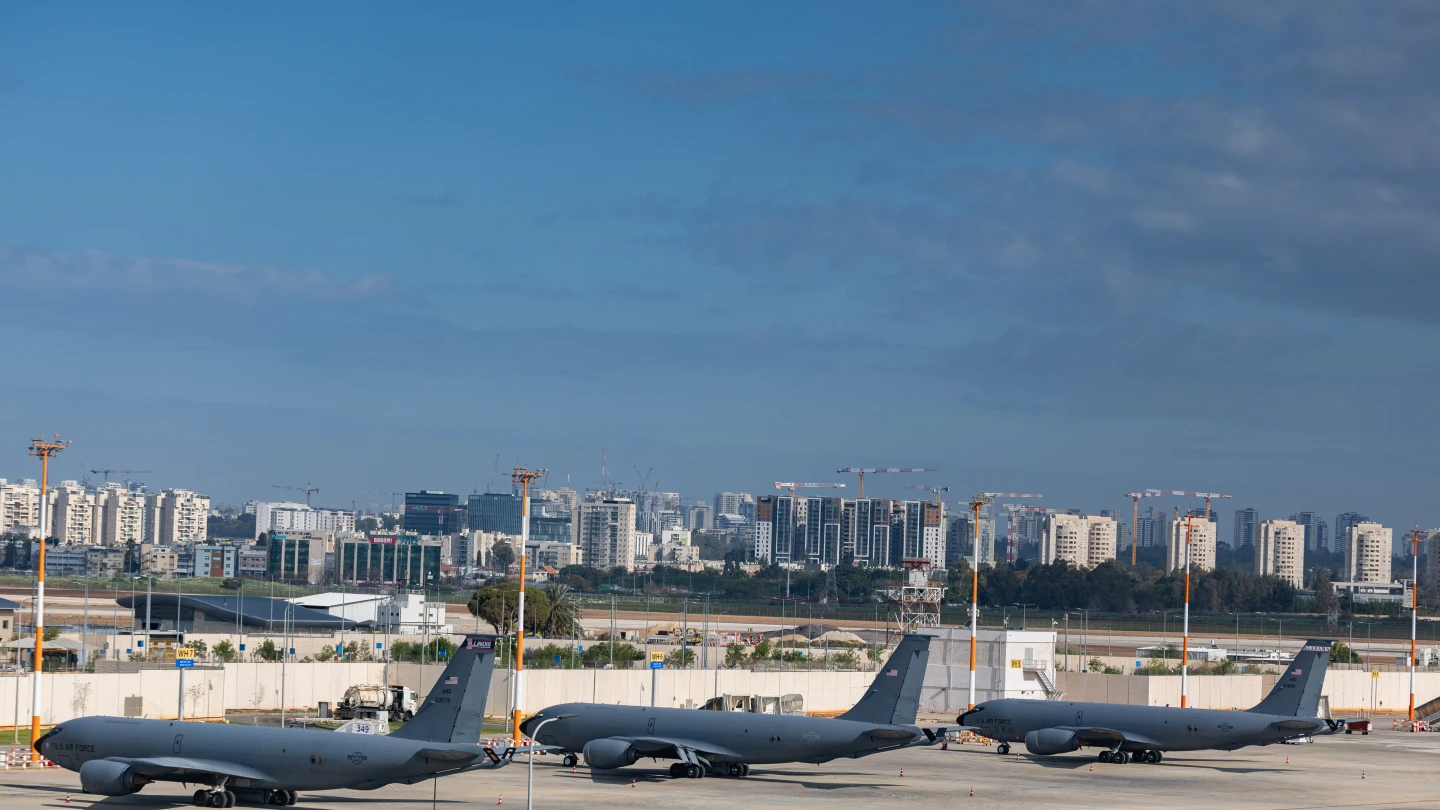

The U.S. is sending dozens of refueling planes to Israel ahead of a possible expansion of military operations against the Islamic Republic of Iran.
In coordination with the Israel Defense Forces, the U.S. has decided to reinforce the “existing fleet of aerial refueling aircraft stationed in Israel with additional refueling aircraft,” an IDF official told JNS on Saturday.
The move is a part of a U.S. adjustment to its “force posture in the region,” the official continued.
The refueling aircraft will land at Israeli Air Force bases to “minimize disruptions to civilian air traffic,” as well as due to “operational and logistical considerations.
“The preparations at the Israeli Air Force bases were made possible through advance planning conducted jointly by the IDF and the U.S. The IDF is making every effort to facilitate the deployment of U.S. forces in Israel while safeguarding the State of Israel’s international civil aviation needs,” the official added.
U.S. President Donald Trump is weighing a massive offensive in Iran, after tit-for-tat strikes that have reemerged in the region in light of disputes regarding the free and safe transit of commercial vessels in the Strait of Hormuz, Axios reported.
Among the targets being considered are Iranian infrastructure facilities such as power plants and additional strikes on Tehran’s nuclear sites, the report continued.
The president has not made a final decision yet but could order wider military acts in the coming days, according to Axios.
The U.S. currently has some 60 refueling aircraft in Israel, about half at Ben Gurion International Airport near Tel Aviv and the other half at Ramon Airport in southern Israel, the report read. The U.S. wants to send several dozen more, matching the total number of refueling aircraft stationed in Israel at the beginning of the war on Feb. 28.
Meanwhile, U.S. strikes on Saturday hit a water desalination plant in the city of Jask in southern Iran, affecting about 10,000 people in the region, The New York Times reported, citing Iranian state media.
The U.S. Central Command said that it had completed its seventh consecutive night of strikes against Iran overnight Friday, targeting surveillance sites, military logistics infrastructure, underground weapons storage, and maritime capabilities.
U.S. forces employed fighter aircraft, aerial drones, and warships in addition to other assets, CENTCOM stated, adding that some 50,000 American service members are operating across the Middle East “and remain vigilant, lethal and ready.”
In a separate statement, CENTCOM said that two U.S. service members were killed in Jordan on Friday and another is missing in action.
Four American service members were evacuated to Jordanian hospitals and have since been discharged. “Other personnel who were evaluated for minor injuries have returned to duty,” the military body added.
“Out of respect for the families, CENTCOM will withhold additional information, including the identities of the fallen warriors, until 24 hours after the next of kin have been notified.”
CENTCOM Statement on Recently Fallen, Missing U.S. Service MembersTAMPA, Fla. — On July 17, two U.S. service members in Jordan were killed in action as U.S. Central Command (CENTCOM) and partner forces defended against Iranian ballistic missile and drone attacks. Additionally,…
Iran attacked Jordan and Gulf states on Saturday, hitting a desalination plant in Kuwait and forcing the country to close its international airport following barrages of missiles and drones, Reuters reported.
Kuwait Petroleum Corporation said in a statement that one of its oil facilities had been hit, causing significant damage and some injuries, the report read.
Iran’s Islamic Revolutionary Guard Corps said that it had moreover struck two U.S. military bases in Kuwait, destroying a radar facility at Ali Al Salem Air Base.
“Since there is no international institution to prevent the savagery of the U.S. military, we have no path before us except the Quranic command: ‘Whoever attacks you, attack them in the same manner,’” the IRGC was quoted as saying in a statement.
Houthis prepare for Red Sea closure
Meanwhile, Iran’s Deputy Foreign Minister Kazem Gharibabadi said on Saturday that the Memorandum of Understanding signed with Washington on June 17 has been suspended, according to the IRGC-affiliated Fars News Agency.
Iranian Supreme Leader Ayatollah Mojtaba Khamenei released a statement, also on Saturday, calling Trump’s signature on the MoU “worthless and invalid,” the Times cited Iranian state media as reporting.
He warned that the Islamic Republic and its proxies had “unforgettable lessons” in store for the “American enemy,” the report continued.
Tehran has asked its Houthi proxies in Yemen to prepare to close the Bab el-Mandab strait connecting the Red Sea to the Gulf of Aden and by extension the Indian Ocean if the U.S. were to strike Iranian power infrastructure, three sources told Reuters on Thursday.
The move, if carried through, could put more pressure on maritime routes for commercial transit, straining the global economy.
A source close to the Houthis was cited as saying that the terrorist group had completed preparations to attack shipping by deploying missiles and drones near the strait in Yemen’s highlands overlooking the port city of Hodeidah and the Gulf of Aden.


Get the latest updates in our WhatsApp group.


© All rights to the original article belong to the source. Din Online shows a headline, an excerpt and a link only. The objectivity rating is computed automatically and is an estimate only.
Discussion
No comments yet — be the first to comment.